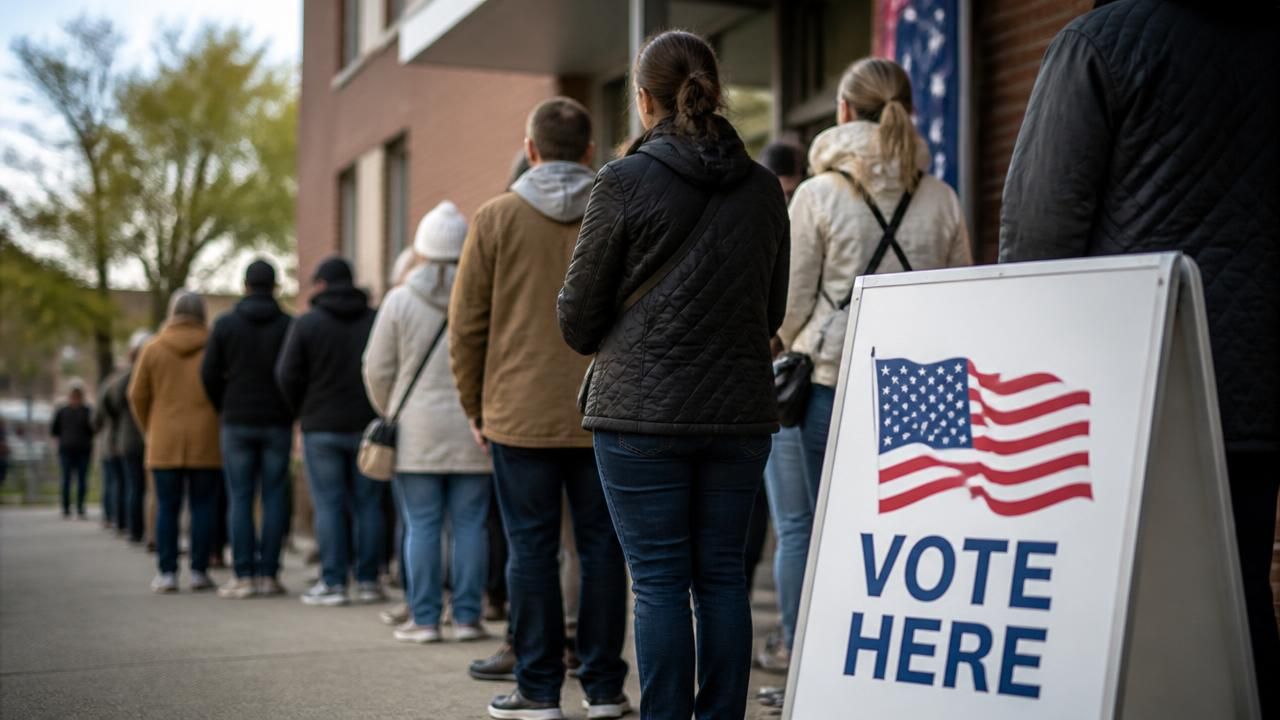
Voters across the United States cast ballots on Tuesday in midterm elections that will determine control of Congress and, by extension, the practical limits of President Trump's second-term agenda. The contest unfolds with an unusual dynamic at its center: the president himself is not on any ballot, yet his record is.
"Though President Trump's name is not on the ballot, voters are weighing the effects of his agenda in Tuesday's midterm elections," The New York Times reported in its preview of the vote, citing national political reporter Lisa Lerer's assessment that three crucial issues are shaping how voters make their decisions.
The stakes are structural as much as political. Every House seat and roughly a third of the Senate are in play, along with dozens of governorships and state legislative chambers that will draw the district lines and administer the elections of the next decade.
Why This Election Matters
Midterms are traditionally a referendum on the party holding the White House, and both parties have organized their closing arguments accordingly. USA Today framed the final stretch around the president's personal investment in the outcome, reporting that Trump made a final push "with control of Congress at stake." Yahoo News described the race in similarly sweeping terms, calling it a "consequential election" whose stakes extend well beyond individual races.
International outlets have treated the vote as a global story. India's Siasat led its coverage bluntly — "US votes today in high-stakes midterm elections" — reflecting how foreign capitals read American midterms as a signal about the durability of Washington's trade, security and climate commitments.
The Issues Driving the Vote
In the campaign's final weeks, a consistent cluster of concerns dominated advertising, town halls and closing rallies:
- Cost of living and the economy — household prices, housing costs and interest rates remained the top-rated concern in most public polling throughout the cycle.
- Immigration and border enforcement — the issue Republicans pressed hardest, and one on which the White House has staked significant political capital.
- The state of democratic institutions — election administration, the courts and the norms of executive power, an argument Democrats returned to repeatedly.
The Times' preview emphasized that it is the interaction of these questions — not any single one — that has moved voters, particularly in the suburban districts that will decide the House majority.
How the Coverage Differed
The same event produced markedly different journalism. The Times offered reported analysis built around voter psychology and issue salience. USA Today and Yahoo pursued the horse-race frame, centering the president's travel schedule and the arithmetic of congressional control. Siasat's wire-style dispatch emphasized timing and turnout for an audience watching from abroad.
"Though President Trump's name is not on the ballot, voters are weighing the effects of his agenda." — The New York Times
Coverage was also uneven in a more literal sense. Several outlets' election-day pages were inaccessible to readers and to automated news systems, returning Cloudflare challenges, "Access Restricted" notices or rate-limit errors. That technical fragmentation is itself a feature of modern election coverage: on the highest-traffic day of the political calendar, many readers encounter a login wall rather than a ballot guide.
A Wider Cultural Backdrop
American elections rarely stay contained within America's borders, and the social questions that animate its electorate echo elsewhere. Courts and legislatures in other jurisdictions have spent recent years weighing adjacent controversies — among them the U.S. Supreme Court's contemplation of same-sex marriage and a defeated motion in Queensland's Parliament concerning transgender women in sport. Such debates shape how parties on both sides of the Atlantic and Pacific define their coalitions, even when they are not literally on the ballot.
The mechanics of political journalism have a history of their own. Britain's Leveson Inquiry, which examined phone hacking at the Daily Mirror and other outlets, established a durable public record of how aggressively — and sometimes unlawfully — newsrooms have pursued political stories. Wikinews' archive of campaign-trail interviews, including one with long-shot Republican presidential candidate Fred Karger, represents a different tradition: citizen-reported coverage of candidates the mainstream press often overlooks.
What Happens Next
Polls close across the country on Tuesday evening, with results expected to roll in through the night and, in closely contested states, to remain unsettled for days. Both parties have assembled legal teams prepared for recounts and litigation in marginal districts. Election administrators have warned that mail-ballot processing in several states will extend the count beyond election night — a routine practice that has become, in recent cycles, a source of political contention in its own right.
Whatever the outcome, the result will determine whether the president governs with a compliant Congress or a divided one — and whether the three issues his opponents and allies have argued over for months become legislative priorities or campaign footnotes.