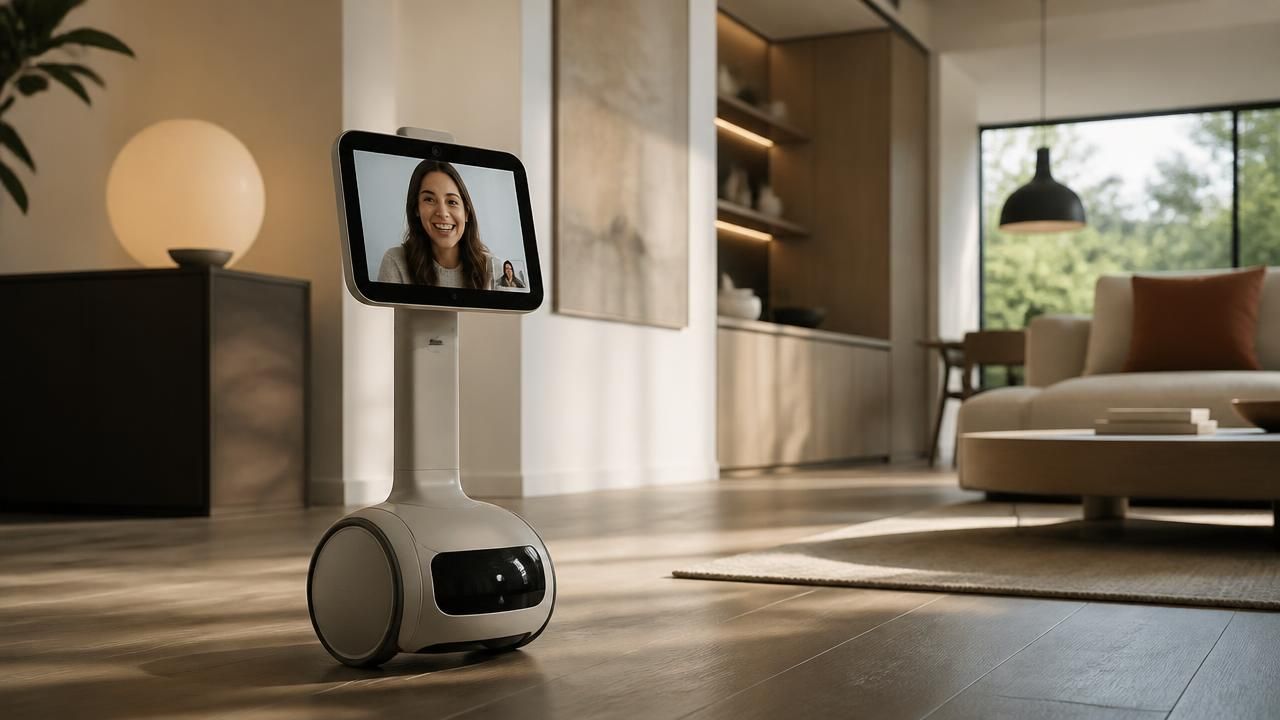
Apple is reportedly developing a consumer home robot that could carry a price tag of $1,000 or more and arrive as soon as 2027 — though internal delays could push the launch into 2028, according to a report in The Information relayed by Ars Technica. The device, internally code-named J595, may be marketed as the HomeView Ultra, slotting alongside Apple's forthcoming stationary HomeView smart display.
The project is said to be a priority for Apple's incoming chief executive, John Ternus, who is reportedly pushing the company's household robotics efforts. The earliest prototypes date back to 2018 and received the green light from then-CEO Tim Cook to continue development — making the robot a long-gestating ambition rather than a sudden pivot.
What the Robot Is Meant to Do
According to people who worked on Apple's robotic projects, the AI-driven device is designed to autonomously roam around the home. Its headline functions include supporting FaceTime calls and automatically switching lights on whenever a person enters a room. The positioning suggests Apple sees the robot as an ambient, mobile extension of its smart-home and communications ecosystem rather than a general-purpose household helper.
That framing is also the project's central challenge. Sources describe Apple's engineers as working to give the robot capabilities beyond being a "fancy way to make FaceTime calls" in order to justify a premium price. Teams have reportedly spent years refining the software and layering in more AI technologies, a sign that the hardware may be closer to readiness than the intelligence that makes it compelling.
Engineers are reportedly trying to give the robot more capabilities beyond being a "fancy way to make FaceTime calls" in order to justify a high price tag.
Competing Framings Across Outlets
Coverage of the leak has varied in emphasis, and the discrepancies are instructive. Ars Technica framed the story around Apple's strategic direction under Ternus, emphasizing the roving, autonomous nature of the device and its ambient-computing ambitions. Other outlets, including techrepublic.com and neowin.net, headlined the same underlying report with a sharper focus on timing and price — one describing a "$1,000 tabletop robot" arriving in 2027, another leading with the possibility that Apple has "delayed plans" to launch its home robot at all.
Perhaps the widest divergence comes from ithinkdiff.com, which published two separate takes: one warning that the HomeView Ultra could cost $1,000 and "slip to 2028," and another describing the product as the "HomeView with a Robotic Arm" arriving in 2027. The variation — tabletop robot, robotic arm, autonomous rover — reflects genuine ambiguity in early reporting about the device's physical form factor, and likely the different configurations Apple is prototyping internally.
Why Timing Matters
Apple has historically entered product categories late, then reframed them around integration and usability: the iPod, the iPhone, the Apple Watch, and more recently the Vision Pro. A home robot would follow that playbook, arriving years after Roomba-maker iRobot popularized domestic robotics and after Amazon's Astro — a $1,600 home robot unveiled in 2021 — struggled to find mainstream traction.
The economics are difficult. Domestic robots combine expensive sensing hardware, battery constraints, mechanical reliability concerns, and privacy sensitivities around cameras moving through private spaces. At $1,000 or more, Apple would need a device that feels indispensable rather than novel — a bar Amazon's Astro did not clear.
The HomeView Ecosystem
The robot's reported naming — HomeView Ultra — signals that Apple intends to build a family of home products, likely anchored by a stationary smart display running a home-focused operating system. A robotic sibling would extend that platform into mobility, similar to how the iPhone and Apple Watch share software foundations. That ecosystem logic may ultimately matter more to Apple than the robot's individual spec sheet.
What Remains Unknown
- Final form factor: Reports variously describe a tabletop device, a robotic arm, and an autonomous rover.
- Pricing: The $1,000 figure is described as a floor, not a ceiling.
- Timeline: 2027 is the target; 2028 is the fallback if development slips.
- Software maturity: AI capabilities are reportedly the pacing item.
Apple has not commented publicly on the project, and the company routinely cancels or indefinitely delays internal initiatives before they reach market. The 2018 prototype timeline is a reminder that a long runway does not guarantee a launch — but the reported backing of a new CEO, combined with Apple's renewed AI push, suggests the company views the home as its next major frontier.
If the HomeView Ultra does arrive around 2027, it will test whether Apple can do for household robotics what it did for smartphones: turn a category of expensive curiosities into a product people expect to own.