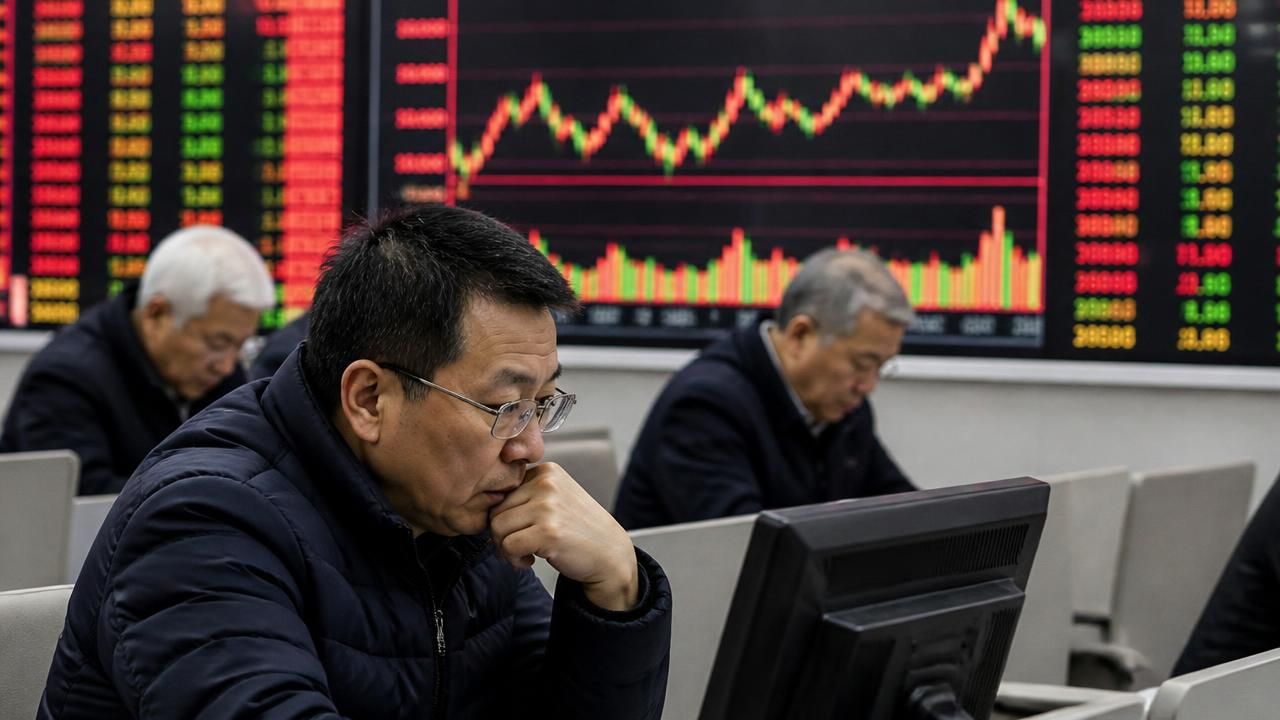
Chinese equities opened higher on Monday after reports that the country's financial regulators will convene a meeting with banks and securities firms to discuss measures aimed at supporting the capital market — a signal that Beijing is stepping up efforts to halt a persistent sell-off in its stock markets.
Bloomberg Markets first reported that regulators had scheduled the session with lenders and brokerages for Monday, framing it as evidence of a "renewed effort to halt a slump." Syndicated versions of the story carried by MSN and other aggregators echoed the headline, describing talks over "market support tools" and measures "to arrest the stock slide." Coverage across outlets was notably thin on specifics, with several versions consisting largely of headline-level detail, and at least one syndicated report — carried by MarketScreener — was inaccessible to readers, returning an access-denied error page rather than the underlying article.
What we know — and what we don't
The core of the story, as reported across sources, is procedural: a scheduled meeting between financial regulators, commercial banks and securities firms, with the agenda centered on the capital market and the tools available to stabilize it. The reports did not specify which regulatory bodies would attend, which institutions had been summoned, or which measures were under consideration.
That ambiguity is itself significant. In China's policy ecosystem, such gatherings are often the precursor to coordinated action — a venue where the securities regulator, the central bank and the financial watchdog align with state-owned banks and brokerages before announcements are made public. Markets have learned to read the scheduling of these meetings as a forward indicator of policy support.
"Authorities' renewed effort to halt a slump" — how Bloomberg Markets characterized the reported meeting in its market wrap.
Why now: a market under pressure
The reports land against a backdrop of sustained weakness in Chinese equities, which have repeatedly tested policymakers' tolerance for further declines. Sliding share prices weigh on household wealth at a time when consumer confidence is already fragile, complicate the pipeline of initial public offerings, and raise questions about the ability of listed companies to raise capital.
For Beijing, the stock market has become a proxy for broader economic sentiment. Weakness in equities sits alongside concerns about property-sector stress, deflationary pressure and tepid domestic demand — a combination that has made market stabilization a recurring item on the policy agenda rather than a one-off intervention.
The tools in the box
While the reports did not detail specific measures, the menu available to Chinese authorities is well established from previous episodes of market stress:
- State buying: So-called "national team" purchases of exchange-traded funds by state-linked funds, a tactic deployed repeatedly to absorb selling pressure.
- Institutional guidance: Informal directives to mutual funds, insurers and brokerages to limit selling or increase equity allocations.
- Short-selling curbs: Tightening of securities lending rules and restrictions on certain hedge-fund strategies.
- Liquidity support: Central bank operations to keep funding markets loose during periods of stress.
- Supply management: Slowing the pace of IPOs and share placements to reduce the volume of new stock hitting the market.
The involvement of commercial banks in Monday's reported meeting is notable, since lenders sit at the intersection of credit policy and market liquidity. Any coordinated package would likely require banks to play a role in channeling funds or supporting brokerages' balance sheets.
A familiar playbook
China has intervened in its equity markets with varying degrees of intensity over the past decade, from the 2015 rescue operation that mobilized state funds and restricted short selling, to more recent rounds of state ETF purchases and regulatory tweaks aimed at curbing bearish positioning. The results have generally been short-lived rallies followed by renewed pressure, as investors weigh structural growth concerns against government support.
The debates among analysts echo a familiar split. Bulls argue that coordinated official action can create a floor and buy time for fundamentals to improve; skeptics counter that market-support measures treat symptoms rather than causes, and can distort price discovery, deter foreign investors and erode confidence if the underlying economic weakness persists.
How the coverage differed
The framing across outlets reflected the constraints of the story. Bloomberg's coverage emphasized the market reaction — stocks rising on the report — treating the meeting as a catalyst for sentiment. Aggregated reports on MSN led with the interventionist angle, casting the meeting as a bid "to arrest the stock slide," a framing that places authorities on the defensive. MarketScreener's headline emphasized the market's open — "Chinese Stocks Open Higher as Regulators Prepare Market Support Meeting" — though its article body was unavailable, a reminder that in fast-moving market stories, headlines often travel further than the details behind them.
What to watch
The key questions in the days ahead: whether the meeting produces concrete, publicly announced measures; whether state funds are activated at scale; and whether any rally holds beyond the initial headline-driven jump. Traders will also watch the Chinese currency and bond yields for signs of how aggressively authorities are injecting liquidity.
For global investors, the episode is another data point on how Chinese policymakers manage market stress — reactive, coordinated and opaque — and on how much of a premium they are willing to pay while waiting for a durable turn in economic fundamentals.