There is no such thing as "the news" anymore — only a stack of competing agendas arriving at the same hour. That is the lesson of a single day's transatlantic feed, in which Bloomberg's daily headlines roundup shared shelf space with dispatches from Chile, Scotland, Zurich and a New York living room. Taken together, they sketch a media landscape where a White House memo, a plane crash in the Pacific and a golfer's record sit within a thumb-scroll of one another, each demanding the same scarce attention.
The roundup: AI, Harvard and a magazine reborn
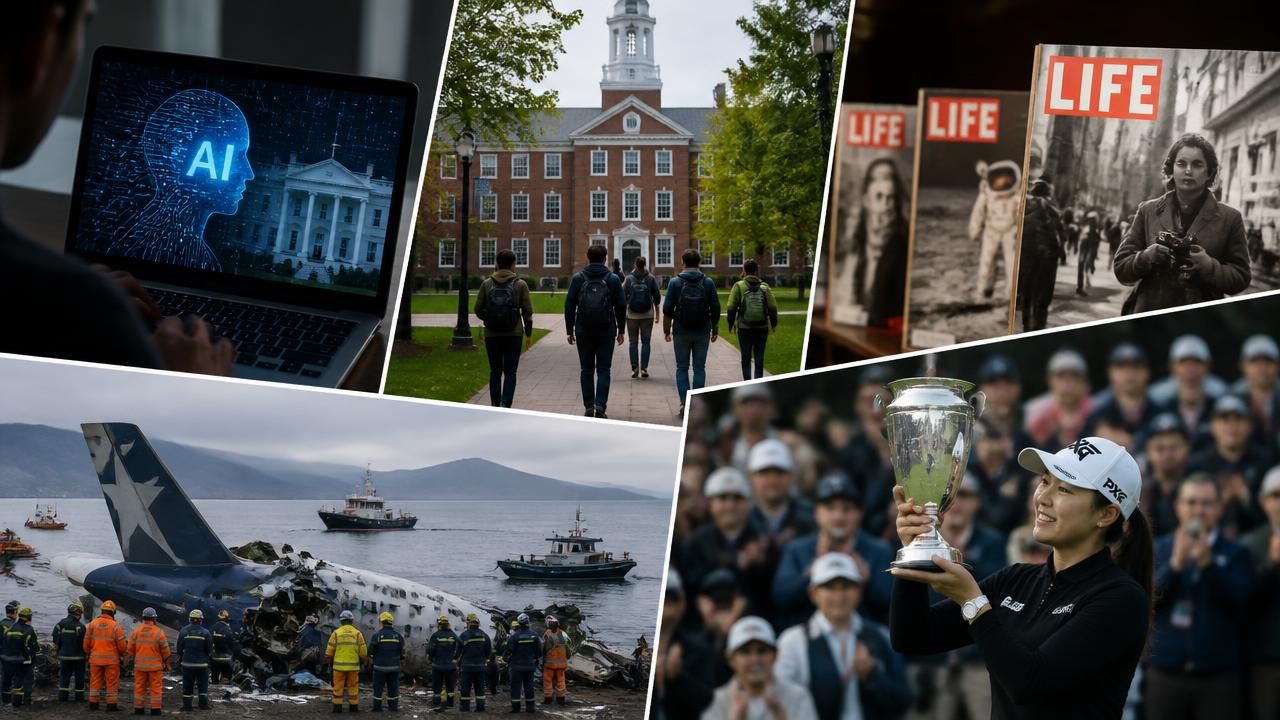
Bloomberg's By The Way segment — hosted by Nathan Hager, David Gura and Lisa Mateo — is built on the premise that some stories fall between the cracks of the trading-day agenda. Its current installment leads with artificial intelligence creeping into the language of White House press releases, a development that raises the question of how much of official Washington's prose is now machine-assisted, and what that does to the evidentiary value of a government statement.
The same segment flags a Harvard course described as "brutal" yet improbably popular — a reminder that demand for rigor has not collapsed, whatever the complaints about grade inflation and student fragility. And it notes the latest revival of Life, the photo-driven magazine that defined American visual storytelling for much of the twentieth century before folding, returning, and folding again. Each item is small. Together they describe a culture still arguing about automation, excellence and the economics of print.
Then there is daylight saving time, the annual ritual whose justification — energy savings — has been shrinking under scrutiny for years. Studies have repeatedly found the electricity savings are marginal or nonexistent in the modern economy, while health researchers point to disrupted sleep and a measurable spike in heart attacks after the spring shift. The U.S. Senate passed a unanimous bill to make daylight saving permanent in 2022; it died in the House. The clock change survives largely because no one can agree on which clock to keep.
The day's most consequential stories and its most ephemeral ones now arrive in the same feed, formatted identically, competing on the same terms.
Tragedy in the Juan Fernández Archipelago
Against that backdrop of soft features, the harder dispatches land with force. A Chilean military aircraft crashed in the Juan Fernández Archipelago in the Pacific, with reports indicating no survivors. The islands — best known as the home of the castaway Alexander Selkirk, whose story inspired Robinson Crusoe — are reachable only by air or a long sea crossing, which makes any aviation accident there difficult to reach and harder to report. Chilean authorities mounted a search and recovery operation in open ocean, and the absence of survivors was confirmed within days.
The human cost reached well beyond the manifest. The flight was carrying a television crew and officials tied to reconstruction planning following the 2010 earthquake and tsunami that devastated the Chilean coast. That an aircraft bound for a disaster-recovery mission should itself be lost is the kind of detail that turns a transport accident into a national event.
Sport: a record and a reckoning
In golf, Yani Tseng captured the Women's British Open for a record fifth major championship, a result that placed the Taiwanese player at the summit of the women's game at an age when most professionals are still learning the tour. Tseng's run through the majors — she would hold the world number one ranking for more than a hundred weeks — arrived as the LPGA was rebuilding its commercial footing, and her dominance gave the circuit a star at precisely the moment it needed one.
Football offered the opposite kind of story. FIFA moved to change its rules after Thierry Henry's handball helped France past Ireland in a World Cup qualifying play-off, a moment broadcast to millions and replayed endlessly. The governing body's response — additional assistant referees stationed behind each goal, and a review of disciplinary procedures that had left Henry unpunished — was an early, reluctant concession that technology and retrospective justice might have a place in a sport that had long resisted both. The episode is now a landmark in the long argument that eventually brought goal-line technology and VAR.
Talese and the craft
Finally, and most quietly, Gay Talese offered his assessment of the state of journalism, the Iraq war and his own life. Talese, the great practitioner of the New Journalism and author of Frank Sinatra Has a Cold, has spent six decades insisting that reporting is a matter of patience and presence — of standing in a lobby long enough to see something true. His verdict on the profession, delivered after the Iraq war's corroding effect on press credibility, amounts to a warning: that the craft survives on accretion of detail, not on volume.
That is an odd but useful lens for the rest of the day's feed. The stories above share no subject, no geography and no audience. What they share is a marketplace in which an AI press release, a crashed CASA transport, a golf record and a daylight saving debate are equally formatted, equally urgent, and equally forgettable. Whether readers can still tell the difference is the question the industry has yet to answer.