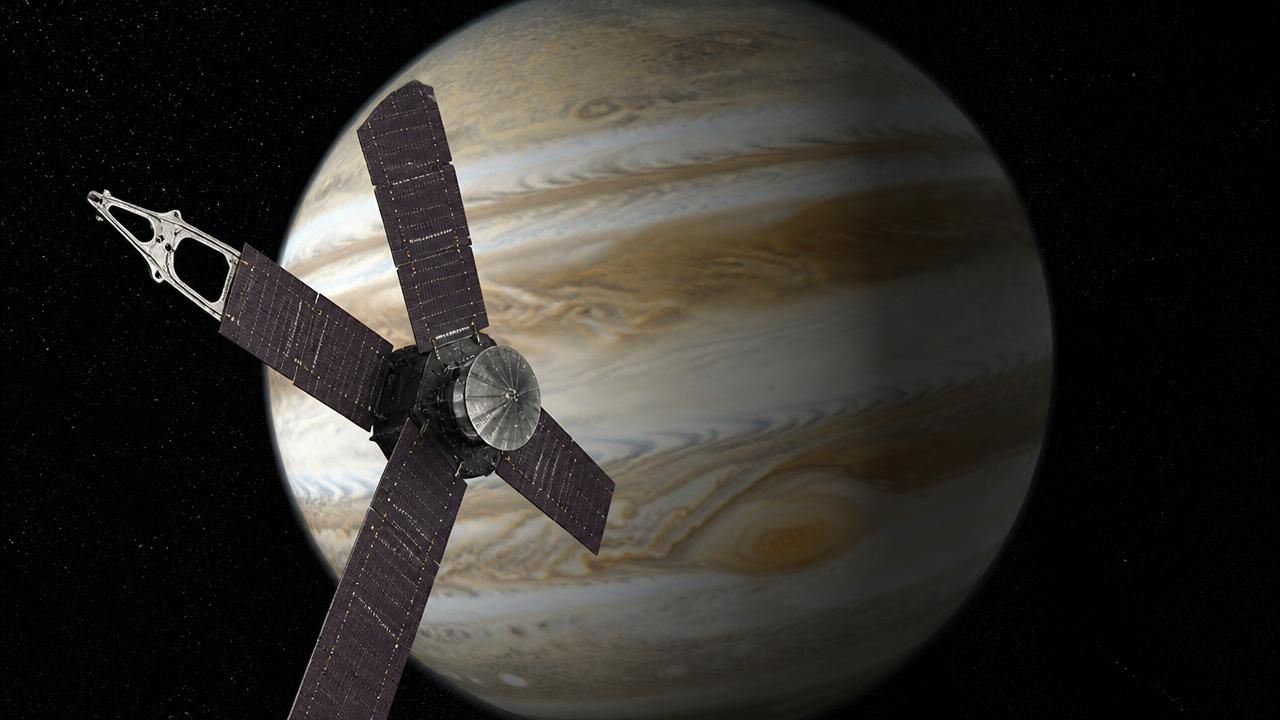
NASA's Juno spacecraft has found that Jupiter does not shield itself from the solar wind the way Earth does. Instead, the giant planet fends off the stream of charged particles streaming from the Sun using a surprisingly intricate system of powerful plasma waves and multiple shock regions — a structure that appears considerably more complex than the single, well-defined magnetic barrier that protects Earth, ScienceDaily reported.
The findings, drawn from Juno's instruments as the spacecraft sweeps past Jupiter's poles, are being framed in strikingly different ways across the outlets that carried the story. Some emphasised the physics of the shock itself; others reached for a simpler, more evocative image — a "hidden solar shield" unlike anything found on Earth.
A shield built from plasma, not solidity
Jupiter's magnetic field is the largest structure in the solar system after the heliosphere itself. Its magnetic moment is roughly 20,000 times Earth's, and the resulting magnetosphere inflates a cavity millions of kilometres wide, with a boundary that typically sits 60 to 90 Jovian radii toward the Sun — comfortably beyond the orbit of the moon Io, whose volcanic output feeds a dense torus of plasma around the planet.
Earth's protection arises because the solar wind arrives supersonic and super-Alfvénic and is forced to slow abruptly at the bow shock, a thin, single transition region. Jupiter's obstacle is vastly bigger and its plasma environment far more dynamic — loaded with sulphur and oxygen ions from Io — and Juno has found that the planet's boundary instead comprises a series of shock regions and wave activity rather than one clean front.
Jupiter uses a complex system of powerful plasma waves and multiple shock regions to defend against the solar wind, the Juno team's findings describe — a system markedly different from Earth's.
"Jupiter has built a hidden solar shield that works unlike anything on Earth," one aggregator headline read, capturing the attraction of the result for a general audience even as it stripped away the plasma-physics vocabulary that makes the discovery significant.
Why Jupiter isn't just a bigger Earth
Scale alone does not explain the difference. Several factors conspire. Jupiter's rotation period of under ten hours drags its magnetic field lines around at speed, while its moons inject mass directly into the magnetosphere. The result is a foreshock region — the turbulent zone upstream of the shock where particles are reflected and accelerated — that is unusually extended and unusually rich in wave activity.
NASA's Juno mission, launched in August 2011 and in orbit around Jupiter since 4 July 2016, is uniquely placed to measure this. Its polar orbit repeatedly dives through regions no previous spacecraft visited, carrying a magnetometer, a radio and plasma wave instrument, and energetic-particle detectors capable of sampling the boundary from the inside.
Lightning a hundred times more powerful
The same close-in vantage point has reshaped another part of the Jupiter story: its lightning. ScienceDaily noted that Jovian lightning may be up to 100 times more powerful than Earth's, a consequence of the enormous energy available in the giant planet's atmosphere. Juno detected the radio signature of these discharges — whistlers and sferics — confirming that lightning occurs in Jupiter's atmosphere as well as in its volcanic moon Io, where the Galileo probe had earlier found it.
Later analysis found something stranger still: shallow lightning occurring at altitudes where water is frozen, apparently powered by an ammonia-water mixture that slushy, downward-dragged "mushballs" carry deep into the atmosphere. Juno also showed that Jupiter's lightning clusters near the poles rather than around the equator, inverting the pattern familiar from Earth — a consequence of the planet's heat distribution and its rotation-driven circulation.
From Jupiter to exploding stars
The scientific payoff extends well beyond the solar system. The shock waves around Jupiter are examples of collisionless shocks — fronts where particles interact through electromagnetic fields rather than by colliding — and these are the same physics that operate in supernova remnants, where expanding blast waves accelerate cosmic rays to extreme energies.
"The findings reveal major differences between Jupiter and Earth and could help scientists understand the enormous shock waves produced by exploding stars," ScienceDaily reported. Astronomers cannot place a probe inside a supernova remnant, so Jupiter functions as a nearby laboratory for a process that shapes galaxies.
There is also an exoplanetary angle. Giant planets orbiting close to their stars, and the many "hot Jupiters" now catalogued, will experience far more violent stellar winds than Jupiter does. Understanding how a giant magnetosphere absorbs and redistributes that energy helps modellers interpret radio emissions that may one day be detectable from such worlds.
What to watch next
- Continued Juno passes: the spacecraft's extended mission has been pushing deeper into the regions where the shock structure forms, refining the picture of how many boundaries exist and how they move with the solar wind.
- Comparative shock physics: researchers will weigh Jupiter's multiple shock regions against Earth's single bow shock and against simulations, to establish which behaviour is generic to giant magnetospheres.
- Lightning energetics: better statistics on Jovian discharge power will sharpen comparisons with terrestrial storms and with the exotic lightning suspected on exoplanets.
The development lands at a moment when the coverage of space science often reduces complex results to a single image — a "shield," a "force field." In this case the metaphor is not wrong, only incomplete. Jupiter's defence is not a wall but a churning, multi-layered system of waves and shocks, and the more precisely Juno maps it, the better scientists can read the same processes written across the debris of dead stars.