NASA is turning one of its most popular public-relations traditions into a two-front campaign. The agency is inviting people around the world to attach their names to a pair of flagship missions — the crewed Artemis II flight around the Moon and Dragonfly, the nuclear-powered rotorcraft that will fly through the skies of Titan, Saturn's largest moon — with participants receiving a personalized digital boarding pass in return.
The two campaigns are being run separately, on different schedules and with different spacecraft, but they share the same premise: names submitted by the public are etched onto a microchip that rides along with the hardware, turning anyone with an internet connection into a very small, very distant stowaway.
Artemis II: names around the far side of the Moon
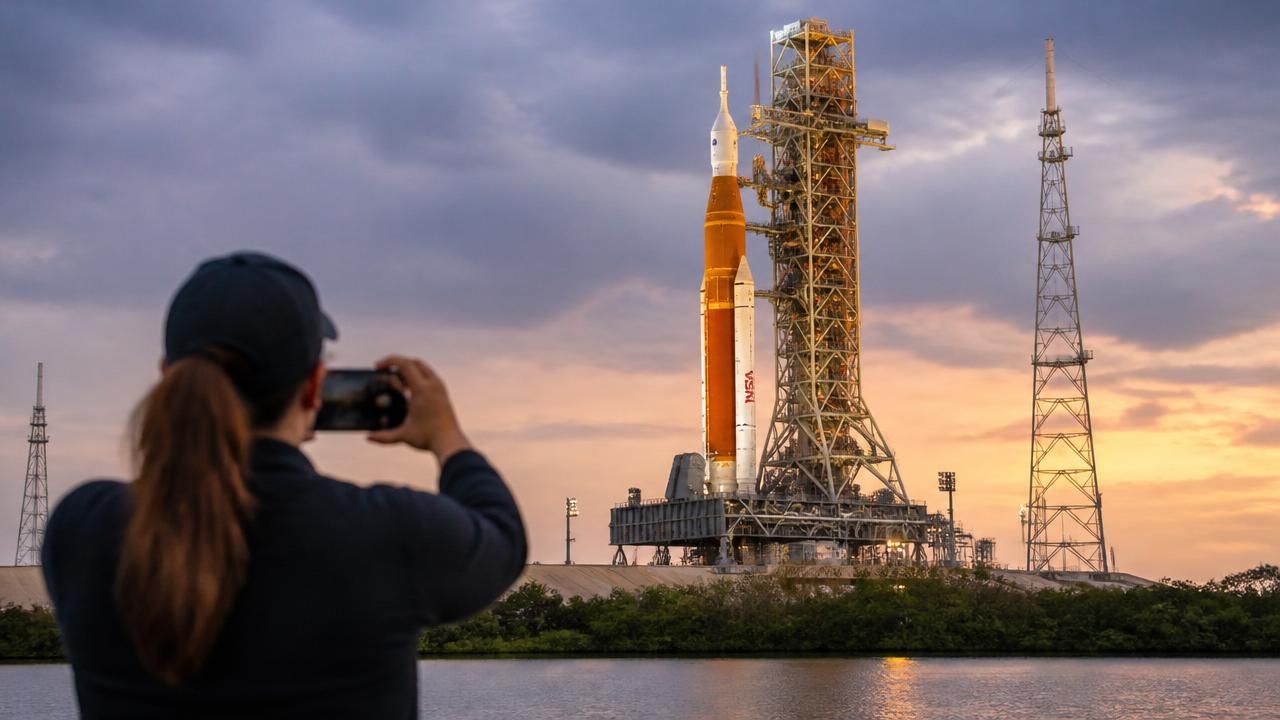
The higher-profile of the two is tied to Artemis II, the first mission to send astronauts around the Moon since Apollo 17 in 1972. The roughly 10-day flight will lift off aboard the Space Launch System rocket from Kennedy Space Center in Florida and carry commander Reid Wiseman, pilot Victor Glover, mission specialist Christina Koch and Canadian Space Agency astronaut Jeremy Hansen on a free-return trajectory that swings behind the Moon before splashing down in the Pacific.
NASA has framed the name campaign as a way for the public to ride along on a mission that will also make history for its crew: Koch will be the first woman and Glover the first Black astronaut to travel to the lunar vicinity, while Hansen will be the first non-American. Spanish-language outlets — including MSN, Univision and Yahoo Noticias — covered the initiative heavily, emphasizing that registration is free, takes only a few minutes, and that participants receive a digital ticket listing their name, the mission and a departure date still subject to change.
Coverage also reflected the practical reality of any launch campaign: deadlines. One Yahoo Noticias headline warned readers of "the last day to send your name to the Moon," a reminder that these registries close weeks before launch so the chips can be manufactured and integrated. With Artemis II targeted for no earlier than 2026 after years of delays and technical reviews, the window for submissions has been finite — and several outlets reported server strain as interest surged.
Dragonfly: a name card for Titan
The second campaign is aimed much farther out. In a release published in Spanish, NASA described "Viaje a Titán" (Journey to Titan), an invitation to send names aboard Dragonfly, a car-sized, eight-rotor aircraft designed to take off, hover and land repeatedly in the dense nitrogen atmosphere of Titan, some 1.2 billion kilometers from Earth.
"NASA's Dragonfly mission will blow you away. By flying the first science mission with a rotorcraft, NASA will explore Titan, Saturn's largest moon, as we search for signs of habitability on this distant world that is so much like our own." — Nicky Fox, associate administrator for NASA's Science Mission Directorate
Titan is a compelling target precisely because it resembles Earth in odd ways: it has rivers, lakes and seas — made of liquid methane and ethane rather than water — plus organic dunes, hydrocarbon rain and a subsurface ocean that may harbor conditions suitable for life. Dragonfly, led by the Johns Hopkins Applied Physics Laboratory under NASA's New Frontiers program, is scheduled to launch in July 2028 and arrive in 2034, landing near the Selk impact crater and hopping between sites for a planned mission of more than two years.
Participants in the Titan campaign register through NASA's website at go.nasa.gov/dragonfly-names, available in Spanish and English, and receive a commemorative boarding pass. As with Artemis, the names will be written to a microchip installed on the spacecraft.
Why NASA keeps doing this
"Fly your name" campaigns date back decades, from the Mars Pathfinder and Phoenix landers to the Orion test flight and the Europa Clipper. They are cheap to run and remarkably effective: they generate mailing lists, media coverage in languages and markets NASA's own channels rarely reach, and a sense of shared ownership for missions funded by public money.
The strategy matters as much off the launch pad as on it. Artemis is a multi-billion-dollar program whose long-term funding depends on political support, and Dragonfly — a $3.35 billion mission whose launch was once threatened by budget pressure — benefits from visible public interest. Turning spectators into nominal crew members is a low-cost way to build that constituency.
- Artemis II: crewed lunar flyby, four astronauts, launching no earlier than 2026; names carried on a microchip with a digital boarding pass.
- Dragonfly: rotorcraft lander to Titan, launching July 2028, arriving 2034; registration at go.nasa.gov/dragonfly-names in Spanish and English.
- The fine print: both campaigns are free, both close ahead of spacecraft integration, and neither involves certifying the participant as an actual astronaut.
Two missions, one message
The sources tell slightly different stories depending on the audience. Spanish-language news outlets concentrated on the Artemis II campaign's mechanics and deadline, often with step-by-step registration guides; the NASA release, by contrast, leaned into exploration and habitability science, pitching Titan as a world eerily like our own. Read together, they describe a single coordinated effort to make deep-space exploration feel personal — even if the closest most participants will get to the Moon or Titan is a line of text on a chip the size of a thumbnail.
Would-be travelers should check NASA's website for current deadlines, since both registries close well before launch. After that, the only way to board is to wait for the countdown.