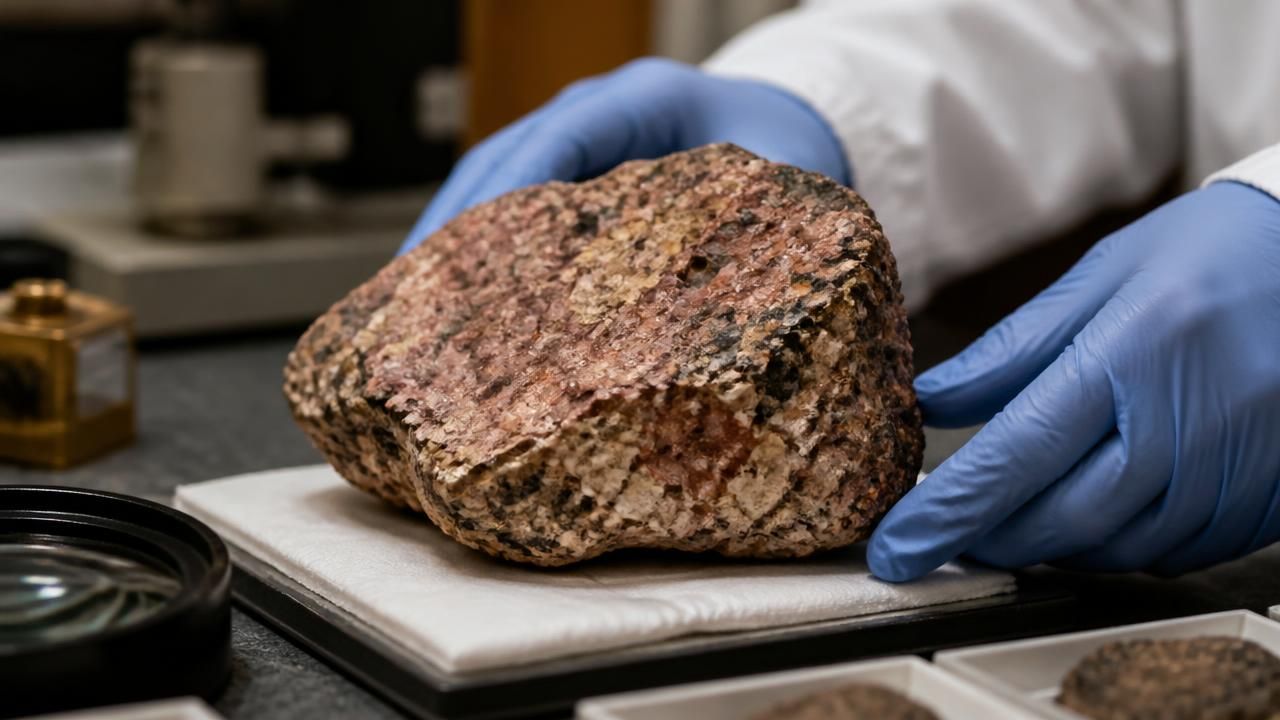
Scientists have confirmed that a rose-colored rock picked up in the Sahara Desert in 2022 is a fragment of Mars that crystallized more than 4.1 billion years ago, making it one of the oldest Martian meteorites ever recovered on Earth. The 800-gram (nearly two-pound) specimen, named Teghaza 001 after the salt plain in Mali where it was found, is described in a paper published Thursday in the journal Science.
The research was funded by NASA and led by Yang Liu of the agency's Jet Propulsion Laboratory in Southern California. According to NASA, the initial characterization offers a rare snapshot of the Red Planet's primordial crust — material that formed during the first few hundred million years of Mars' existence and that has since been largely erased or buried on the planet itself.
A rock that took years to reveal itself
When the meteorite surfaced in the Saharan trade circuit, nothing about it announced its origin or age. It was only after researchers began dating its constituent minerals that the rock's identity became clear. Teghaza 001 joins a catalog of roughly 435 confirmed Martian meteorites, the vast majority of which are far younger.
"It was only after we started looking closely that we realized this meteorite is really unique. One of the paper's reviewers called it a Rosetta Stone for Mars."
— Yang Liu, lead author, NASA Jet Propulsion Laboratory
The comparison is apt. Martian meteorites are rare, random samples, blasted off the surface by impacts and eventually delivered to Earth after millions of years in space. Each one is a free probe of a world that no spacecraft can visit and return from — at least not yet. A specimen whose minerals have survived largely intact since the planet's earliest era gives geochemists a way to test assumptions about how Mars' crust differentiated, how its interior churned, and what its atmosphere looked like before it thinned.
Clues to a wetter, warmer world
The Science paper is not the only line of inquiry. A separate study published in Science Advances in June detailed the meteorite's water content, offering a look at how water shaped the early planet's surface. Together, the two papers sketch a portrait of a young Mars where water and rock interacted extensively.
That question — how much liquid water Mars once held, and for how long — is central to modern planetary science and to the search for evidence of past habitability. NASA's Perseverance rover is currently caching samples in Jezero Crater, an ancient river delta, in hopes of a future return mission; the MAVEN orbiter has spent a decade tracking how the planet lost its atmosphere to space. Meteorites like Teghaza 001 provide a complementary, ground-truth check on those orbital and rover observations, sampled from parts of the planet no mission has visited.
How the story is being framed
The coverage across outlets reflects the different appetites of their audiences. NASA's own release, published through its science communications channels, leads with the institutional process — the age-dating work, the peer-reviewed venues, the JPL affiliation — and emphasizes what future studies could unlock. Aggregated mainstream headlines, by contrast, compressed the story into two hooks: the meteorite's extreme age ("4.1 billion years old") and its implication for Mars' watery past.
Both framings are accurate, but they capture different halves of the same finding. One stresses provenance and method; the other stresses implication. For a general reader, the headline version is the takeaway. For the planetary science community, the value lies in the sample itself, which now becomes one of the most studied rocks in the meteorite collection.
- Name: Teghaza 001, for the salt plain in Mali where it was recovered
- Mass: approximately 800 grams (nearly 2 pounds)
- Age: more than 4.1 billion years, based on mineral dating
- Published: Science (Thursday) and Science Advances (June, water content)
- Rarity: one of only about 435 known Martian meteorites
Why 4.1 billion years matters
Mars formed alongside Earth roughly 4.5 billion years ago. The first 500 million years of its history — the period recorded in Teghaza 001 — is precisely the window in which the planet is thought to have had a thicker atmosphere, flowing surface water, and conditions that could plausibly have supported microbial life.
Yet that record is hard to read. On Earth, plate tectonics and weathering have recycled almost all of the planet's oldest crust. On Mars, the ancient highlands survive, but they are covered in dust and heavily cratered, and landing there is difficult. Only a handful of the catalogued Martian meteorites have crystallization ages exceeding four billion years — most famously the Antarctic find ALH84001, which became the center of a 1990s controversy over putative biosignatures, and the regolith breccia NWA 7034, nicknamed "Black Beauty," whose components date back as far as 4.4 billion years.
Teghaza 001 therefore slots into a very small and very valuable group. Its rose coloration and mineralogy will now be probed for signs of aqueous alteration — the chemical fingerprints left when water reacts with rock — which is where the June water study already broke ground.
What comes next
An initial characterization is, by design, a beginning rather than an end. Researchers will want higher-precision isotopic measurements, micro-analyses of individual mineral grains, and comparisons with data from orbiting spectrometers and rovers. Each of those lines of work could sharpen the timeline of when Mars was wet, how long it stayed that way, and when it turned cold and dry.
For Liu and her colleagues, the significance is already clear. A rock that sat unidentified in a desert for an unknown number of years has turned out to be a piece of the solar system's early history — and, in the words of one reviewer, a key to reading Mars itself.