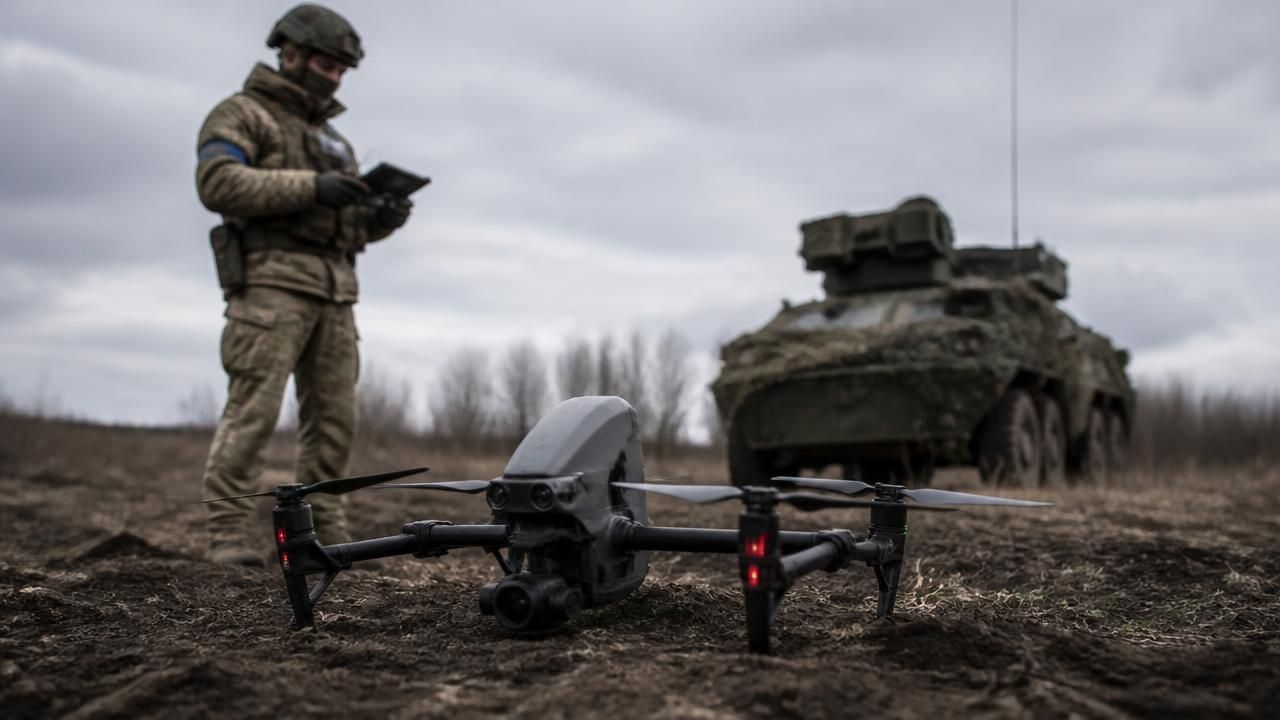
The war in Ukraine has become the world’s first large-scale laboratory for artificial intelligence in combat, with both Kyiv and Moscow fielding drones that can fly faster, identify targets more reliably and, increasingly, act with limited human oversight. The rapid spread of AI-enabled unmanned systems is no longer a narrow tech story: it is reshaping battlefield tactics, defense budgets, corporate valuations, diplomatic warnings and the legal debate over autonomous weapons.
Ukrainian President Volodymyr Zelenskyy used the UN General Assembly to warn that the window for governing AI on the battlefield is closing. According to the New York Post, he told world leaders that current wars must end before AI hits the battlefield, and NPR reported he has warned that AI could be making battlefield decisions as soon as next year. The message was blunt: the technology is arriving faster than the rules meant to constrain it.
A faster kill chain
Drones have evolved from reconnaissance tools and jury-rigged FPV explosives into networked systems. AI compresses the “kill chain” — the sequence from detection to decision to strike — by helping drones track targets even when communications are jammed or operators are overloaded. Ars Technica reported that small AI models now allow drones to autonomously identify and attack battlefield targets, a step beyond remote-controlled kamikaze drones. MSN’s coverage framed the arrival of autonomous drones over Ukraine as a change that “will change just about everything,” while another MSN piece described a dangerous race toward fully autonomous systems.
The battlefield also requires machines to talk. Reuters reported that a Dutch firm is using AI to help drone systems communicate and coordinate on Ukraine’s battlefield — an interoperability layer that could let different drones, sensors and command posts share targeting data. That may sound mundane compared with autonomous attack, but it is militarily significant: swarms and coordinated strikes depend on machines exchanging information faster than humans can relay it.
The defense-tech boom
Investors are pricing in a sustained shift. CNBC reported that an AI drone maker reached a $6.4 billion valuation as the Ukraine war spurred defense technology. The figure reflects more than battlefield demand; it signals that venture capital and established contractors now see autonomous systems as a growth market. The Pentagon is moving in the same direction. Reuters reported that the U.S. Department of Defense created “Autowarcom” to expand AI and drone capabilities, while MSN reported that the Pentagon had bet $75 billion that AI, drones and space will win the next war, with a Navy SEAL explaining what Elon Musk has to do with it. The through-line is convergence: cheap drones, satellite communications, commercial AI and space-based sensing are being knitted into military architecture.
Strikes beyond the trench line
The war is also expanding the definition of a military target. Ars Technica reported that Ukraine’s drones knocked out an AI data center belonging to “Russia’s Google” — a reminder that data centers, cloud infrastructure and AI computing are becoming part of the battlespace. If algorithms help drones navigate and identify targets, the facilities that train or host those algorithms are strategic assets. That raises difficult questions under international humanitarian law about dual-use infrastructure and civilian dependency on the same technology.
Yet autonomy is not a cure-all. Forbes reported that Ukraine expects Russia to exploit drone limitations in its autumn offensive. Electronic warfare, jamming, weather, battery life, lost links and the difficulty of distinguishing decoys from real targets all constrain drones. Russia and Ukraine are locked in a rapid countermeasure cycle: new frequencies, new sensors, new autonomy, new jamming. AI can help a drone keep flying toward a target when the operator’s signal disappears, but it can also make errors at machine speed.
Autonomy’s accountability gap
The ethical and legal debate is catching up. Fully autonomous drones raise questions about who is responsible when a machine misidentifies a target, whether human control must be retained, and how to prevent proliferation. The UN warning from Zelenskyy reflects a wider anxiety: if AI decisions arrive on the battlefield next year, the international community may be negotiating rules after the fact. Defense ministries argue that human commanders remain accountable and that autonomy improves precision; critics warn that speed and scale can erode meaningful human judgment.
“Current wars must end before AI hits the battlefield,” Zelenskyy told the UN, according to the New York Post — a plea that framed AI not as a distant future but as an imminent escalation.
What to watch
Three tests will shape the next phase. First, whether Ukraine and Russia can field reliable autonomy under heavy electronic attack. Second, whether Western militaries institutionalize AI drones through programs such as Autowarcom and the Pentagon’s broader $75 billion bet. Third, whether governments agree on limits before fully autonomous weapons become ordinary. For now, the market, the battlefield and the diplomatic stage are moving in the same direction: toward more AI, more drones and less time for rules.