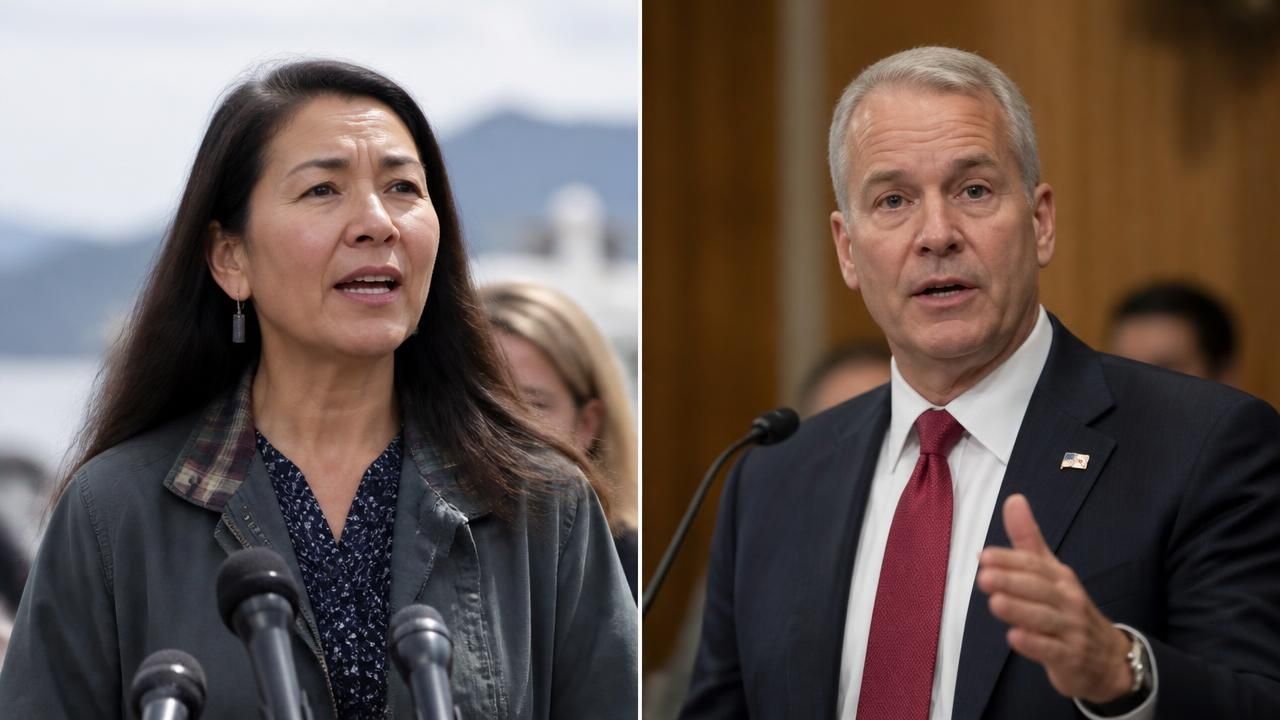
Alaska’s governor has ordered a criminal investigation into Rep. Mary Peltola’s campaign, turning a remarkable behind-the-scenes story about political hardball into a full-blown legal and electoral storm just days before the midterm elections. The probe follows a New York Times report that Peltola’s campaign and national Democratic operatives helped recruit a decoy candidate — a second man named Dan Sullivan — to run in Alaska’s U.S. Senate race and sow confusion among voters.
The governor’s order offered no detail about what law may have been broken, and it landed hours after President Trump publicly demanded that Peltola drop out of her race and face prosecution. The White House has not explained what crime it believes was committed, and legal experts cautioned that recruiting a namesake candidate, however cynical, is not obviously illegal.
How the story broke
The Times reported that people working for Peltola and the Democratic Senatorial Campaign Committee (DSCC) discussed and helped enlist a rival “Dan Sullivan” — a man from the Southeast Alaska community of Petersburg, who has been referred to in local coverage as “Petersburg Sullivan” — in the race against incumbent Sen. Dan Sullivan, a Republican. The intent, according to the reporting, was to trade on the power of a familiar name on the ballot.
Alaska Public Media, which covers the state’s politics closely, emphasized the local dimension: the recruited candidate hails from a small fishing town and shares a name with one of the best-known Republicans in Alaska. The Times also reported that Peltola was “definitely aware” of the effort to find another Dan Sullivan, according to the New York Post, which splashed the allegation across its pages as a “bombshell.”
Coverage diverged sharply in framing. Right-leaning outlets amplified the word “collusion,” tying the episode to the DSCC and treating it as evidence of a coordinated national scheme. Local Alaska reporting focused on mechanics and names. And at least one analysis argued that the controversy may simply be too late to change the trajectory of a race already in its final days, with many ballots already cast.
Why a duplicate name matters
Alaska’s elections are unusual. The state uses a top-four primary and ranked-choice voting in the general election, a system designed to reward broad appeal but one that also makes ballot name recognition unusually powerful. A candidate with an identical name to a sitting senator can, intentionally or not, absorb votes — particularly from low-information voters or those casting ballots quickly.
Aides to Peltola have not disputed that discussions took place, but defenders argue that candidates file for office on their own and that no one can be barred from running because of their name.
“She shouldn’t be allowed to run,” Trump said, according to accounts of his remarks, calling on Peltola to withdraw and face prosecution.
The legal question
The central difficulty for investigators is identifying an actual statute. Election law experts note that “dirty tricks” involving decoy candidates have a long, bipartisan history in American politics — from placeholder candidates in state legislative races to names placed on ballots to split an opponent’s base. Proving coordination is hard; proving that coordination is criminal is harder still.
Potential avenues could include campaign finance rules governing coordination between campaigns and party committees, or Alaska statutes on fraudulent voting or election interference. Whether the facts fit any of those provisions remains an open question. The governor’s office did not specify which theory it is pursuing.
The Department of Justice is also reported to be examining the matter, adding a federal dimension to a state-level inquiry. Meanwhile, reporting indicates the Trump administration has moved to sue to block certification of Alaska’s U.S. Senate election result if Peltola wins — a step that would thrust a state contest into federal court and raise the prospect of a prolonged post-election fight.
The wider political backdrop
The controversy erupted during the final sprint of the midterm campaign, with Trump barnstorming battleground states including Ohio on behalf of Republican candidates and both parties pouring resources into closing arguments. For Republicans, the Alaska story is a ready-made argument about Democratic cynicism toward voters. For Democrats, the risk is being defined by a process story rather than by Peltola’s record.
Peltola, who won a special election and then a full term in a state Trump carried comfortably, is among the most vulnerable Democrats in the country. Her brand depends on cross-partisan appeal — she is known for a folksy style and for emphasizing Alaska-specific issues like fisheries, resource development and rural services. A probe into her campaign’s tactics cuts directly against that brand.
What to watch
- The governor’s investigation: whether it identifies a specific statute, or remains a general inquiry.
- Federal filings: any litigation over certification of the Senate result, and how courts treat it.
- The DSCC’s exposure: whether national Democrats acknowledge a role, and how they justify it.
- Voters: how much a late-breaking process story moves ballots in a ranked-choice system where many votes are already locked in.
For now, the episode has become a case study in the blurry line between aggressive electioneering and fraud — and in how quickly a story first published by one newspaper can become a criminal referral, a presidential demand, and a national flashpoint in the space of a few news cycles.