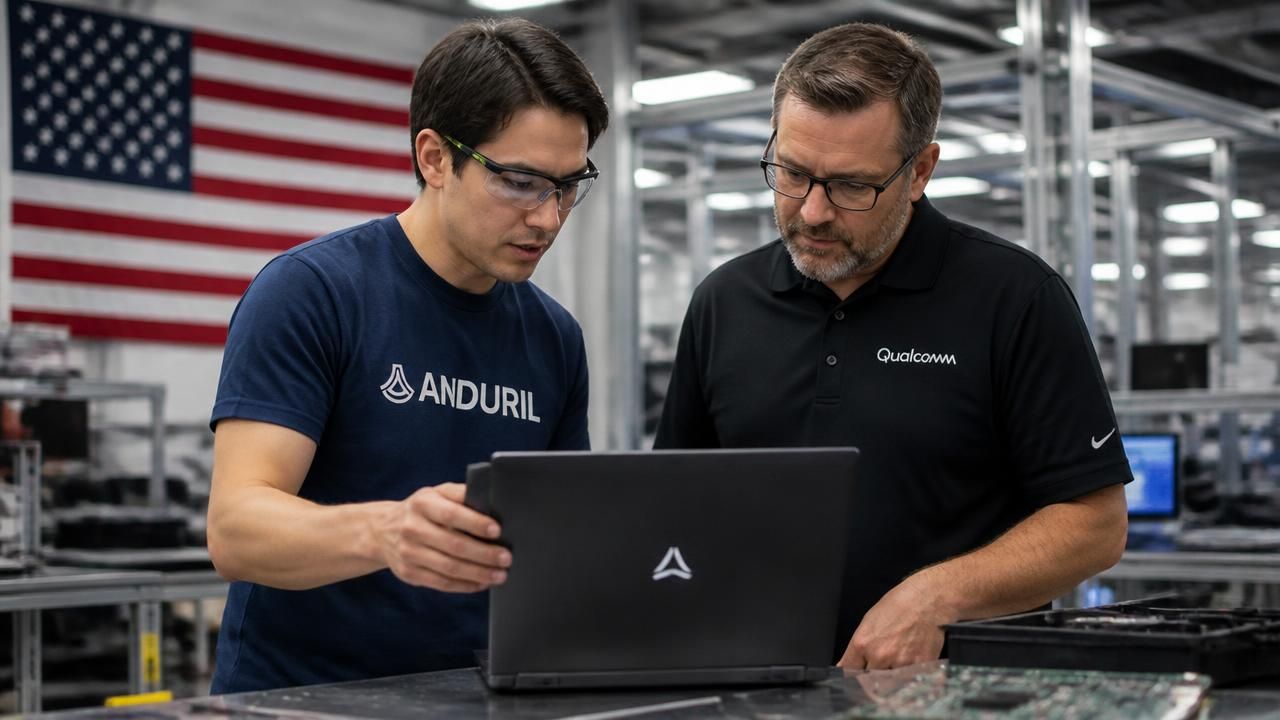
Defense technology company Anduril and chipmaker Qualcomm announced Tuesday that they will jointly build laptops entirely on American soil, beginning with a single model — the BlueChip — scheduled to reach customers in 2027. The two companies said the machine will meet Buy American standards when it launches, and they outlined what they called a “long-term goal” of pushing the broader computer industry toward “a fully domestic supply chain.”
The announcement lands at an unusual intersection of national security policy, semiconductor strategy and election-year politics. Anduril, founded in 2017 by Palmer Luckey and headquartered in Costa Mesa, California, has built its reputation on autonomous drones and military software. Qualcomm, based in San Diego, is the largest technology employer in its region and one of the few American firms designing high-performance processors for portable computers. The pairing unites a defense buyer's security demands with a chip designer's hardware ambitions.
Why a US-made laptop is genuinely unusual
The striking part of the announcement is not the laptop itself but where it would be built. No major American computer company manufactures laptops in the United States — not Apple, not Dell, not HP, not Microsoft. The overwhelming majority of the world's notebooks are assembled in China, Vietnam, Taiwan and Mexico, with components sourced from a sprawling Asian supply web that includes displays from South Korea and China, batteries from Japan and China, printed circuit boards from Taiwan, and rare-earth magnets largely refined in China.
The Verge noted that even a single Made-in-USA laptop would be a surprise, while also flagging a note of caution: the industry has seen companies “briefly and strategically assemble computers here” in ways that appeared designed to court political favor rather than to restructure supply chains. Apple's Mac Pro, assembled in Austin, Texas, since 2013, is the canonical example — a low-volume, high-profile product whose domestic production was repeatedly highlighted during trade tensions, even as the company's mass-market computers remained offshore.
Anduril and Qualcomm are trying to distinguish themselves from that pattern by promising a production line that scales rather than a showcase unit. Whether they can deliver will depend on components that no American factory currently produces at competitive cost.
A national security argument, not just an industrial one
The San Diego Union-Tribune framed the venture in explicitly geopolitical terms: as a counter to Chinese dominance in electronics manufacturing. That framing carries weight in Washington, where lawmakers have spent the past several years trying to reverse decades of offshoring through the CHIPS and Science Act, export controls on advanced semiconductors, and tightening Buy American content thresholds in federal procurement.
For Anduril, whose customers are overwhelmingly the Pentagon and allied militaries, domestic production is less a marketing position than an operational requirement. Defense buyers increasingly demand that communications and computing hardware be free of components that could be disrupted — or compromised — by foreign suppliers. A laptop built to defense-grade security standards, running on Qualcomm's Snapdragon-class processors and tied into Anduril's Lattice software ecosystem, fits neatly into that procurement logic.
The companies described the effort as a “long-term goal” of pushing the computer industry toward “a fully domestic supply chain” — language that acknowledges how far the existing supply chain sits from that target.
The hard part: components, not assembly
Final assembly is the easiest link to move. The harder problem is everything upstream. Qualcomm, like most American chip firms, is fabless: it designs processors but contracts their manufacture to foundries, principally Taiwan's TSMC, which is only now bringing advanced capacity online at its Arizona site. Even a laptop whose board is populated in the United States may carry silicon fabricated abroad for years to come.
Displays represent another bottleneck. There is no large-scale US producer of the LCD and OLED panels used in modern laptops. Battery cells, camera modules and high-density connectors present similar gaps. Industry analysts have estimated that a genuinely domestic laptop would carry a substantial cost premium — potentially hundreds of dollars per unit — which may be tolerable for government and defense buyers but difficult to sustain in the consumer market.
What each outlet emphasized
- The Verge led with skepticism and context, emphasizing that no major US computer maker builds laptops domestically and questioning whether the announcement is as much political signaling as industrial strategy.
- The San Diego Union-Tribune emphasized the China competition angle and Qualcomm's role as a regional economic engine.
- Aggregated business coverage focused on the novelty of the product itself — a laptop with nearly all components sourced domestically, and a military drone contractor moving into the commercial PC market through a new venture.
What to watch
The first test will be whether Anduril and Qualcomm disclose the domestic content percentage of the BlueChip at launch, and whether that figure clears the federal thresholds — which have been rising and are scheduled to reach 75 percent later this decade. The second will be pricing and volume: a laptop built for a few thousand defense customers is a proof of concept, not an industrial revival.
The third, and most consequential, is whether the partnership attracts copycats. If a defense-grade, Buy American laptop proves viable, the Pentagon's enormous procurement budget could create the demand signal that decades of policy incentives have failed to generate — turning a single 2027 product into the beginning of a supply chain rather than a footnote in it.