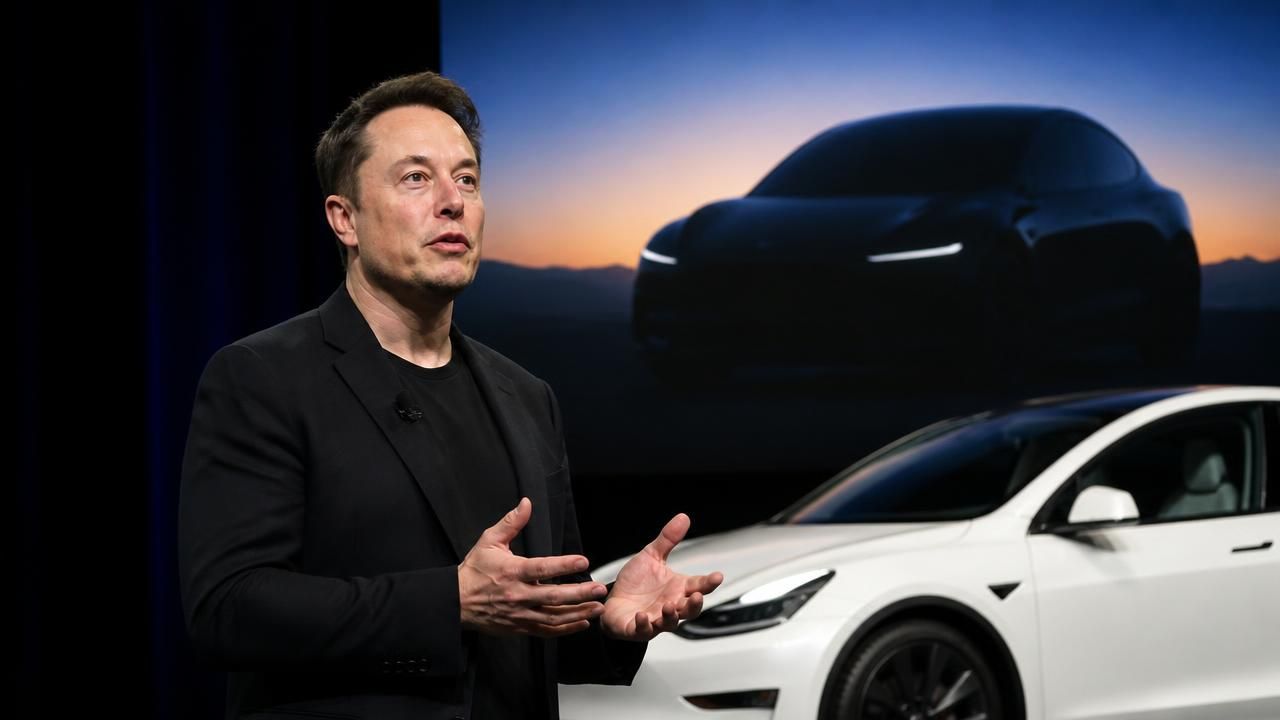
Elon Musk used Tesla's quarterly earnings call on Wednesday to sketch a future in which his carmaker is not merely a carmaker — but also the world's most valuable chipmaker, a dominant supplier of humanoid robots, and the company responsible for "a majority of all passenger miles" traveled on Earth. Buried inside that blizzard of superlatives was a concrete number: 5 million vehicles a year by roughly 2030.
"We were aiming for 5 million vehicles a year by approximately 2030," Musk told investors. "And I think we've got a good shot of achieving that goal."
The target, first reported by Yahoo Finance and echoed across Seeking Alpha and TipRanks, was the headline many outlets seized on. But the reaction on Wall Street was decidedly less euphoric, with Tesla shares falling after a call that, by several accounts, paired a respectable earnings beat with a sobering profit picture.
The number versus the math
The Verge was blunt in its assessment, headlining its coverage with the observation that "math says otherwise." The arithmetic is indeed demanding: Tesla delivered just under 1.8 million vehicles in 2024, so reaching 5 million by the end of the decade implies roughly 18% to 19% compound annual growth every year for six consecutive years — a pace no mass-market automaker has sustained at this scale.
What frustrates analysts isn't the ambition itself, but the way it is delivered. The Verge noted that the 5 million figure arrived amid "a veritable firehose of Musk superlatives," including a claim that Tesla's planned Terafab chip factory "will be the most valuable building in the world," carrying "an economic value that's going to be placed in the top 20 countries." Such predictions have a long track record of slipping: Tesla's original master plans repeatedly pushed volume targets to the right, and the company's long-promised fully autonomous cross-country drive has been re-announced for years.
There is one bullish counterpoint in the sources: Musk reportedly said vehicle demand is currently outpacing production, a claim that lands ahead of the planned Cybercab launch in Dallas. If demand genuinely exceeds supply, the capacity question — not the order book — becomes the binding constraint.
A quarter that beat, a stock that fell
On paper, the quarter looked solid. Coverage from MSN described an earnings beat with strong Full Self-Driving revenue, and USA Today framed part of the story around Tesla having worked through a glut of unsold EVs — a clearing of inventory that flattered deliveries and eased pressure on pricing.
Investors nonetheless marked the stock down. The reason, according to reporting from The New York Times, is the cost of Musk's pivot: Tesla's profit slumped as the company poured money into artificial intelligence and robotics. Seeking Alpha highlighted the scale of that commitment, noting Tesla outlined roughly $20 billion in capital expenditure for 2026 — a figure that dwarfs the spending of a conventional automaker and puts Tesla's balance sheet squarely behind the AI thesis.
That tension — earnings now versus infrastructure promised later — explains the split-screen reaction. Bulls see a company converting automotive cash flow into compute, data and robots. Bears see a carmaker whose margins are being consumed by a research budget with no near-term revenue line.
Optimus slips while the hype holds
The robot story cut both ways. Musk said Tesla aims to begin selling humanoid robots next year, according to MSN — a timeline that would make Optimus a commercial product faster than almost any outside observer expected. But TipRanks reported that Musk also flagged delays to Optimus, a reminder that the product is still in development even as its sales date is being advertised.
"We were aiming for 5 million vehicles a year by approximately 2030. And I think we've got a good shot of achieving that goal." — Elon Musk
The Cybercab and Optimus narratives are intertwined: both depend on Tesla's bet that AI trained on its fleet data will generalize into autonomy, and both are being marketed to investors before they are being sold to customers.
How the outlets framed it
- The skeptical lens: The Verge treated the 5 million target as a rhetorical flourish rather than a forecast, emphasizing its placement inside a stream of grandiose claims.
- The operational lens: Yahoo Finance focused on demand exceeding production and the coming Dallas Cybercab launch — a supply story rather than a hype story.
- The financial lens: The New York Times and Seeking Alpha centered the profit slump and the $20 billion capex plan, casting Tesla as an AI company spending like one.
- The market lens: MSN and USA Today tracked a contradictory day — an earnings beat and cleared inventory on one side, a falling share price on the other.
What to watch
Three data points will determine whether Musk's 2030 number is remembered as a forecast or a punchline. First, whether Tesla's next-generation, lower-cost platform actually reaches volume production — the 5 million figure is arithmetically impossible on the current lineup alone. Second, whether FSD revenue converts into recurring, high-margin software income rather than a one-off accounting boost. Third, whether Optimus ships on anything resembling the stated timeline.
For now, Tesla remains a company asking investors to value it on a future it has not yet built. Musk has set the marker at 5 million cars, millions of robots, and a chip factory worth more than most nations' economies. Wall Street, chastened by a falling stock and shrinking profit, appears willing to wait — but no longer to take the math on faith.