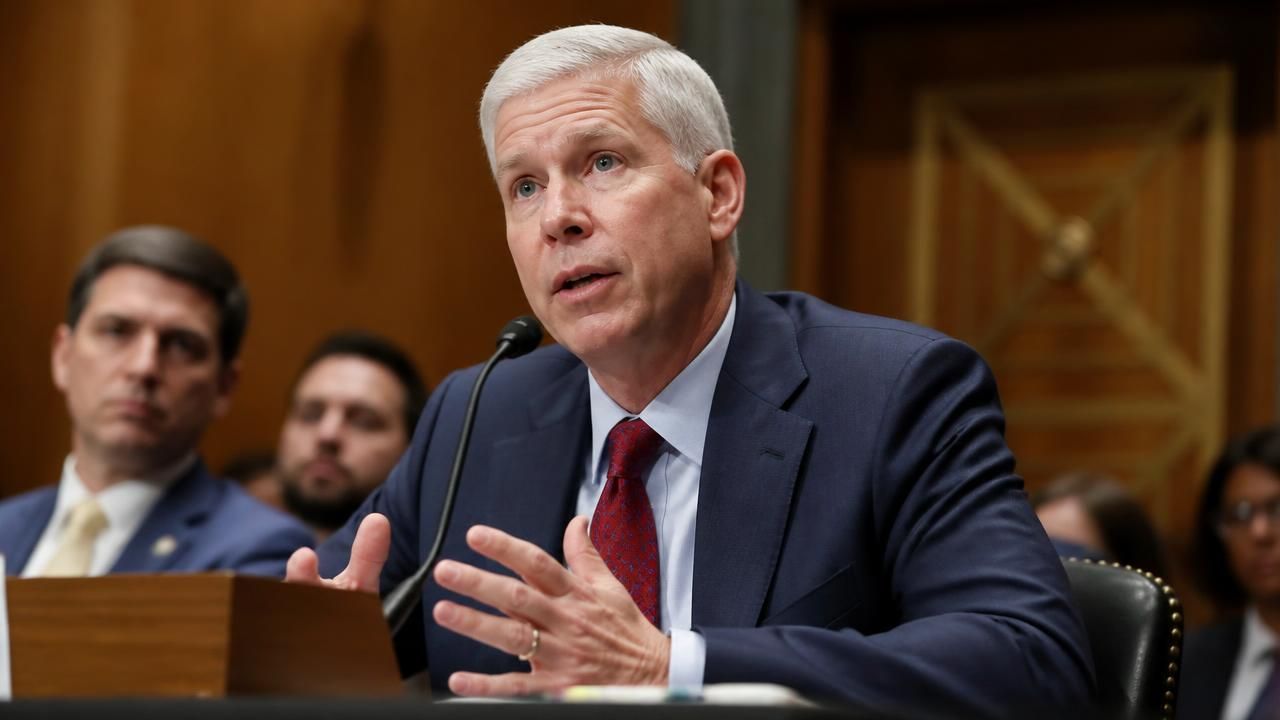
U.S. Energy Secretary Chris Wright moved to calm a rattled fuel market this week, saying he expects diesel prices to fall "significantly" while throwing cold water on the idea of an outright ban on American exports of the fuel — even as other reports suggested President Donald Trump is sympathetic to exactly that step.
The mixed signals landed as Brent crude held above $108 a barrel and U.S. retail fuel prices sat near record highs, with the war with Iran continuing to unsettle global energy flows. The competing headlines — a rejected ban, a favored set of voluntary limits, a president reportedly open to prohibition — have left traders parsing both the policy and the politics.
A ban on the table, then off again
According to MSN, Wright rejected an outright ban on diesel exports and instead favors voluntary limits, an approach that would ask refiners to restrain shipments rather than compel them. The Hill framed the same remarks more bluntly: the energy secretary "throws cold water" on a diesel export ban, cooling speculation that the administration was preparing to restrict shipments.
Yet Yahoo reported that Trump supports a diesel export ban as fuel prices hit records — a reminder that in this administration, cabinet-level caution and presidential instinct do not always point the same direction. The White House has not been described in the available reporting as having finalized any policy, leaving the market to trade on inference.
Wright said he expects diesel prices to be "dropped significantly," but that increased exports out of the Arabian Gulf would be needed to manage it amid the ongoing war with Iran.
That formulation is notable for its direction: rather than restricting American barrels, Wright appears to be looking for more supply from the Gulf to relieve pressure — a supply-side answer to a problem that some in the administration have wanted to solve with export controls.
Gulf barrels and Russian diesel
Wright also addressed Russia, saying that the only way Moscow can benefit from recently permitted exports of diesel is to deliver a ceasefire on energy — or end the war altogether. The linkage turns a commercial question into a diplomatic lever, tying Russian diesel revenues to progress toward a halt in hostilities.
The emphasis on Arabian Gulf exports reflects the geography of the current disruption. With the conflict with Iran threatening flows through the world's most important energy corridor, the marginal barrel has become both scarcer and more expensive to move. Any policy that simultaneously constrained U.S. exports would tighten an already stressed global distillate market.
Markets: WTI's discount deepens
Reuters reported that talk of a U.S. export ban on diesel deepened U.S. crude futures' discount to the global benchmark. The mechanism is straightforward: if Washington restricts refined product exports, U.S. refiners have less incentive to run crude hard and less outlet for their output, which weighs on domestic crude prices relative to Brent and other international grades.
The spread matters well beyond the futures pit. A wider discount signals a domestic market being walled off from global prices — good news, in theory, for U.S. drivers at the pump, but a warning sign for refiners, for the credibility of U.S. crude as a globally priced benchmark, and for allies who count on American distillate.
Why diesel is the pressure point
Diesel and other distillates sit at the center of the global economy: they power trucking, freight rail, agriculture, mining and construction. When distillate cracks widen, the cost ripples through food and goods prices within weeks. That is why an export ban is a more consequential tool than it first appears — and why the refining industry and trading houses have lobbied against it.
- The policy question: whether the United States mandates export restraint or merely requests it.
- The market question: whether Gulf supply can be restored quickly enough to cap prices.
- The political question: whether relief at the pump arrives before voters render a verdict.
- The diplomatic question: whether Russia's permitted diesel exports become leverage for a ceasefire.
Peak prices?
Wright's most consequential claim, reported by OilPrice.com alongside Brent's move above $108, was that gas prices have peaked. If correct, it gives the administration room to argue that markets are already healing and that heavy-handed intervention would be counterproductive. If wrong, it sets a benchmark against which every subsequent week of elevated prices will be measured.
The differing coverage — Bloomberg on Gulf supply, Reuters on the futures curve, MSN and The Hill on the ban, Yahoo on presidential preference — describes not six stories but one unresolved argument inside the U.S. government about how far to intervene in energy markets during a war. For now, the answer appears to be: as little as politics will allow.
What to watch
Traders will watch three things: whether the administration formalizes voluntary export restraint, whether distillate inventories rebuild ahead of winter, and whether Gulf shipping lanes remain open. Any one of those can move the WTI-Brent spread, the pump price, and the political temperature in Washington.