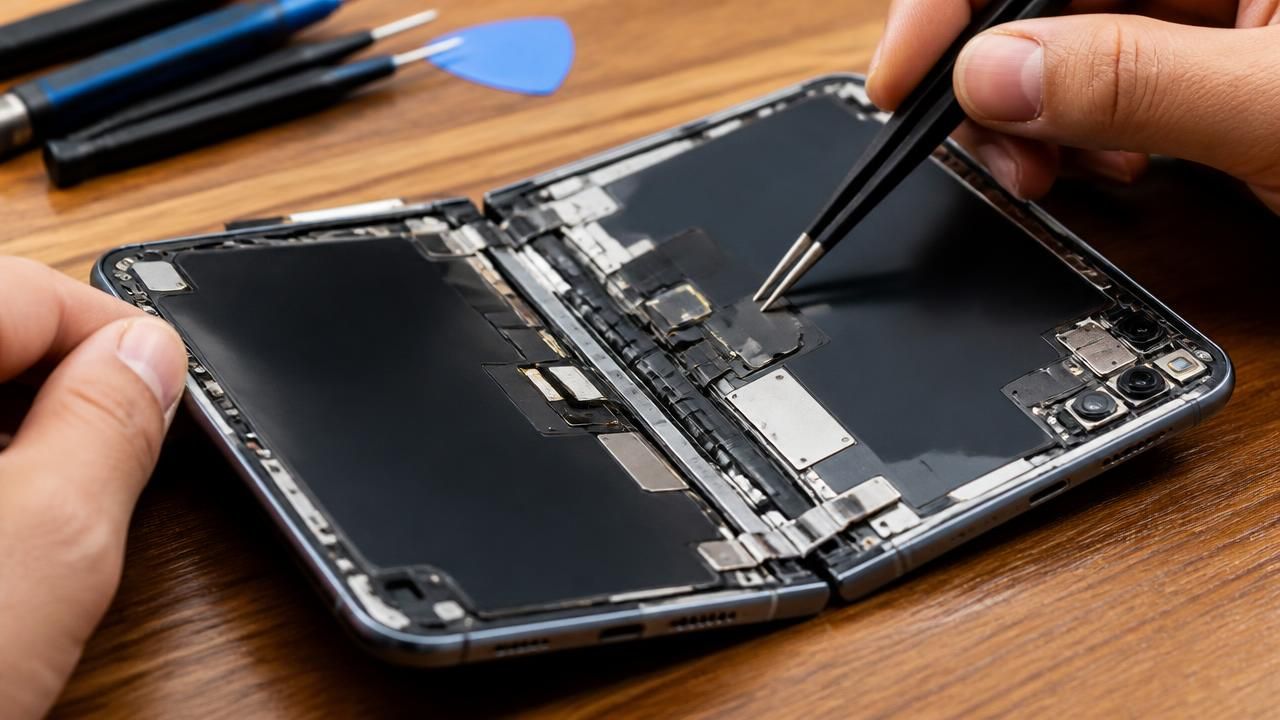
iFixit’s latest teardown has given the iPhone Duo an unusually close look — and an unusually favorable repairability score for a foldable — as owners and reporters try to explain why some units are developing cracks in the folding display and problems around the hinge. The repair site’s findings, first reported by The Verge and followed by MacRumors, MSN and iClarified, point to a combination of display-layer design, hinge stress and the engineering tricks Apple uses to hide the crease. Apple has not publicly commented on the teardown or the owner complaints.
What iFixit found
The Verge’s report focuses on the display engineering. iFixit found that the internal screen’s matte nano-texture cover does more than improve readability in bright sunlight. It also scatters reflections in a way that helps mask the fold crease. Under a microscope, iFixit observed oval-shaped subpixels arranged at various angles, which the site believes are part of the design intended to manage light and viewing angles on the folding panel. Those details help explain how Apple is trying to make a folding screen look more like a conventional slab phone, but they also add complexity to a part that is already difficult to repair.
Why the hinge matters
MacRumors frames the teardown as pointing to a possible cause of the screen cracks. The key question is whether failures originate in the display stack itself, in the hinge mechanism that constantly flexes the panel, or in the interaction between the two. iClarified’s coverage is more direct: it says iFixit is investigating the iPhone Duo screen failures and points to a possible hinge issue, with a video walking through the teardown. MSN’s headlines capture the consumer side of the story, noting that owners are complaining about cracking folding displays while iFixit tries to explain why and gives the device a low repairability score.
Repairability score and context
The score itself is a central data point. iFixit gave the iPhone Duo a 5/10 for repairability. That may sound middling, but it is the best score the site has given to a foldable yet. The context matters: folding phones pack flexible displays, complex hinges, multiple layers of protective film and tight tolerances into a chassis that is meant to fold thousands of times. Repairability has historically been a weak spot for the category, so a 5/10 is a relative win even as it leaves plenty of room for improvement.
That might not seem particularly high, but it is the best score the site has given to a foldable yet.
iFixit’s teardown tradition is part of the story’s authority. The site opens devices, maps components, examines adhesives and fasteners, and assigns a score based on how easily parts can be accessed and replaced. In this case, the teardown did not simply catalog parts. It offered a forensic look at a durability complaint that is difficult for buyers to evaluate before purchase. A folding display can look flawless in a store and still fail after months of folding, dust exposure, temperature swings and normal pocket pressure.
How coverage differs
The differing coverage also shows how a single teardown can be framed in several ways. The Verge emphasizes the clever display engineering and the crease-masking nano-texture cover. MacRumors highlights the possible cause of screen cracks. MSN foregrounds owner complaints and the low repairability score. iClarified packages the findings as an investigation with a video, making the hinge issue the headline. Together, they describe the same underlying tension: a foldable phone is a mechanical system as much as a computing device, and the display is only as reliable as the hinge and layers around it.
Key teardown findings
- The internal screen uses a matte nano-texture cover that improves outdoor readability and scatters reflections to reduce the visible crease.
- Microscope images show oval-shaped subpixels arranged at various angles, which iFixit believes are part of a display design intended to manage light and viewing angles.
- The teardown points to the hinge as a possible contributor to screen failures, though a full root-cause analysis would require more data from failed units.
- The iPhone Duo earned a 5/10 repairability score, the best iFixit has given a foldable but still a reminder that folding devices remain hard to service.
What it means for buyers
For buyers, the practical takeaway is not that every iPhone Duo will crack. The reports describe complaints and a teardown-based investigation, not a confirmed failure rate or a formal recall. But the story raises familiar questions for the foldable category: how much stress the display can take at the crease, how well the hinge manages that stress, and how easily a damaged screen or hinge can be repaired without replacing major assemblies. Those questions matter because foldables remain expensive, and repair costs can approach a significant fraction of the purchase price.
The next steps will be watchful. Apple could face pressure to explain the failure reports, extend warranty coverage or revise the design in a future model. iFixit’s findings may also push rival manufacturers to be more transparent about hinge durability and display-layer construction. For now, the teardown gives the clearest technical window yet into why a folding screen can fail — and why repairability remains one of the foldable category’s hardest problems.