More than 7,000 years after one of the most violent eruptions in recent geological history, the seafloor south of Japan is stirring again. A vast magma reservoir beneath the Kikai caldera is slowly refilling, according to a new study based on underwater seismic surveys — a finding that offers an unusually clear look at how a supervolcano rebuilds itself between cataclysms.
The research, reported in a peer-reviewed journal and amplified this week by ScienceDaily under the headline "One of Earth's most explosive supervolcanoes is recharging with fresh magma," describes a magma body that appears to have accumulated largely since the Kikai-Akahoya eruption roughly 7,300 years ago. The work has since been picked up by aggregators including MSN and Yahoo, which framed it in sharper terms: "One of Earth's deadliest volcanoes is slowly reloading with magma" and "One of Earth's Most Explosive Volcanoes Is Quietly Refilling With Magma."
What the survey found
Kikai is a submarine caldera lying just south of Kyushu, Japan, partly submerged and marked at the surface by the post-caldera dome of Iodake on Satsuma-Iojima and the smaller islet of Takeshima. Because most of the volcanic system sits beneath the sea, it has long been harder to image than land-based systems such as Yellowstone or Campi Flegrei.
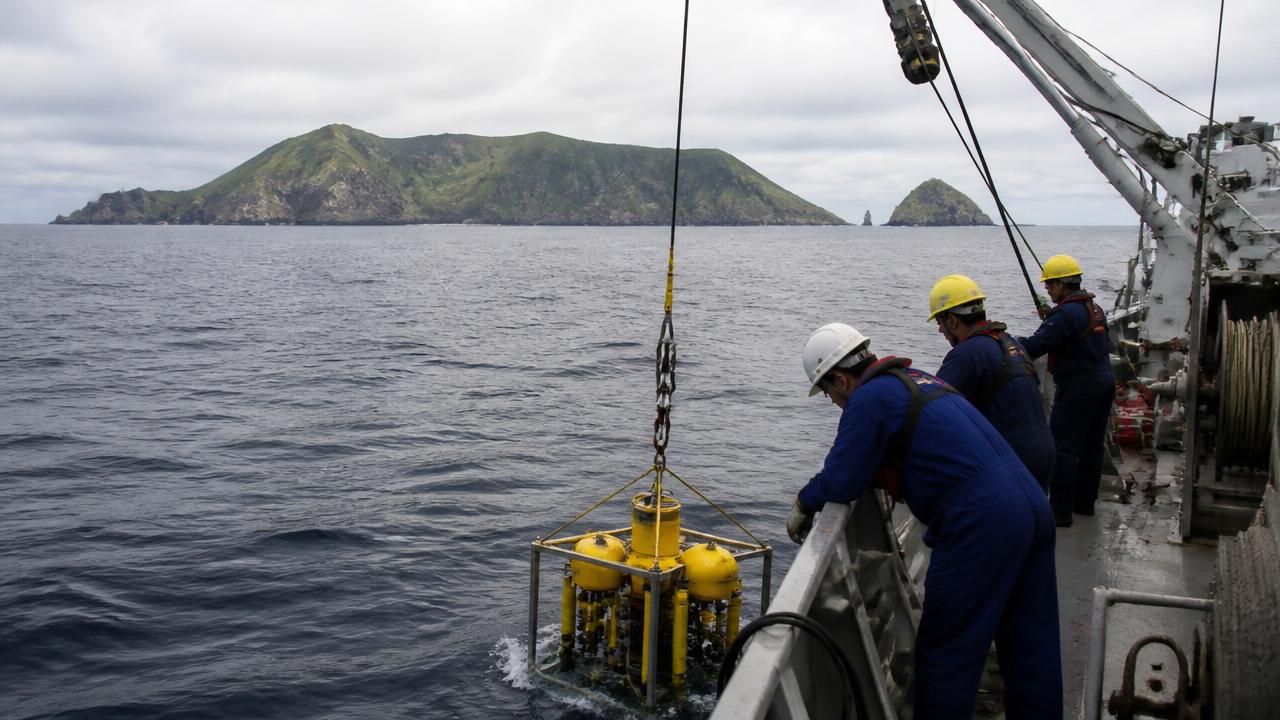
The researchers worked around that problem by deploying ocean-bottom seismometers and firing acoustic pulses — a marine version of the seismic reflection and refraction techniques used to map oil fields — to image the crust beneath the caldera floor. What emerged was a substantial reservoir of molten and partially molten rock at depth, with a structure consistent with magma that has been recharged since the caldera-forming event.
The findings suggest that the Kikai system has been quietly rebuilding its magma supply for millennia, a process largely invisible at the surface but fundamental to the life cycle of supervolcanoes.
The precise dimensions and melt fractions of the reservoir are the kind of detail that matters to volcanologists, because they distinguish a body of mostly crystalline mush — the common state of most large magma chambers — from one with enough mobile melt to be gravitationally unstable.
Why Kikai matters
The Kikai-Akahoya eruption, dated to about 7,300 years ago, is regarded as one of the largest explosive events of the Holocene. It ejected well over 100 cubic kilometers of material, blanketing southern Kyushu in pyroclastic flows and ash and scattering tephra as far as the Korean Peninsula and parts of Honshu. Archaeological evidence suggests the eruption devastated Jomon-era populations in the region and reshaped coastlines in the process.
The event left behind the sunken caldera that dominates the modern landscape — and the question of how long a supervolcano takes to reload afterward. Kikai is one of a small handful of systems where the answer can plausibly be studied: it erupted catastrophically, it sits close to a well-monitored island chain, and its subsurface structure can now be probed with marine instruments.
Comparison with Yellowstone, Toba and Campi Flegrei
Supervolcanoes worldwide are thought to follow loosely similar rhythms: massive caldera-forming eruptions, followed by tens of thousands of years of post-caldera volcanism, subsidence, and gradual recharge from below. Yellowstone's magmatic system is drained and refilled in pulses, with the most recent caldera-forming eruption about 640,000 years ago. Toba, in Sumatra, produced an eruption about 74,000 years ago of staggering scale. Campi Flegrei, west of Naples, has been showing signs of unrest for decades.
Kikai's advantage as a natural laboratory is that it is a relatively recent case: a full recharge cycle is far enough along to be imaged, yet young enough that the post-eruption history is comparatively well preserved in the geological record.
- Submarine imaging gives researchers a cross-section of the crust that land studies cannot easily supply.
- Recharge rates help calibrate models of how quickly supervolcanoes rebuild magma after colossal eruptions.
- Surface monitoring on Satsuma-Iojima, where hydrothermal vents and steaming fumaroles persist, complements deeper seismic data.
The hazard question
Reports of a "recharging supervolcano" tend to travel faster than the scientific caveats attached to them, and that gap in framing was visible in this week's coverage. ScienceDaily's treatment emphasized the geology: what the reservoir means for understanding how supervolcanoes build up to their next titanic eruption, with a direct comparison to Yellowstone and Toba. The MSN and Yahoo headlines leaned harder on risk language — "deadliest," "most explosive" — while retaining the reassuring word "quietly," a small hedge that mirrors the actual state of the volcano.
Scientists stress that a refilling reservoir is not a forecast. Magma chambers can sit in a mostly solid, mushy state for tens of thousands of years; recharge is the normal, ongoing background condition of an active caldera rather than an omen of imminent unrest. The Kikai system's post-caldera activity — including historical eruptions on Iodake — has been modest compared with the caldera-forming event.
Still, Kikai is not far from heavily populated parts of Kyushu, and Japan's dense network of seismic and geodetic monitoring is explicitly designed to catch the kinds of ground deformation and seismicity that would accompany a significant change in the system's behavior.
What comes next
The study's immediate value is comparative. With a better picture of Kikai's reservoir, researchers can test models of melt accumulation, buoyancy, and the threshold conditions under which magma might eventually rise. Those models feed directly into assessments at Yellowstone, Toba, Campi Flegrei, and other calderas where direct observations are even harder to obtain.
Further marine surveys are expected to refine the dimensions of the reservoir and date the accumulated magma more precisely — a key check on whether the recharge has been steady or episodic. For now, the headline finding is a reminder that Earth's most explosive systems spend almost all of their time not erupting, but rebuilding. Seven thousand three hundred years after Kikai's last great outburst, the process is quietly underway.