Scientists have outlined a detection strategy for "mirror life" — a hypothetical class of organisms built from mirror-image molecules — arguing that the ability to identify such organisms in a lab, a culture dish or an environmental sample is a necessary safeguard before anyone attempts to create them. The proposal, reported by Science Daily and carried by outlets including MSN and Mirage News, relies on fluorescent molecules and a form of polarized light familiar to anyone who has worn 3D glasses at a cinema.
The work is not about finding mirror life in nature. No mirror organism is known to exist. It is about building a tripwire for a technology that a growing number of scientists believe should not be pursued at all — or at least not yet.
What 'mirror life' actually means
Every living thing on Earth is built on a single handedness, or chirality. Amino acids are almost exclusively "left-handed," sugars in DNA and RNA are "right-handed," and the double helix twists in one direction. This property, known as homochirality, is one of the deepest and least explained features of biology: it shapes how proteins fold, how enzymes recognize targets, how drugs bind to receptors and how immune systems distinguish self from foreign.
Mirror life would flip that. A mirror bacterium would use right-handed amino acids and left-handed sugars. Chemically it would be a near-perfect reflection of ordinary biology. Functionally, it could be something else entirely.
Why the concern is serious
The fear is not that mirror microbes would be superbugs in the conventional sense. It is that they might be invisible to the systems that keep microbes in check. Predatory bacteria, bacteriophages and the immune defenses of plants and animals all depend on precise molecular recognition — the kind that chirality makes possible. A mirror organism's molecules would not fit those locks.
The consequences could compound. An organism that nothing eats and that no immune system readily detects could, in the worst-case projection, persist and spread, competing with ordinary microbes for the same nutrients while escaping the ecological feedback loops that normally limit growth. Some researchers have described the scenario as an environmental contamination problem that could not be reversed once established.
The scientific case for caution rests less on what mirror life would do inside a laboratory and more on what could happen if it left one — a containment failure whose effects would be biological rather than chemical, and potentially self-propagating.
The detection idea: chirality meets 3D glasses
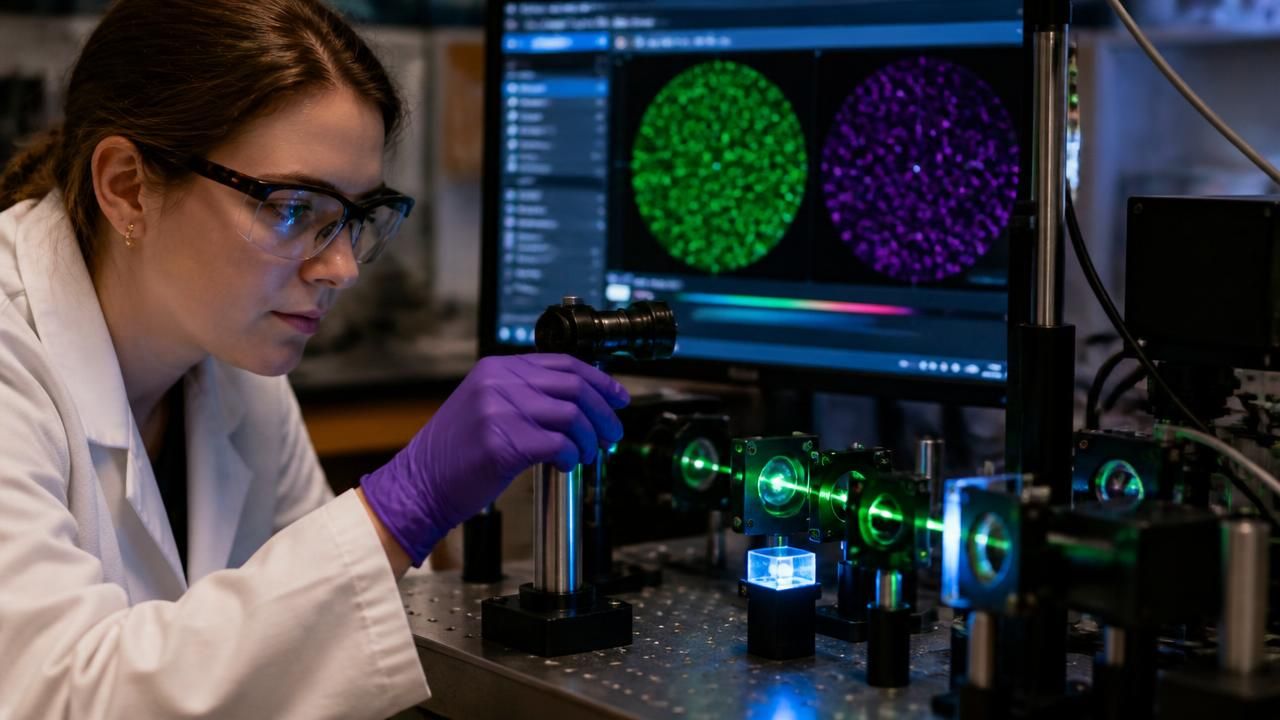
The proposed method borrows a trick from display technology. The polarized glasses handed out in 3D cinemas work because each lens admits light of a different circular polarization — clockwise in one eye, counterclockwise in the other — so two images arrive separately and the brain fuses them into depth.
Circularly polarized light is also emitted, faintly, by many fluorescent molecules, and the handedness of that emission is exquisitely sensitive to the chiral environment around the molecule. Certain fluorescent probes bind to biomolecules and then glow with a measurable preference for left- or right-circular polarization. Ordinary, Earth-standard biology produces one signature; its mirror counterpart should produce the opposite one.
According to the researchers, that difference could let laboratories distinguish ordinary organisms from mirror-image ones using optical instruments rather than the far slower and more laborious process of full genomic or chemical characterization. In practical terms, a detection method of this kind could serve as a routine screening tool — a way to verify that a culture is what it claims to be, or to confirm that a containment breach has not occurred.
Caveats worth keeping in view
- The approach appears designed for detection, not for assessing risk. Knowing an organism is mirrored says nothing directly about how dangerous it is.
- Chiral fluorescent probes are sensitive to their chemical surroundings, so environmental samples — soil, water, complex mixtures — could complicate interpretation.
- No mirror organism has been built, which means the method cannot yet be tested against a real target, only against synthesized mirror biomolecules and model systems.
- Detection only helps if someone is looking. A screening tool does little without a governance framework that requires its use.
A field arguing with itself
The detection proposal lands in the middle of an unusually public dispute. In December 2024, a group of several dozen researchers — including prominent synthetic biologists and Nobel laureates — published a policy forum in the journal Science calling for a broad moratorium on efforts to create mirror bacteria, warning that the technology could pose "unprecedented and irreversible" risks. The signatories did not call for a halt to all mirror-molecule research, but drew a line at mirror cells and mirror organisms.
Opponents of a pause argue that the risks are speculative, that mirror biology could yield valuable insights into the origins of homochirality and novel therapeutics, and that moratoriums historically struggle to bind the actors most likely to ignore them. Supporters counter that the field is at the design stage — a rare moment when a global norm can be set before commercial and geopolitical incentives harden.
How the outlets framed it
Coverage varied in emphasis. Science Daily foregrounded the technical mechanism and the safety rationale, presenting the method as a way to "detect dangerous mirror life" before it exists. Mirage News used nearly identical framing in its headline, echoing the institutional release. MSN's aggregation carried the same core claim to a general audience, while Around Prague's version posed the question more openly — "Could light reveal mirror-image life before anyone builds it?" — a subtle shift from a tool that detects risk to a tool that might make the debate more tractable.
The divergence is telling. A story about an optical technique and a story about whether humanity should build a parallel biosphere are not the same story, even when they share a press release. The detection method matters most if mirror-life research proceeds; if the moratorium takes hold, it becomes a monitoring instrument for a field that promises not to need one.
What comes next
The immediate questions are practical. Can the technique be validated against mirror proteins and mirror membranes assembled from synthetic chemistry? Can it be made portable and cheap enough for routine biosafety use? And will any regulatory body — a national biosafety authority, a journal, a funder — require it?
Those questions will be answered faster than the larger one. Whether mirror life should ever be built remains a debate about scientific ambition and precaution, and no optical instrument, however elegant, can settle it.