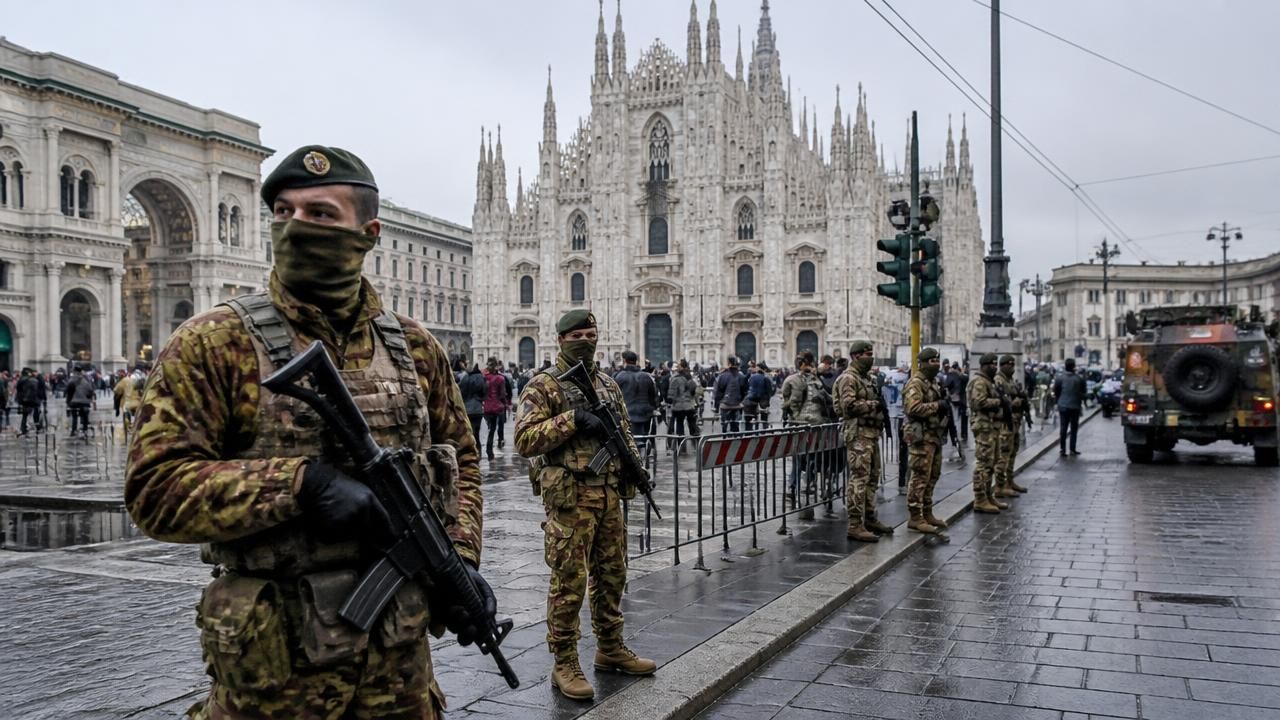
Hundreds of soldiers took up positions in the heart of Milan on Saturday as Italy's government moved to restore order after days of protests and looting, while thousands of demonstrators marched through cities across the continent in a coordinated show of dissent that stretched from Rome and Madrid to Lisbon and Tirana.
The deployment turned Italy's financial capital into the most heavily fortified city in Western Europe over the weekend, with armored vehicles and military patrols visible in the Piazza del Duomo and around the commercial district. It marked one of the most visible domestic security operations in Italy in years and signaled that the government of Prime Minister Giorgia Meloni intends to draw a hard line against unrest that has spilled beyond peaceful assembly.
A garrison in the center of Milan
Reports of the scale of the deployment differed sharply between outlets. The Guardian reported that Italy would send 500 troops to Milan following days of protests and looting, framing the move as a calibrated reinforcement of police ranks. NDTV, by contrast, put the figure at more than 5,000 soldiers guarding the city — a tenfold discrepancy that officials did not immediately clarify. The true number is likely somewhere between the two, reflecting the difference between combat troops deployed to fixed positions and the broader security apparatus, including carabinieri and riot police, mobilized around them.
The Italian defense ministry has not published a detailed breakdown of the operation, and the gap in reporting underscores how quickly the story has been shaped by official briefings and local estimates rather than transparent disclosure. What is not in dispute is the visual impact: soldiers in full kit standing watch over luxury shopping streets that had, in recent nights, been the scene of break-ins, smashed windows and running clashes between youths and police.
From Milan to Tirana: a continent in motion
NPR reported that while protests in France have claimed most international attention, large demonstrations also rocked many European cities on Saturday — from Milan to Rome to Madrid, Lisbon and Tirana. MSN characterized the Italian scenes more bluntly, describing thousands taking to the streets as protests turned violent in several cities.
The geography matters. The marches were not confined to a single capital or a single cause. They were dispersed, simultaneous and largely decentralized — the signature of a protest wave that organizers coordinate loosely through social media rather than through a single political party or trade union. That structure makes the demonstrations harder to negotiate with and harder to police, and it helps explain why governments have reached for visible, uniformed deterrence rather than dialogue.
France draws the world's gaze
The New York Times led its coverage on France, reporting that hundreds of thousands marched amid heavy security. Paris has become the reference point for the weekend's unrest — the place where the scale of mobilization is measured in six figures and where the interior ministry's troop counts are parsed like economic data.
NBC News and HuffPost both framed the story through the lens of Milan, emphasizing the soldiers guarding the city center while noting that protesters were marching across European cities simultaneously. The same events produced two distinct narratives: an Italian security crisis in some newsrooms, a pan-European mobilization in others. Readers of any single outlet would have come away with a materially different understanding of what happened.
The deployment of soldiers to a European city center on a weekend of continent-wide protest is a measure of how far governments are willing to go to keep the streets open — and how much they fear what happens when they are not.
A familiar Italian playbook
Italy is not new to soldiers on its streets. The Strade Sicure ("Safe Streets") operation, launched in 2008, has for years stationed thousands of troops at train stations, monuments and diplomatic sites across the country, ostensibly to deter terrorism and assist police. Successive governments of left and right have extended it, and it has become a permanent, if costly, feature of Italian public life.
Using that existing framework to respond to civil unrest is a subtle but significant escalation. Troops trained for external defense are now performing a public-order function in a city of 1.4 million people, raising questions about rules of engagement, legal liability and the militarization of urban space. Civil-liberties groups have long argued that the presence of armed soldiers chills assembly and normalizes the idea that protest is a security threat rather than a political act.
Why it matters beyond Italy
Three implications stand out. First, the numbers gap between 500 and 5,000 soldiers is itself a story about information: in a fast-moving security event, governments control the facts and newsrooms are left to triangulate. Second, the fact that unrest in Milan, looting in several Italian cities and mass marches in France are being covered as separate stories obscures a shared regional dynamic — rising costs, strained public services and diminished confidence in institutions that cross borders.
Third, the precedent travels. If a weekend of unrest can be met with hundreds of troops in Milan and heavy security in Paris, other capitals will be watching the results closely. Whether the show of force restores calm or inflames the next round of demonstrations is the question that will define the coming weeks.
- Milan: Hundreds to thousands of soldiers deployed to the city center after nights of looting.
- Italy: Violence reported in several cities; Rome among those where crowds marched.
- Elsewhere: Demonstrations in Madrid, Lisbon and Tirana on the same day.
- France: Hundreds of thousands marched under heavy security, dominating international coverage.
For now, the piazzas are quieter and the barricades are down. But the soldiers remain, and so does the discontent that brought them there.