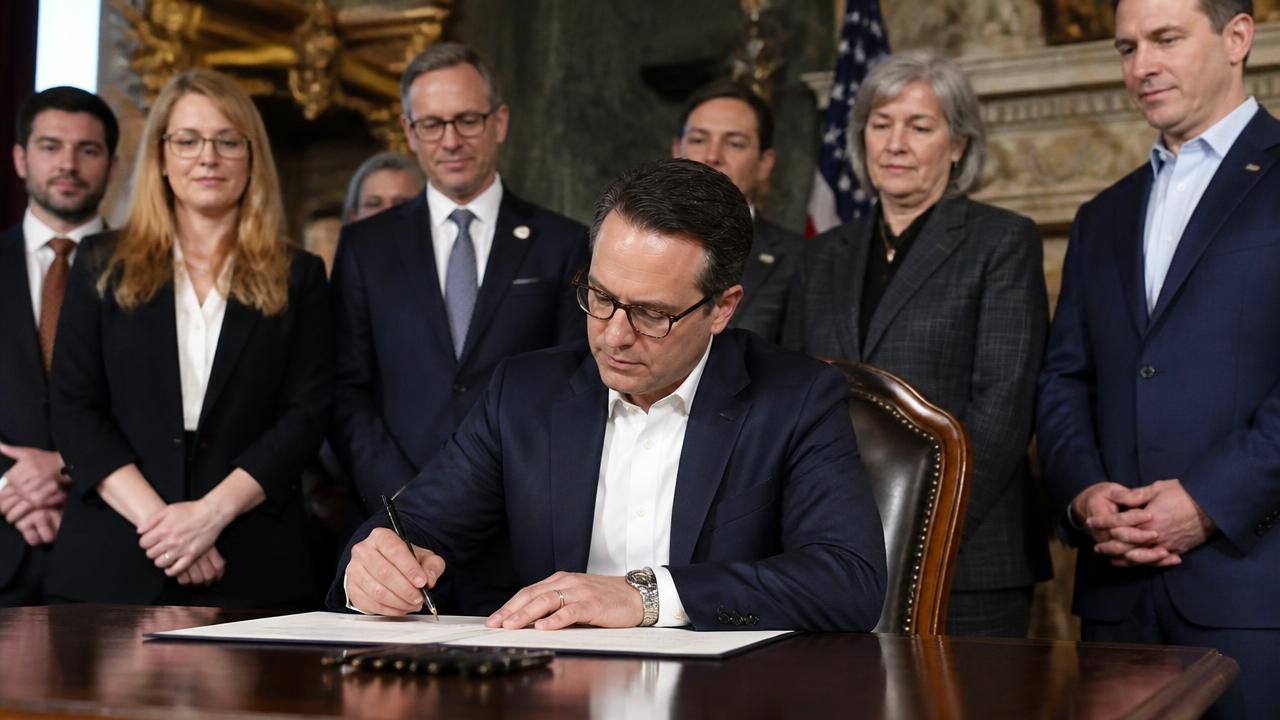
Pennsylvania Gov. Josh Shapiro signed the Artificial Intelligence Deceptive Advertising Act into law on Thursday, making the commonwealth one of the first states to require clear labels on advertisements that have been significantly generated or modified by artificial intelligence. The measure, reported by The Verge and carried in abbreviated form by MSN and other outlets, applies to still images, video, audio and text, and it reaches both national TV commercials and local businesses’ crowded flyers.
Under the law, any ad that
“has been significantly modified or generated by artificial intelligence”must include a disclosure in the same format as the ad itself. A text ad needs a textual label; an audio spot needs an audio disclosure; a video needs an on-screen or spoken notice. The requirement is designed to travel with the ad’s medium rather than sit in fine print somewhere else. The Verge noted that the law is unusual in its breadth: it covers multi-billion-dollar advertisers and small restaurants promoting wing specials, and it applies to TV commercials as well as printed or digital flyers.
The law’s name signals its focus: deceptive advertising. It does not ban AI-generated ads; it requires that viewers, listeners and readers be told when synthetic tools have been used in a significant way. That distinction matters. Pennsylvania is not trying to outlaw the technology outright, but to attach a warning label to commercial speech that might otherwise blur the line between human-made and machine-made persuasion.
A first-of-its-kind disclosure regime
The Verge framed the signing as a first-in-the-nation moment for AI advertising rules, noting that Pennsylvania is one of the first states to require disclosures on AI content. The law applies whether the ad is a still image, video, audio or text, and the label must match the format of the ad. In practice, that means advertisers cannot bury an AI disclosure in a website’s terms of service or a television commercial’s closing credits if the ad itself is synthetic.
The scope is deliberately broad. It covers political advertising, corporate branding, product promotions and small-business pitches. The Verge highlighted the contrast between multi-billion-dollar companies’ TV commercials and restaurants’ ugly, crowded flyers about wing specials — both would fall under the same disclosure principle if AI significantly modified or generated the ad. That breadth is likely to make Pennsylvania a test case for how far state disclosure laws can reach into everyday commercial speech.
Campaign deepfakes raise the stakes
The timing is not accidental. AI-generated campaign ads are proliferating ahead of the 2026 midterms, and state lawmakers are under pressure to respond to deepfakes, cloned voices and synthetic imagery that can spread faster than fact-checkers can work. Fox43 reported that AI-generated campaign ads have drawn backlash and renewed pushes for bans, in a political environment that has referenced both Shapiro and Pennsylvania Treasurer Stacy Garrity. The Morning Call framed the issue more skeptically, reporting that AI ads are popular in the 2026 midterms but that state laws have not stopped a lack of disclosure.
Those two frames — backlash and inadequate enforcement — capture the central tension. Disclosure laws are easier to pass than to police. They depend on advertisers’ honesty, platforms’ willingness to enforce labels and regulators’ capacity to investigate complaints. They also depend on a shared definition of what counts as significantly modified. A campaign that uses AI to clean up audio may argue it did not generate a synthetic candidate. A restaurant that uses AI to resize an image may argue the change was not significant. The word significantly is likely to be contested in court and in advertising review.
Industry and legal patchwork
The ad industry is watching closely. Marketing Dive reported that the Interactive Advertising Bureau is revisiting AI disclosure guidance as legal requirements multiply. That suggests Pennsylvania is part of a broader patchwork that advertisers fear could produce inconsistent rules across states. National brands prefer one standard; political campaigns prefer clear lines; civil liberties groups worry about compelled speech; and consumer advocates argue that labels are the minimum needed to preserve trust.
Pennsylvania’s law does not resolve those debates, but it shifts them from theory to compliance. Advertisers will need to document how AI was used, decide when a modification is significant and ensure that the label appears in the same medium as the ad. For a television commercial, that could mean an on-screen notice or a spoken disclosure. For a flyer, it could mean a line of text. For a radio spot, it could mean an audio tag. The law’s format-matching requirement is meant to prevent disclosures from being hidden in places consumers never look.
Can detection keep up?
A central question is verification. Northcentral PA asked whether an AI detector could help verify what is real. In practice, AI detectors are probabilistic tools, not truth machines. They can flag likely synthetic text or images, but they produce false positives and false negatives, and they struggle with edited, compressed or adversarially altered content. Metadata can be stripped. Watermarks can be removed. A determined bad actor can evade detection, while a small business using a legitimate AI tool may struggle to prove compliance.
That does not make disclosure laws useless. It means they are one layer in a broader accountability system that includes platform policies, advertiser certifications, public complaints and traditional fact-checking. Pennsylvania’s law gives regulators and consumers a formal hook: if an ad looks synthetic and lacks a label, there is now a legal standard to cite. But the law’s effectiveness will depend on enforcement resources and on whether courts accept the state’s definitions.
What happens next
The immediate impact will be felt by advertisers running campaigns in Pennsylvania. Political committees will need to review synthetic imagery and audio in the 2026 midterms. National brands will need to adapt their disclosure workflows to a state-specific rule. Small businesses will need plain-language guidance on when an AI-generated flyer requires a label. Platforms may face pressure to add their own labels or risk hosting noncompliant ads.
The bigger story is federal inertia. With no comprehensive national AI advertising standard, states are stepping into the gap. Pennsylvania’s law is one of the first, but it is unlikely to be the last. As more states follow, the question will shift from whether AI ads should be labeled to how those labels can be made consistent, verifiable and meaningful. For now, Pennsylvania has sent a clear signal: in the commonwealth, synthetic persuasion must disclose itself.