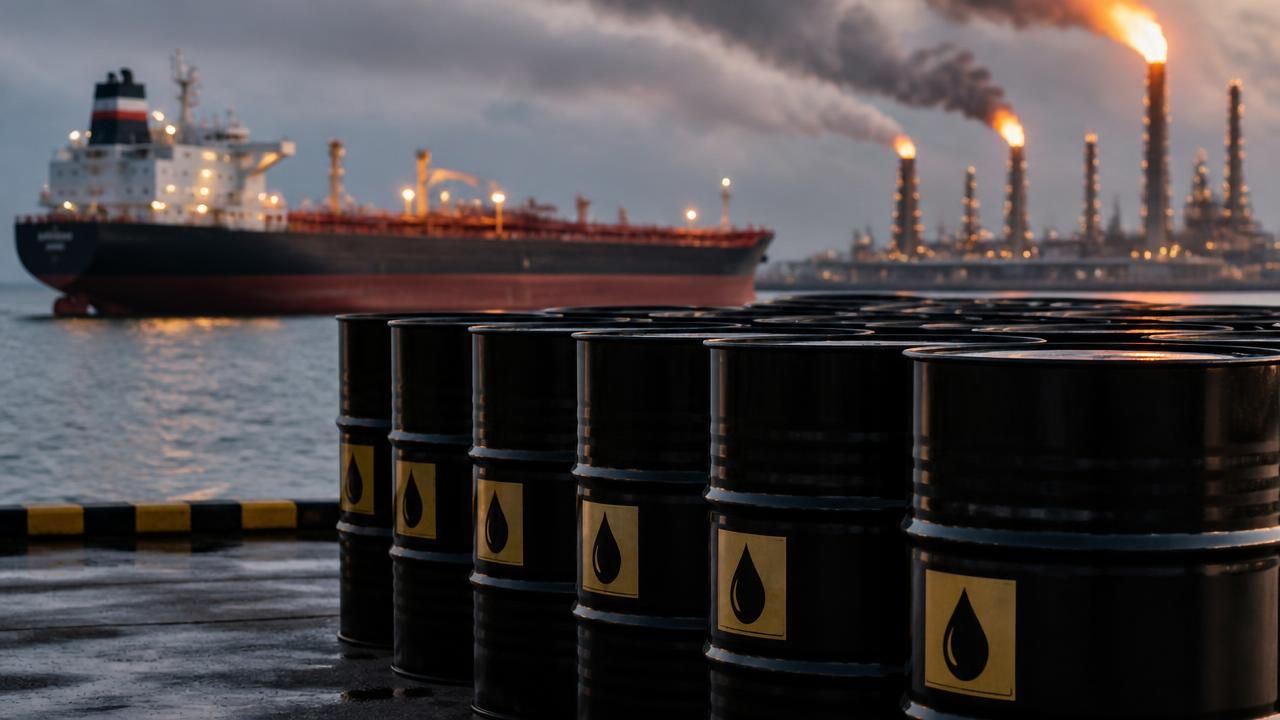
Crude oil touched $110 a barrel for the first time since May on Monday, as a fresh round of Middle East security threats collided with a startling policy pivot in Washington: the prospect of the United States importing millions of tons of Russian diesel while simultaneously threatening to choke off its own fuel exports.
The two developments, reported across financial and general-interest outlets over the weekend and into Monday's session, mark one of the sharpest reversals in global energy policy since the West imposed a price cap on Russian crude in late 2022. They also set off alarms in allied capitals, where officials are now weighing releases from emergency distillate stockpiles to prevent a winter supply crunch.
What Happened
Traders pushed front-month crude benchmarks to $110 during Asian and European hours, extending a rally that has been building for weeks on renewed attacks against shipping in the Red Sea, hardening rhetoric over Iran's nuclear program, and persistent fears that Russian refinery outages could knock out a meaningful share of global diesel supply.
Diesel is the pressure point. Russia was, before the war, among the world's largest seaborne exporters of the fuel, shipping close to a million barrels a day to markets in Europe, Turkey, Brazil and Africa. The United States is the other pillar of the trade, exporting well over a million barrels a day of refined product — making Washington's threat to restrict those flows a genuinely global event rather than a domestic one.
According to reports citing the aftermath of direct talks between President Donald Trump and President Vladimir Putin, the U.S. is preparing to authorize the import of millions of tons of Russian diesel to relieve domestic fuel prices. The arrangement would effectively require sanctions waivers for refined products, a step that would unwind a core element of the allied sanctions architecture.
The Export-Ban Paradox
The second prong of the policy is stranger still. The White House has signaled it may restrict U.S. diesel exports to hold down domestic prices — a measure that would immediately tighten an already fragile Atlantic Basin market.
The New York Times framed the threat bluntly in its headline:
"Trump's Threat to Ban Diesel Exports Sets Off Global Alarms" — The New York Times
The Sun, reporting from a European vantage point, described the response from G7 finance and energy chiefs:
"Emergency stockpiles of diesel to be released by G7 chiefs after Trump US export ban threat" — The Sun
The mechanics explain the alarm. A U.S. export ban would likely soften pump prices at home in the near term, but it would strip supply from Europe and Latin America, where inventories are already below five-year averages. Allied governments would be forced to draw on strategic distillate reserves — a finite buffer that cannot be replenished quickly if a genuine shortage develops.
Markets and the Analyst View
Bloomberg's weekend broadcast captured the mood of a market that has stopped treating energy as a backwater and started treating it as the defining macro variable of the quarter. Strategists appearing on the program noted that every incremental dollar on crude feeds directly into headline inflation, complicating any path toward rate cuts and squeezing the consumer-facing sectors that had led equity gains earlier in the year.
Geopolitical risk consultants made a parallel point: the episode demonstrates how quickly sanctions policy can be reversed when domestic political pressure — in this case, fuel prices ahead of a midterm cycle — collides with alliance management. What was framed for three years as a moral and strategic consensus is now being renegotiated in real time.
- Crude: Front-month benchmark at $110, the highest since May, with Brent and WTI both extending gains.
- Diesel: Crack spreads widening on both sides of the Atlantic as traders price in the possibility of lost U.S. barrels.
- Policy: Russian diesel imports would require sanctions relief; a U.S. export ban would require invoking emergency authorities.
- Response: G7 members preparing coordinated releases from emergency distillate stockpiles.
How the Coverage Differed
The story looks different depending on where it is read. Financial outlets led with the price print and the trading implications, treating the Russia arrangement as a supply-side detail. General-interest and European outlets led with the political shock — an American president negotiating fuel supply with Moscow while threatening to cut off allies who have spent three years reorienting their energy systems away from Russia. The framing gap is itself a signal: the same headline is a trading event in New York and a strategic rupture in Brussels.
What to Watch
Three questions will determine whether this becomes a short-lived spike or a durable repricing of energy risk. First, whether the Russian diesel arrangement is formalized with waivers or remains a headline commitment. Second, whether the export ban is actually invoked or used as leverage to extract concessions. Third, how large the G7 stockpile releases prove to be — and what happens when they run out.
For now, the market has rendered its verdict: a barrel of crude costs more than it has in six months, and the world's two largest diesel suppliers are both moving in unpredictable directions at once.