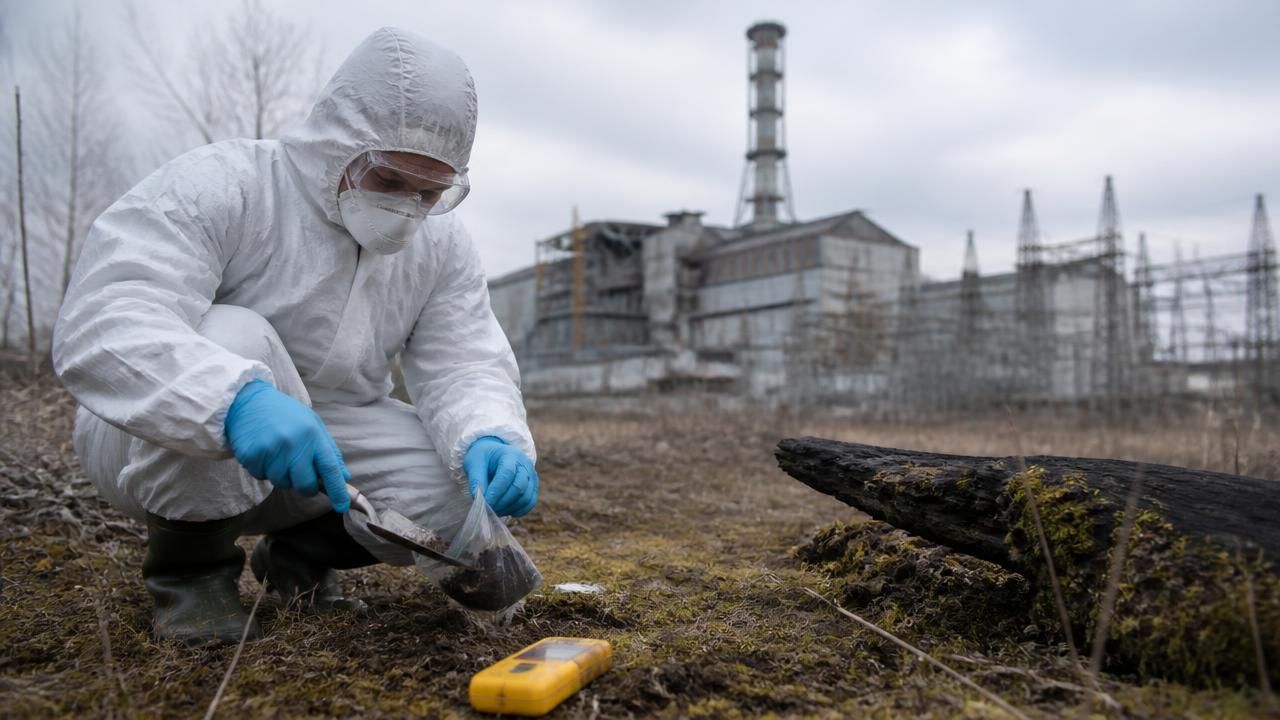
Four decades after the April 1986 explosion at the Chornobyl nuclear power plant, scientists are finding that the story of the accident’s radioactive legacy is more complicated than once assumed. Tiny radioactive particles that settled into the soil around the plant have remained surprisingly stable, according to new research described by Science Daily and SciTechDaily, with some microscopic nuclear fuel fragments still largely intact after 40 years.
The finding, reported under headlines that range from “not what scientists expected” to “the danger still lurking,” does not mean the Chornobyl exclusion zone is safe. Rather, it suggests that the long-term environmental behavior of the fallout is shaped by the physical and chemical durability of individual particles—some of which appear to be trapping radioactive substances inside their structure instead of releasing them into the surrounding environment.
What the new research found
Using powerful X-rays, scientists examined radioactive particles that persist in Chornobyl’s soil. The techniques allowed them to probe the particles at microscopic scales and assess how their radioactive contents are bound within their structure. According to Science Daily, some of these particles have remained “surprisingly stable,” holding radioactive substances inside rather than letting them escape into soil or water.
Other coverage framed the same result in starker terms. MSN headlines emphasized that radioactive fragments have “barely changed” and that microscopic nuclear fuel particles from Chornobyl are “still intact after 40 years.” SciTechDaily’s headline similarly stressed that the debris is “defying scientists’ expectations.” The common thread is persistence: particles that many expected to weather, dissolve, or release their radioactive payload more readily appear to be enduring in the environment.
That does not make them benign. The particles are still radioactive, still part of the contaminated landscape, and still capable of posing risks if disturbed, inhaled, or incorporated into food chains. But their durability changes how scientists think about the timing and pathways of contamination.
The discovery does not mean the exclusion zone is safe. It means the hazard is more complicated than a simple countdown to radioactive decay.
Why microscopic fuel particles matter
Chornobyl’s fallout was not a uniform cloud of dissolved radioactivity. The explosion and fire sent a mixture of gases, aerosols, and solid fragments into the environment. Among the most important are so-called hot particles: microscopic pieces of nuclear fuel or reactor material that carry concentrated radioactivity. The new findings focus attention on these particles because their behavior can differ sharply from that of soluble radioactive compounds.
If radionuclides are locked inside a durable particle, they may leach more slowly into groundwater or be less readily taken up by plants. That could, in principle, reduce short-term exposure pathways in some areas. But persistence cuts both ways. A particle that remains intact can keep a concentrated source of radiation in place for decades, and its eventual breakdown—through weathering, erosion, fire, or human activity—could release radioactivity in ways that are difficult to predict.
The research therefore adds nuance to a central question in Chornobyl science: how much of the contamination is mobile, and how much is locked in place? The answer appears to vary particle by particle, which complicates broad assumptions about environmental recovery.
How scientists studied the particles
The studies used powerful X-ray techniques to examine the structure and chemical state of individual radioactive particles. X-rays can reveal how atoms are arranged and bonded inside a material, helping scientists understand whether radioactive elements are trapped in a stable matrix or are vulnerable to release. In this case, the particles’ stability suggests that some radioactive material has been incorporated into resistant structures that have survived four decades of environmental exposure.
That is significant because scientists have long expected Chornobyl’s fuel particles to alter over time. Freeze-thaw cycles, moisture, soil chemistry, and microbial activity can all degrade materials. The fact that some particles have barely changed implies that their resistance was underestimated, or that the conditions in the soil have been less aggressive than models assumed.
Still, the research does not suggest that all Chornobyl particles are equally stable. The environment around the plant is highly heterogeneous, with varying soil chemistry, moisture, and radiation levels. Some particles may remain intact while others have already weathered or dissolved. The new work points to the need for particle-specific risk assessments rather than treating contamination as a single, uniform pool.
Different headlines, same tension
The coverage illustrates how the same scientific result can be framed in different ways. Science Daily and SciTechDaily emphasize surprise and scientific revision: the particles are not behaving as expected. The MSN headlines foreground danger and persistence: radioactive fragments are still there, barely changed, still intact. Both frames are accurate, and together they capture the central tension.
For the public, the story may sound contradictory: radioactive material is both more stable than expected and still dangerous. For scientists, that is not a contradiction. Stability can limit the spread of contamination while preserving a concentrated hazard. The key issue is not whether the particles are harmless—they are not—but how their durability affects long-term risk, remediation, and monitoring.
Implications for cleanup and safety
The findings have implications for the Chornobyl exclusion zone, where radiation levels remain uneven and cleanup is a decades-long challenge. If radioactive particles are more resistant to leaching than assumed, some contamination may stay closer to where it was deposited. That could affect decisions about soil removal, land use, and monitoring. It could also influence how scientists model the movement of radioactivity toward rivers, groundwater, and surrounding ecosystems.
At the same time, persistent particles could complicate cleanup. Removing contaminated soil might be less effective if the hazard is concentrated in tiny fragments that are difficult to detect and separate. Leaving them in place might reduce immediate disturbance, but it would not eliminate the long-term risk. Wildfires, construction, erosion, and other disturbances could remobilize particles, making continued monitoring essential.
The research also underscores a broader lesson from Chornobyl: environmental recovery is not a straightforward process of radioactive decay. It depends on chemistry, particle physics, ecology, and human activity. Four decades after the accident, scientists are still learning how the fallout behaves—and why some of its most dangerous remnants have proved unexpectedly stubborn.