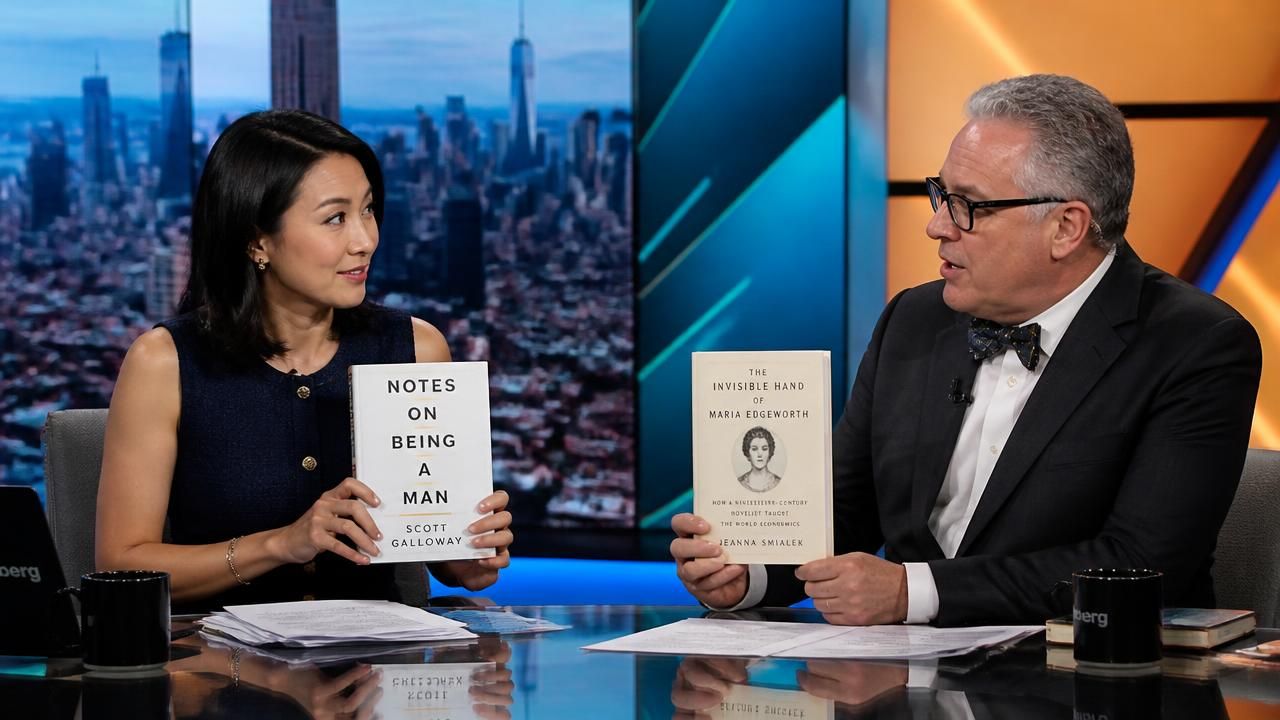
On the latest edition of Bloomberg Money, hosts Scarlet Fu and Tom Keene set aside the day's market tape for a segment that has become a quiet fixture of the program: the must-read book of the week. This time the pair brought two titles to the table, and the contrast between them says as much about the current state of business publishing as it does about the books themselves.
The first is Notes on Being a Man by Scott Galloway, the NYU marketing professor and serial entrepreneur whose plainspoken commentaries on work, wealth and masculinity have made him one of the most widely circulated business essayists of the past decade. The second is The Invisible Hand of Maria Edgeworth: How a Nineteenth-Century Novelist Taught the World Economics by Jeanna Smialek, a study of an Anglo-Irish writer whose novels and educational tracts helped popularise economic thinking well before the discipline had a name.
Two Books, Two Centuries
The pairing is not as arbitrary as it first appears. Galloway's volume belongs to a flourishing genre of confessional, advice-driven non-fiction written by financiers and entrepreneurs — books that use personal narrative to argue about how markets, families and institutions should be organised. Smialek's subject sits at the opposite end of the shelf: a work of intellectual history that recovers a novelist's role in shaping how ordinary readers came to understand supply, demand, rent and labour.
Bloomberg's description of the segment: Fu and Keene discuss their must-read book of the week — 'Notes on Being a Man' by Scott Galloway and 'The Invisible Hand of Maria Edgeworth: How a Nineteenth-Century Novelist Taught the World Economics' by Jeanna Smialek.
Maria Edgeworth (1768–1849) is best remembered today for Castle Rackrent and The Absentee, novels that dissected Irish landlordism with a precision that anticipates the social problem novel. But her Practical Education, written with her father Richard Lovell Edgeworth, and her moral tales were read across Britain and Europe by households that would never have opened a treatise on political economy. The argument at the heart of Smialek's book is that fiction functioned as the discipline's early delivery mechanism — that the ideas later formalised by Smith, Ricardo and Mill travelled first through story.
Galloway's territory is more immediate and more contested. Notes on Being a Man arrives amid a sustained public argument over male disengagement from education and the labour force, over loneliness, and over the meaning of mentorship in an economy that rewards credentialism. That such a book now shares airtime with a scholarly recovery of a Regency-era novelist is itself a data point: finance journalism has widened its aperture well beyond the earnings call.
Why Business Media Wants Book Critics
The shift is structural. Podcasts and long-form broadcast segments have given financial journalists room to treat reading as part of the job rather than a hobby, and audiences appear to reward it. A book segment produces something a ticket-level market update cannot — a durable idea, a conversation that survives the weekend. It also positions the hosts as generalists in a medium that increasingly rewards specialisation, and it gives Bloomberg a bridge to the publishing and education economies it covers.
The same impulse is visible across the wider news ecosystem. Wikinews, the citizen-journalism arm of the Wikimedia movement, has for years built its output around long-form interviews with creative figures rather than wire copy — a Q&A with Finnish folk-metal outfit Kivimetsän Druidi, a conversation with the playwright and actor Eric Bogosian about the creative urge, and an interview with the indie songwriter John Vanderslice on the occasion of a New York City show. None of these are finance stories, yet they occupy the same format: the extended conversation, lightly edited, in which the subject's own words do the work. Wikinews has also turned the same format on itself, producing an annual overview of the news year — the 2008 instalment, for instance, includes the exposure of the Austrian cellar case in which a man had imprisoned his daughter for 24 years — and on popular culture, sending contributors to ComicCon in Bangalore as the convention circuit expanded across India.
The Economics of Attention
What links a Regency novelist, a marketing professor and a folk-metal band is the economics of attention. Financial media is competing for a finite pool of reader and listener time against entertainment, sport and streaming. Book programming is one answer: it is cheap to produce, generates evergreen archive material, and flatters the audience's self-image as serious people.
- For readers: a curated shortlist functions as a proxy for taste, and a trusted anchor's recommendation carries weight that a retailer's algorithm cannot easily replicate.
- For publishers: a single broadcast mention can move a title into a second printing, making business-news slots a genuine marketing channel.
- For the discipline: recovering figures such as Edgeworth broadens economics' origin story, complicating the assumption that the field began with formal theory rather than with narrative.
- For the hosts: the segment builds a persona — Keene and Fu as readers rather than merely tape-watchers — that differentiates the programme in a crowded market.
There are limits. A recommendation segment is not criticism; it rarely has room for a negative verdict, and the books chosen tend to flatter the audience rather than challenge it. Nor does the format travel evenly — much of the interview journalism produced outside legacy newsrooms, including Wikinews' contributions, reaches comparatively small audiences despite its depth, and several items in the current cycle arrived in truncated or placeholder form, a reminder of how unevenly the open-journalism model is resourced.
Still, the pairing on this week's Bloomberg Money makes an argument worth taking seriously: that the way a society talks about money is shaped less by equations than by stories, and that the people who write those stories — novelists, essayists, even visiting musicians — are part of the financial conversation whether or not they own a Bloomberg terminal.