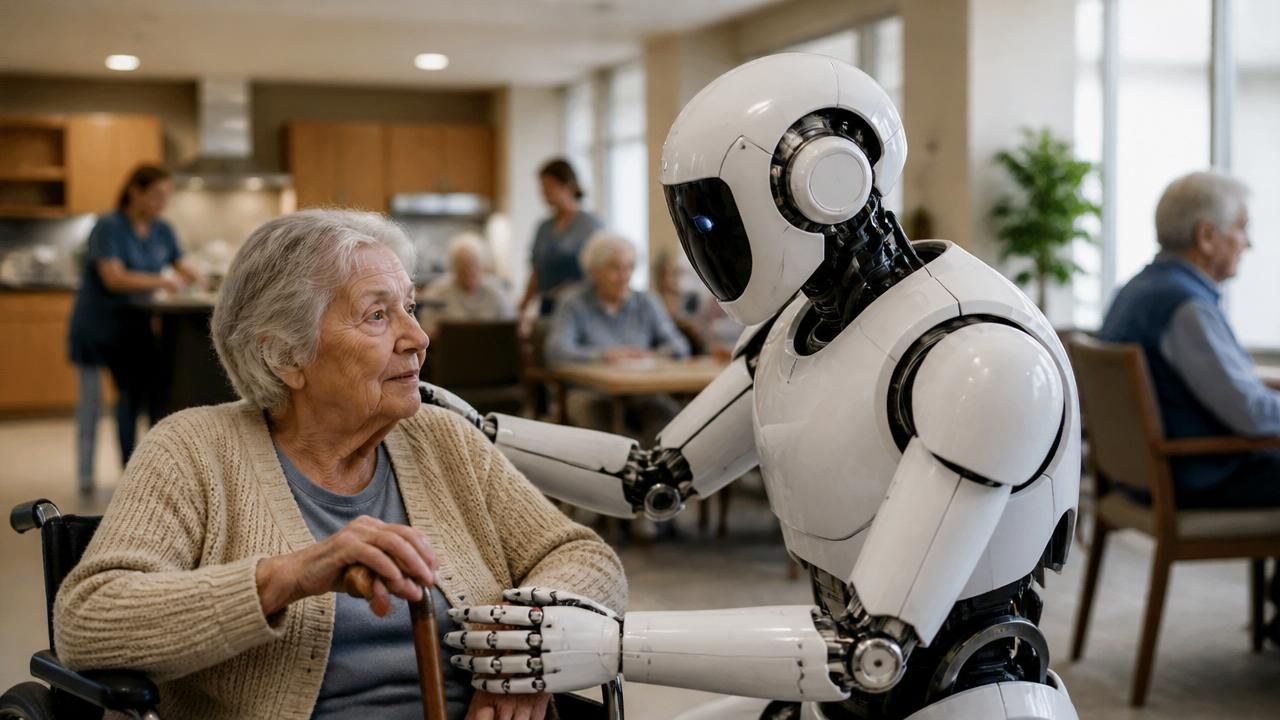
As the United States grapples with the dual pressures of a rapidly aging population and the rise of artificial intelligence, a leading economist warns that the two trends are not a simple trade-off. Martha Gimbel, executive director and cofounder of the Budget Lab at Yale University, argues that AI, while promising, is unlikely to fully offset the economic challenges posed by demographic shifts. Her comments, reported by Bloomberg Markets, come amid a broader global conversation about AI's role in addressing societal challenges—from healthcare to climate change—where optimism often clashes with practical limitations.
The Demographic Challenge
The U.S. population is aging at an unprecedented rate. By 2030, all baby boomers will be over 65, and by 2035, older adults will outnumber children for the first time in history. This shift strains social security systems, healthcare infrastructure, and labor markets. Gimbel emphasizes that the U.S. is confronting two major transitions simultaneously: an aging population and the integration of AI into the economy. Rather than one solving the other, she suggests they are intersecting forces that require careful navigation.
“AI could improve productivity in some areas, particularly by helping caregivers with physically demanding tasks,” Gimbel told Bloomberg. “But there's a real question about whether consumers will embrace automation in roles where human interaction remains essential.”
Her skepticism echoes broader debates about AI's capacity to replace human labor in caregiving, a sector already facing severe shortages. While AI-powered tools can assist with lifting patients or monitoring vitals, the emotional and relational aspects of care remain deeply human.
AI in Healthcare: Real-World Implementations
Despite these concerns, AI is making inroads in healthcare. A recent study published in Nature Medicine details the nationwide real-world implementation of AI for cancer detection in population-based mammography screening. The research highlights how AI can improve diagnostic accuracy and efficiency, potentially reducing radiologist workloads. Similarly, a roadmap in npj Digital Medicine explores the promise and challenges of “agentic AI” in psychiatric care, envisioning systems that can autonomously support mental health treatment—though authors caution about ethical and safety risks.
The Australian Journal of General Practice's Horizon Scan 2035 predicts that digital health, including AI, will fundamentally reshape general practice, enabling personalized medicine and remote monitoring. Yet it also warns of digital divides and the need for robust regulation.
Contrasting Perspectives
While these medical applications show promise, they also underscore Gimbel's point: AI may augment, but not replace, the human touch. In psychiatric care, for instance, patient trust and therapeutic alliance are critical, and over-reliance on AI could backfire.
AI and Climate Change: A Race Against Time
Beyond healthcare, AI is being deployed in the fight against climate change. Siemens, a global industrial conglomerate, has championed AI-driven solutions for energy efficiency, grid management, and carbon capture. In a recent report titled AI & the Race Against Climate Change, the company argues that AI can optimize renewable energy systems and reduce emissions across industries. However, critics note that AI itself has a significant carbon footprint, and its net impact on the climate remains uncertain.
India's Ambition: AI for Socio-Economic Development
On the global stage, India has positioned itself as the “AI Use Case Capital of the World,” aiming to leverage AI for socio-economic development. A critical analysis on TechPolicy.Press, however, argues that this narrative often serves as hype, masking deep structural inequalities. The article questions whether AI-driven solutions can truly address poverty, education, and healthcare in a country where digital infrastructure remains uneven. This tension between aspiration and reality mirrors Gimbel's caution about AI's limitations in the U.S. context.
Historical Context and Data Points
The current debate is not new. Throughout history, technological revolutions—from the steam engine to the internet—have been hailed as panaceas for societal ills, only to fall short of expectations. A 2023 Pew Research Center survey found that 52% of Americans are more concerned than excited about AI in daily life, with older adults particularly wary. Meanwhile, the U.S. Bureau of Labor Statistics projects that healthcare and social assistance will add 2.6 million jobs by 2032, many of which involve direct human interaction—jobs that AI may assist but not eliminate.
Expert Views and Implications
Gimbel's perspective aligns with a growing chorus of economists who argue that AI's productivity gains may be unevenly distributed. For example, while AI can automate routine tasks, it may exacerbate income inequality if benefits accrue primarily to capital owners. In the context of an aging population, this could mean that the economic burden falls disproportionately on younger workers and those in caregiving roles.
“We need to think about AI as a tool, not a savior,” Gimbel concluded. “It can help, but it won't solve the fundamental challenges of an aging society—like funding Social Security and Medicare, or ensuring that care is both high-quality and compassionate.”
Conclusion
As the U.S. and other nations navigate the intersection of demographic change and AI, the conversation must move beyond hype. Real-world implementations in healthcare, climate, and development offer glimpses of potential, but they also reveal persistent gaps. The promise of AI will be realized not through technology alone, but through thoughtful policy, robust regulation, and a clear-eyed recognition of what machines can and cannot do. For now, the aging population remains a challenge that no algorithm can fully solve.