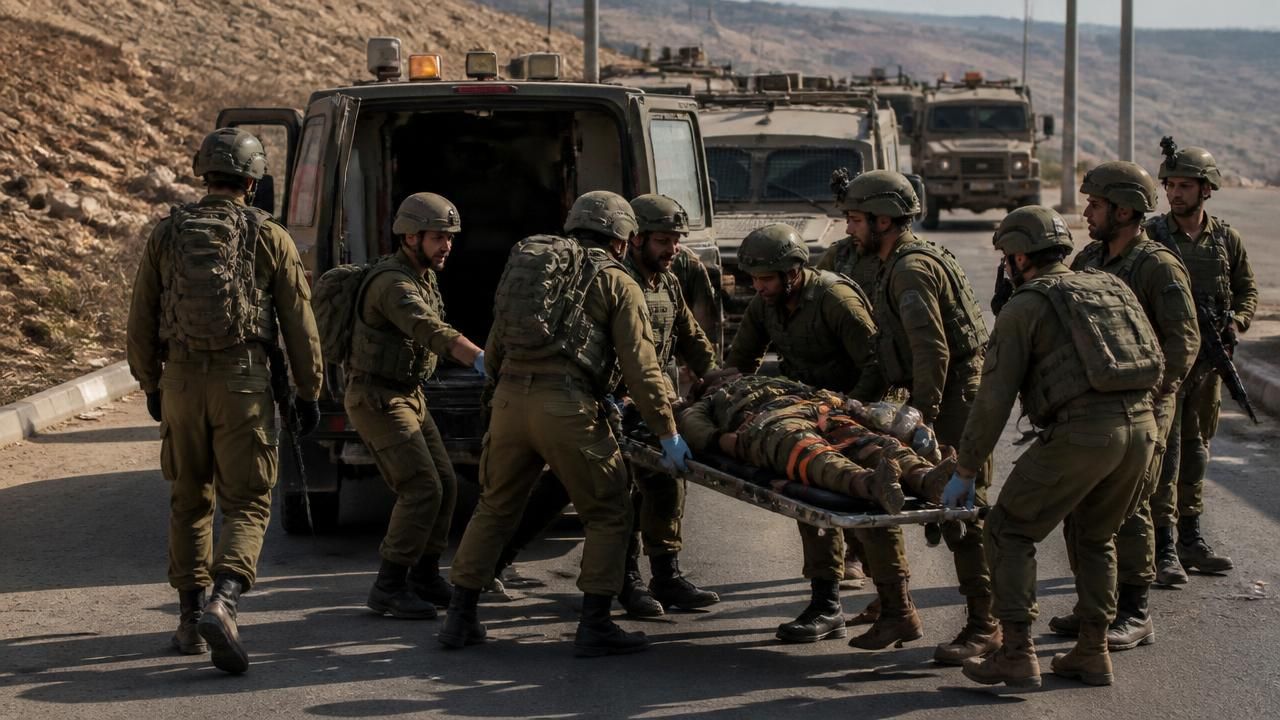
Two Israeli soldiers were killed and several others wounded when Palestinian gunmen opened fire on Israeli forces in the occupied West Bank, an attack the Israeli military says was the opening move of a far larger plot aimed at Israeli civilians. Prime Minister Benjamin Netanyahu responded by vowing a wide-ranging military operation and ordering the closure of the West Bank, escalating tensions just as Israel heads into an election campaign.
The Israeli military said two soldiers and two attackers were killed in the exchange, with three additional soldiers wounded. Other accounts, including those carried by MSN and Pakistani outlet Jang, put the number of wounded Israelis at five. The discrepancy in casualty figures — a common feature of fast-moving security incidents — had not been fully reconciled in official statements.
The Attack and the Alleged Larger Plot
According to the Israel Defense Forces, the two Palestinian gunmen were identified as 27-year-old residents of Hebron from the same family, a detail first reported by The Times of Israel. Military officials said the men were not carrying out a spontaneous shooting but had prepared for a more ambitious assault targeting Israeli civilians — a claim that, if substantiated, would mark the incident as a significant escalation rather than a lone ambush.
NBC News reported that Israel ordered a "sweeping West Bank operation" after the military confirmed the two soldiers' deaths and the killing of both gunmen. The New York Times reported that Netanyahu "vowed to launch a major offensive in the Israeli-occupied territory." The precise scale of that operation — whether it would resemble the large-scale incursions of 2002 or the narrower raids that have become routine in recent years — remained unclear.
A Closure Order and Demolitions
Netanyahu announced a full shutdown of the West Bank following the attack, according to Jang, which reported that five Israelis were injured. Yahoo News UK reported that the prime minister also said Israel would demolish the homes of the attackers — a long-standing Israeli policy of punitive house demolition that human rights groups have criticized as collective punishment and that critics say has failed to deter attacks.
The timing is politically charged. One MSN headline framed the decision bluntly: "Netanyahu Orders West Bank Closure as Attack Wounds Israelis before Election." With Israelis preparing to vote, security incidents historically reshape the political terrain, benefiting candidates seen as hawkish on Palestinian militancy.
"The Israeli military said two soldiers and two attackers had been killed, and three soldiers wounded. Prime Minister Benjamin Netanyahu vowed to launch a major offensive in the Israeli-occupied territory." — The New York Times
A Parallel Killing and Regional Flashpoints
Coverage diverged sharply on a second, related incident. Reuters and NBC News both reported that a Palestinian gunman shot dead an Israeli in the West Bank, after which Israeli soldiers killed a motorist. The framing of that headline — centering the Palestinian shooting first, then the soldiers' killing of a motorist — drew scrutiny from media-watch groups for how it distributes agency and emphasis across a chaotic sequence of events.
The wider region was also unsettled: Wikinews reported an explosion at a Palestinian intelligence service headquarters, an incident with potentially significant implications for internal Palestinian security arrangements and for coordination with Israeli forces.
Framing Wars: How Outlets Told the Story
The same events produced markedly different headlines. The New York Times led with the shooting and Netanyahu's vow, foregrounding Israeli casualties and the political response. The Times of Israel emphasized the military's belief that a larger civilian attack had been thwarted. MSN's coverage oscillated between casualty counts, the closure order, and the pre-election context. Jang foregrounded the shutdown itself, while Reuters and NBC organized their reporting around the killing of an Israeli and the subsequent death of a motorist.
Media criticism followed quickly. Honest Reporting Canada said it had filed a complaint over a CBC News headline that told readers "Israeli Soldiers Fatally Shoot 2 Palestinians" — a framing that, the group argued, obscured who initiated the violence. According to the group, the headline was amended after the complaint. The episode illustrates a recurring debate over whether headlines should lead with the initiating act or the resulting deaths, and how word order shapes reader perception of responsibility.
Deeper Context: Settlers, Rites, and Rising Violence
The attack lands amid a broader deterioration in the West Bank. A separate New York Times investigation published alongside the coverage described how Israeli settlers have turned a Palestinian religious rite into "a gantlet of violence and fear" — reporting that underscores the everyday friction, harassment, and intimidation that shape Palestinian life in the territory and that frequently precede — and follow — eruptions of armed confrontation.
Violence in the West Bank has climbed sharply over the past two years, with mounting Palestinian fatalities in Israeli raids, a wave of attacks on Israelis, and unprecedented settler rampages in Palestinian towns. Analysts caution that each cycle hardens positions on both sides and erodes the already diminished credibility of the Palestinian Authority, whose security forces are themselves a target, as the reported explosion at its intelligence headquarters suggests.
What to Watch
- The scope of the operation: Whether Israel mounts a sustained campaign across multiple West Bank cities or a targeted raid will determine the scale of Palestinian casualties and the risk of wider escalation.
- Home demolitions: Punitive demolitions are likely to be challenged before Israeli courts and condemned internationally.
- Electoral effects: Security crises have historically shifted Israeli public opinion toward parties emphasizing military response.
- The Palestinian Authority: A weakened PA, facing internal security shocks, may struggle to contain further violence or to coordinate with Israel.
- Media framing: Expect continued disputes over headline language and the attribution of responsibility in a conflict where narrative is itself contested terrain.
For now, the immediate facts remain contested in detail — the exact number of wounded, the precise sequence of the second incident — even as the broad outlines are clear: two Israeli soldiers dead, two Palestinian gunmen killed, a territory sealed off, and a government promising more to come.