Tesla reported third-quarter 2026 financial results on Wednesday afternoon, and the headline number told a story investors have grown accustomed to over the past year: the company can still move metal, but the profit engine is sputtering. Net profit fell 43 percent year over year to $787 million, while revenue held roughly flat at $28 billion, according to figures published after the bell and first detailed by Ars Technica.
The quarter has been defined as much by what Tesla is promising as by what it delivered. As AP News framed its coverage, the results arrive as Tesla prepares for a possible merger with SpaceX — Elon Musk's other publicly traded company — a tie-up that would reshape the investment case around both firms. Meanwhile, Yahoo Finance reported that Tesla has begun Optimus humanoid robot production in California, a capital-intensive bet that helps explain a balance sheet increasingly tilted toward the future.
The numbers behind the headline
Tesla's automotive business, still the overwhelming majority of its revenue, brought in $20.6 billion — a 3 percent decline year over year. That weakness was offset by services and other revenue, which includes parts, accessories and Supercharger network usage, and which grew by a third to $4.6 billion. Total revenue of $28 billion was essentially unchanged from the same quarter in 2025.
Perhaps the most striking line item was in energy. Tesla's solar panels and battery storage segment had been one of its fastest-growing divisions, but revenue there fell 16 percent year over year to $2.9 billion — a reversal that undermines one of the bull case's central pillars.
Expenses climbed sharply. Operating expenses rose 39 percent to $4.8 billion, compressing Tesla's operating margin to just 2.6 percent, down from 5.8 percent a year earlier. Capital expenditures more than doubled, up 110 percent to $4.7 billion, and free cash flow fell 62 percent to $1.5 billion.
Beating estimates while missing the point
Therein lies the central tension of the quarter, and the reason coverage diverged so widely. CNBC's headline declared that Tesla "beats on earnings and sales even as auto revenue declines" — a reflection of the fact that, as Ars Technica noted, Tesla sold fewer cars than in the same quarter of 2025 yet still cleared analyst projections. MSN's market coverage was blunter, noting that TSLA stock traded flat after hours following drops in revenue and earnings alongside heavy AI spending.
The gap between "beat" and "flat" captures a company being judged against two different scorecards at once. On the operational one, Tesla continues to outperform lowered expectations. On the financial one, profitability is eroding.
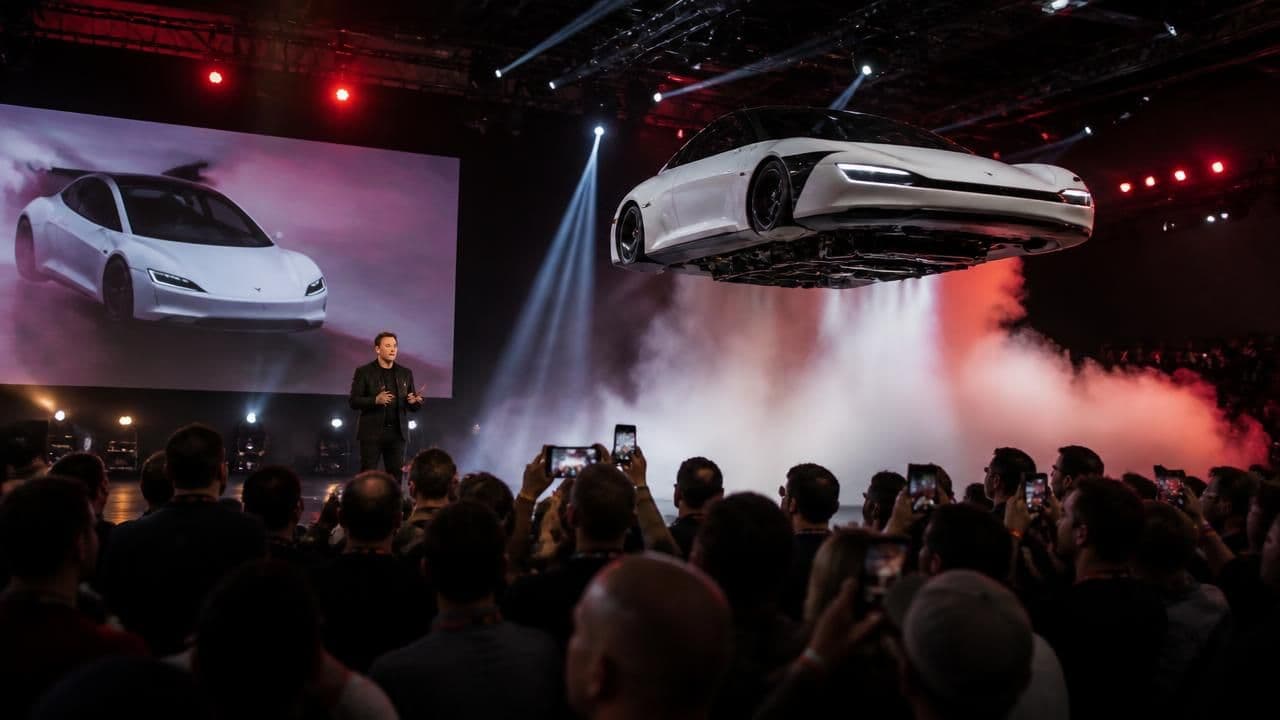
"Flying Roadsters can't lift Tesla's flat Q3 revenues."
That was The Verge's framing — a wry nod to the theatrics Musk's company has used to sustain enthusiasm even as its core financials plateau. The line lands harder given the quarter's realities: a halved operating margin and a doubling of capital spending.
Demand, discounts and the China question
Ahead of the release, Yahoo Finance asked whether Tesla's China discounts could lift third-quarter sales or hurt margins further. The answer, embedded in the results, appears to be a bit of both: volumes held up well enough to beat expectations, but the pricing pressure shows in automotive revenue and in the margin line.
MSN's preview coverage had framed the quarter around a narrower question — whether Tesla could reverse a recent pattern of earnings-per-share and revenue misses. Seeking Alpha, meanwhile, polled contributors on the biggest takeaway from Tesla's delivery and production report, a debate that in previous quarters has centered on the gap between production and deliveries, and what inventory build implies about underlying demand.
Robotaxis, robots and the AI spending bill
Prediction-market traders had already tipped their hand on where they expect management's attention to go. According to Moneycheck, Kalshi traders placed a 99 percent probability on robotaxi discussion featuring prominently on the earnings call — a striking consensus that the autonomous-ride-hailing program, not the car business, would dominate the narrative.
The Optimus production start reported by Yahoo Finance fits the same arc. Tesla is positioning itself less as an automaker and more as an artificial intelligence and robotics platform, and it is spending accordingly. The 110 percent jump in capital expenditures and the 39 percent rise in operating expenses are the visible cost of that pivot.
- Revenue: $28B, roughly flat year over year
- Automotive revenue: $20.6B, down 3%
- Energy revenue: $2.9B, down 16%
- Services revenue: $4.6B, up 33%
- Operating margin: 2.6%, down from 5.8%
- Net profit: $787M, down 43%
- Free cash flow: $1.5B, down 62%
The SpaceX wildcard
Complicating any clean read on the quarter is the prospect of a merger with SpaceX, which AP News placed at the center of its coverage. A combination would create a conglomerate spanning electric vehicles, energy storage, humanoid robotics, satellite broadband and launch services — and would force investors to value Tesla against a very different set of comparables than the automotive peer group they have historically used.
For now, the market's reaction was muted. Shares traded roughly flat after hours, suggesting investors had largely priced in a soft quarter and are waiting for strategic clarity on robotaxis, Optimus and the SpaceX question.
What comes next
The immediate test is whether Tesla can stabilize margins while funding its AI ambitions. The energy segment's 16 percent decline is a warning that the company's most reliable growth story is not immune to competitive pressure. The services line's 33 percent growth, driven by Supercharging, offers a reminder that Tesla's installed base remains a durable asset.
But the deeper question — the one The Verge's headline poked at — is whether spectacle can continue to substitute for earnings growth. A flying Roadster may generate headlines. A 2.6 percent operating margin generates harder conversations.