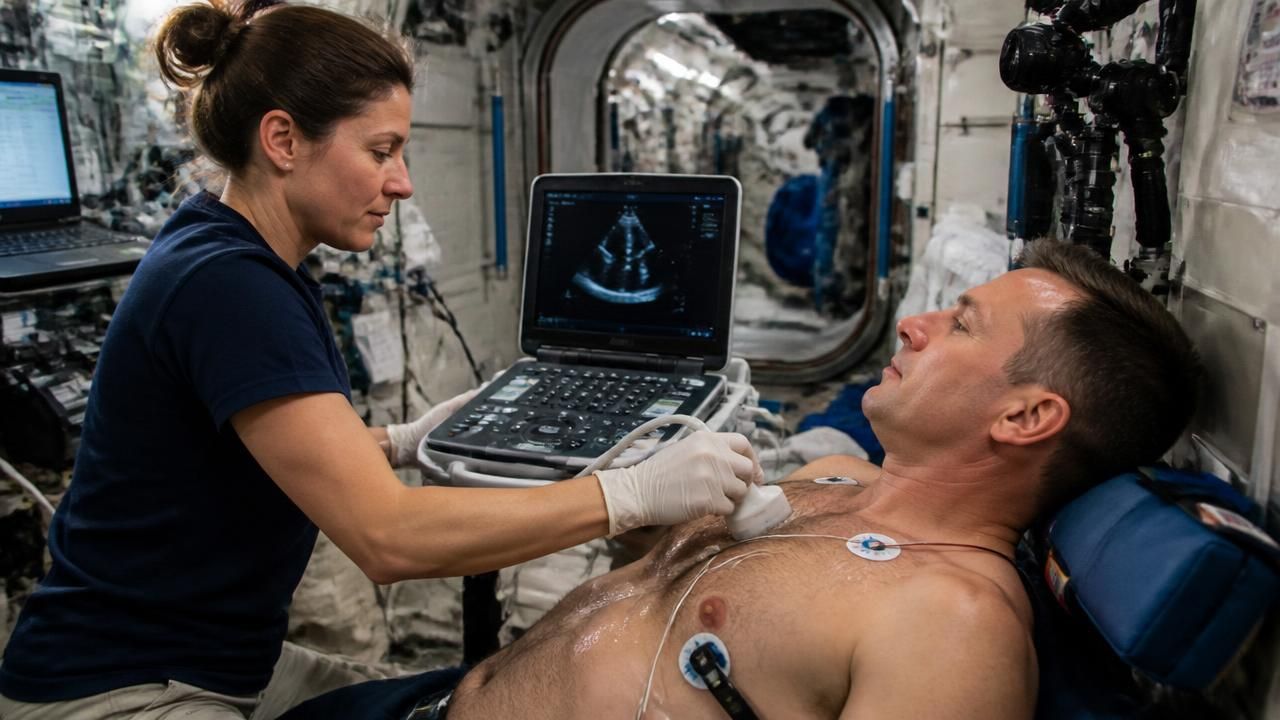
For decades, the cardiovascular risk of long-duration spaceflight has been one of the most stubborn obstacles standing between humanity and the Red Planet. Now, a small but closely watched study of 13 astronauts suggests the human heart may be more resilient than mission planners feared — provided crews stick to a rigorous exercise regimen while in orbit.
The research, reported by Science Daily, Newswise and other outlets this week, tracked astronauts through months of weightlessness aboard the International Space Station and then subjected them to simulated Martian gravity. The finding, according to the study's authors: the heart adapted to microgravity without major deterioration, and handled the roughly one-third gravity of Mars — about 0.38 g — without significant problems.
What the Study Actually Measured
At the center of the work is a surprisingly simple tool: the echocardiogram. As STAT News framed its coverage, the story is as much about how the research was done as what it found. Investigators used ultrasound imaging of the heart, including sessions conducted in space, to capture how cardiac structure and function changed across a mission — before launch, during flight and after return.
That longitudinal approach matters. Earlier studies of astronaut health often relied on pre- and post-flight data, leaving researchers to infer what happened in between. By imaging the heart in orbit, the team could watch adaptation as it occurred rather than reconstructing it after the fact.
The cohort is small — 13 astronauts — a limitation that is essentially unavoidable in human spaceflight research, where the total population of people who have flown long-duration missions numbers in the low hundreds. Still, the consistency of the results across participants is what gives the findings weight.
Exercise as the Countermeasure
The headline conclusion across outlets is that exercise is doing the heavy lifting. Astronauts who maintained regular, structured exercise during spaceflight preserved cardiac mass and function far better than the historical picture of deconditioning would predict. In microgravity, the heart no longer has to pump against gravity, and like any muscle deprived of load, it tends to shrink and weaken — a phenomenon sometimes described as cardiac atrophy.
Modern ISS crews spend roughly two hours a day on exercise hardware, including resistive devices and a treadmill that uses harnesses to simulate body weight. The new findings suggest that investment is paying off not just for bone and muscle, but for the heart itself.
The heart may be surprisingly well equipped for a journey to Mars, especially when astronauts exercise regularly during spaceflight.
Why Martian Gravity Is the Real Test
Transiting to Mars is only half the challenge. Upon arrival, astronauts would step into a gravitational field roughly 38 percent as strong as Earth's — a partial load to which the cardiovascular system has never been exposed for extended periods.
The study's simulated-gravity component is where the Mars angle becomes concrete. Using ground-based techniques to mimic Martian conditions, researchers observed how previously unloaded hearts responded. MSN's coverage emphasized the core takeaway: heart tests suggest astronauts could tolerate Mars' gravity after months in space. No catastrophic loss of pumping capacity or orthostatic collapse emerged as a systematic problem.
The research appears to have been led by a Dallas-based team, a detail highlighted in regional coverage of the findings. That geographic framing reflects a broader truth about space medicine: much of the discipline's foundational work happens in hospital labs and university cardiology departments far from any launch pad.
Differing Frames, One Finding
- Science Daily emphasized hope — a heart "surprisingly well equipped" for Mars, with exercise as the enabling factor.
- STAT News foregrounded methodology, spotlighting echocardiography in space as the analytical backbone of the result.
- Regional and aggregator coverage foregrounded the Martian-gravity tolerance angle, the detail with the most direct bearing on mission architecture.
- Newswise, distributing the institutional release, framed it plainly: exercise keeps astronauts' hearts strong enough for the flight to Mars.
What It Means for a Mars Mission
A crewed Mars mission would involve roughly six to nine months of transit each way plus a surface stay, potentially totaling two to three years. NASA and its partners have long identified cardiovascular deconditioning, bone loss, radiation exposure and psychological isolation as the principal human-risk categories.
This study chips away at the first. If exercise can preserve cardiac capacity through weightlessness and the transition to partial gravity, mission planners gain one fewer showstopper. It also strengthens the case for exercise hardware as non-negotiable payload — mass that cannot be trimmed when launch budgets tighten.
Important caveats remain. Thirteen astronauts is a small sample; the study cannot capture rare events. Simulated Martian gravity on Earth or in orbit is an approximation, not the real thing. And longer missions will test adaptation over timescales no human has yet experienced.
Still, the direction of the evidence is encouraging. The heart, these findings suggest, is not the fragile link in the chain to Mars that many once assumed — as long as astronauts keep moving.