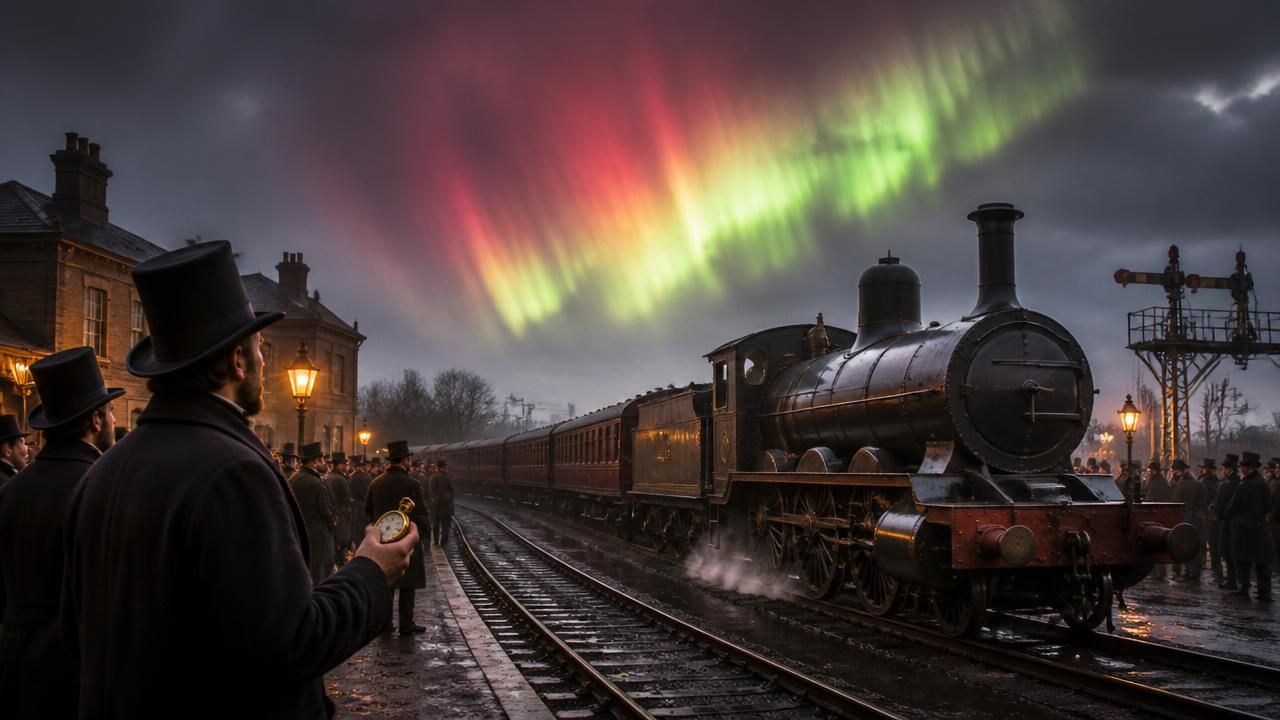
For generations, the story has been told as a curiosity of the industrial age: a solar storm, a telegraph line gone haywire, and a Victorian train left sitting on the tracks for 16 minutes. The year, according to nearly every retelling, was 1841. It was the earliest known example of the Sun reaching down and disrupting human technology.
There is just one problem. According to a new investigation reported by Science Daily and covered across international outlets, the celebrated incident took place in 1848 — and in 1841, the railway line in question did not yet exist. The finding closes what scientists describe as a 178-year-old mystery and quietly rewrites the opening chapter of space weather history.
A detective story hidden in the archives
The research, according to the study team's own description, had "a hint of a detective story" about it. What began as a routine citation check turned into a archival manhunt spanning railway timetables, Victorian newspaper columns, magnetic observatory logs and sunspot records.
The discrepancy was hiding in plain sight. As one widely syndicated headline put it bluntly: "A solar storm supposedly delayed a train in 1841. But the railway didn't exist yet." That single anachronism — a geomagnetic disruption attributed to infrastructure that had not been built — was the thread that unravelled the whole account.
By cross-referencing the documentary trail, the researchers concluded that the event belongs to 1848, when a magnetic disturbance strong enough to interfere with telegraph traffic forced railway operators to halt or slow services. Without working telegraphs, Victorian railways lost the ability to signal that the line ahead was clear, and trains proceeded under caution — producing the 16-minute delay that would become the stuff of legend.
"Our research has a hint of a detective story." — the study authors, describing the archival work behind the redating
Why a seven-year error matters
The correction is not merely antiquarian bookkeeping. The 1841 date has been used for decades as the foundational data point in the history of technological space weather — the moment when a natural phenomenon moved from the sky into the realm of infrastructure. Moving that marker to 1848 changes the chronology of how quickly the industrial world became vulnerable to the Sun.
It also matters because of what came after. The 1848 incident predates the Carrington Event of 1859 — the great solar storm that set telegraph papers aflame and shocked operators — by little more than a decade. Historians of the period now have a firmer early anchor: a documented case of geomagnetically induced currents disrupting a commercial network before the technology had matured.
The episode sits at a very specific technological hinge. Telegraphy was the first human system to run on long metallic conductors spanning great distances — and therefore the first to act, in effect, as an unintended antenna for the Earth's magnetic field. When a coronal mass ejection compresses the magnetosphere, those long wires pick up induced currents. In the 1840s, that meant garbled messages and stopped trains. Today, the same physics applies to continent-spanning transmission grids, oil pipelines, undersea cables and satellite constellations.
Different outlets, different framing
The coverage illustrates how the same finding can be packaged for very different appetites. Science Daily leans into the research narrative — a mystery cracked, a date corrected, a historical record revised. Phys.org frames the story through Victorian technology, emphasising how a 16-minute delay exposes the fragility of early industrial systems. News aggregators, meanwhile, have gravitated toward the punchiest version of the tale: the railway that did not exist, the headline that could not be true.
Even the arithmetic has been contested. One outlet described the discovery as uncovering a "185-year-old error," counting back to 1841, the wrong date; Science Daily called it a 178-year-old mystery, measuring the span since the redated event. The gap is a useful reminder that historical errors compound — first in the archive, then in the citation, then in the retelling.
The threat that never went away
The researchers' underlying message is contemporary. Space weather remains one of the few natural hazards capable of damaging infrastructure on a continental scale. Among the documented risks:
- Power grids: Geomagnetically induced currents can saturate transformers; a March 1989 storm blacked out Quebec within roughly 90 seconds.
- Satellites: Energetic particles degrade solar panels and electronics and can disrupt navigation and timing signals on which finance and logistics depend.
- Communications: Radio blackouts and ionospheric disturbances interfere with aviation, maritime and emergency communications.
- Pipelines and cables: Long conductors can suffer corrosion or signal disruption from induced currents.
In that sense, the 1848 train delay is less a quaint relic than a proof of concept. The mechanism that stopped a Victorian locomotive is the same one that threatens modern grids — only now the conductors are larger, the dependencies deeper, and the margin for a 16-minute delay far narrower.
What comes next
The redating gives historians a cleaner timeline and gives forecasters a better-constrained early record against which to test models of extreme events. It also serves as a caution for anyone citing old anecdotes as data: the 178-year-old mystery was not solved by new instruments, but by someone noticing that the railway could not have been there.
The Sun, as ever, was not keeping a calendar. The error was ours — and it took nearly two centuries to fix.