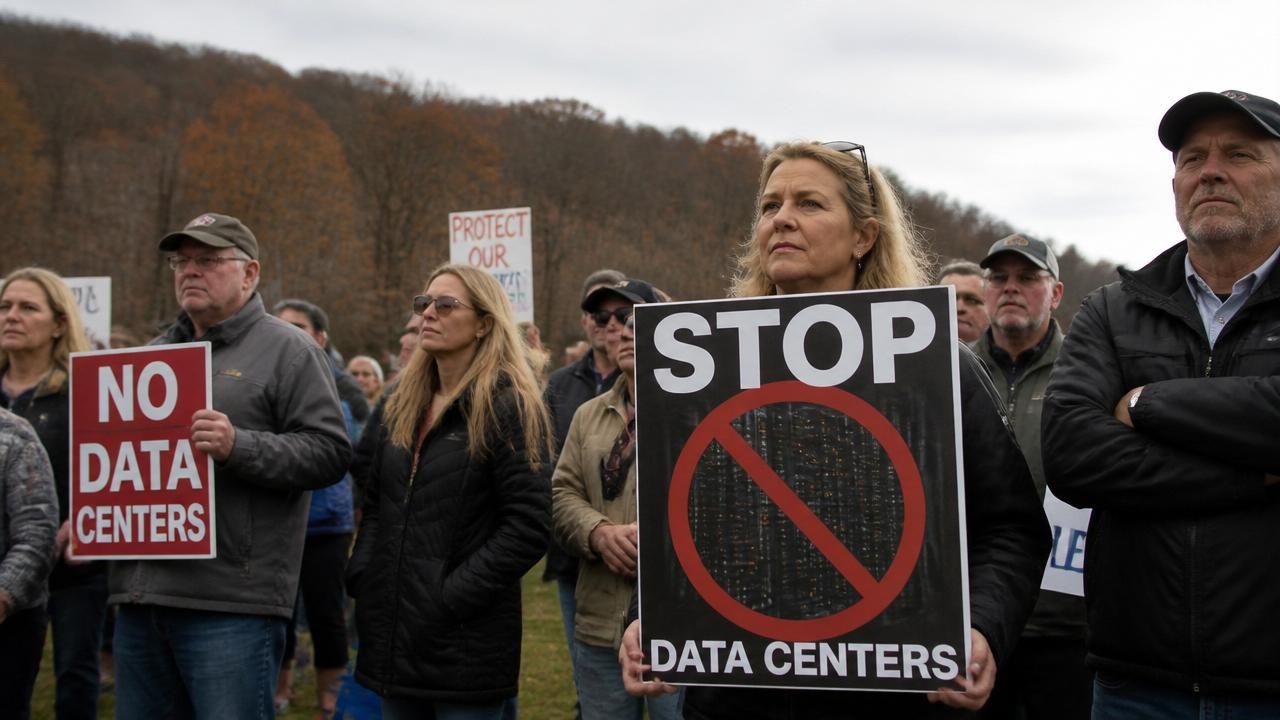
Across the United States, a once-in-a-generation grassroots movement is taking shape—one that pits local communities against the relentless expansion of AI data centers. From the rolling hills of Pennsylvania to the suburbs of Georgia, residents are organizing, protesting, and voting to block the construction of massive facilities that they say threaten their environment, health, and way of life. The fight, which has already stalled over $130 billion in projects this year alone, according to Ars Technica, is not just about data centers—it's a referendum on the unchecked power of Big Tech and the future of artificial intelligence.
A Nationwide Uprising
The opposition has erupted in dozens of communities. In Mount Carmel Township, Pennsylvania, yard signs reading "No Data Centers" dot the landscape. In West Michigan, residents are battling Microsoft over plans to build AI infrastructure on farmland. In a small town of 7,000 in Virginia, six data centers have been proposed—equivalent to 51 Walmart Supercenters in a 17-square-mile area—leading four of seven town council members to resign. In New Jersey's Andover Township, chaotic meetings have erupted over a proposed $1.8 billion facility. And in Kentucky, a mother-daughter duo is fighting an anonymous Fortune 100 company's plans.
The movement has drawn unlikely allies. Environmental activist Erin Brockovich has launched a tracking website that has already logged over 2,700 reports from affected communities. The Nashville Zoo is leading a petition against a 69,000-square-foot data center that would overlook animal habitats, garnering over 375,000 signatures. Even billionaire Mark Cuban waded into the fray, arguing that the opposition masks deeper anxieties about AI and wealth concentration—only to be dragged on social media.
The Environmental Toll
At the heart of the backlash are the immense resource demands of AI data centers. These facilities require vast amounts of electricity and water for cooling, straining local grids and water supplies. The Los Angeles Times reported on Elon Musk's massive AI data center in Memphis, which sparked a fight over clean air laws. In Georgia, residents face eminent domain seizures for a $16 billion data center plan that would power AI. The agriculture sector is also mobilizing, as data centers consume prime farmland and threaten rural economies.
"The new pollution is data, and it's coming to a town near you," writes Erin Brockovich on her report site. The Guardian's editorial board warns that these protests are "a warning to big tech" about the social and environmental costs of the AI boom. Brookings Institution analysts note that the backlash signals a broader fight over AI's power consumption and governance.
Political Fallout
The issue has become a political lightning rod. In Virginia's battleground House districts, data centers are a top concern. In Kentucky, the fight was front and center in primary elections. Texas Governor Greg Abbott, who previously backed the AI boom, is now calling for blocking data centers. Some lawmakers have even alleged, as reported by the New York Post, that China is fueling the protests to undermine US tech dominance—a claim that has been met with skepticism.
Democrats are deeply divided. In Virginia, the data center fight has deepened intra-party splits, with one lawmaker telling colleagues to "read the damn room." In Pennsylvania, lawmakers are talking about regulations but have yet to act. Meanwhile, Ohioans are set to protest at the Statehouse, and a tiny New Jersey borough that approved a $1.8 billion AI data center now faces a fierce backlash from its own residents.
Global Echoes
The resistance is not confined to the US. In Canada, residents of New Brunswick are battling the government over a planned data center. In Australia, there are concerns that the data center boom will benefit offshore companies. In Chile and the Philippines, communities are pushing back against AI's ecological footprint. The London data center plans have sparked a similar backlash, as ABC News reports. The movement is truly global.
What's at Stake
For many, the fight is existential. "The data center rebellion is only the beginning," writes one commentator on Blood in the Machine. The Jacobin argues to "stop the AI build-out, start the fight." The Atlantic warns that the AI backlash "could get very ugly." And the Guardian's Astra Taylor and Saul Levin frame it as a democratic struggle: "It's not just about tech—it's about democracy."
Wall Street has taken notice. The New York Times reports that local opposition is slowing AI data centers, and investors are growing wary. With $350 billion in debt piled up by Big Tech to fuel the AI race, as the LA Times notes, any slowdown in data center construction could have significant financial repercussions.
The Way Forward
As the movement gains momentum, questions remain: Can communities and tech companies find common ground? Will regulators step in? Or will the backlash force a fundamental rethinking of AI's infrastructure? What is clear is that the fight against AI data centers is just beginning. It represents a broader struggle over who controls the future—and at what cost.
"The fight against AI datacenters is important – but it's just a starting point," write Bruce Schneier and Nathan E Sanders in The Guardian. "It's a fight for democracy itself."