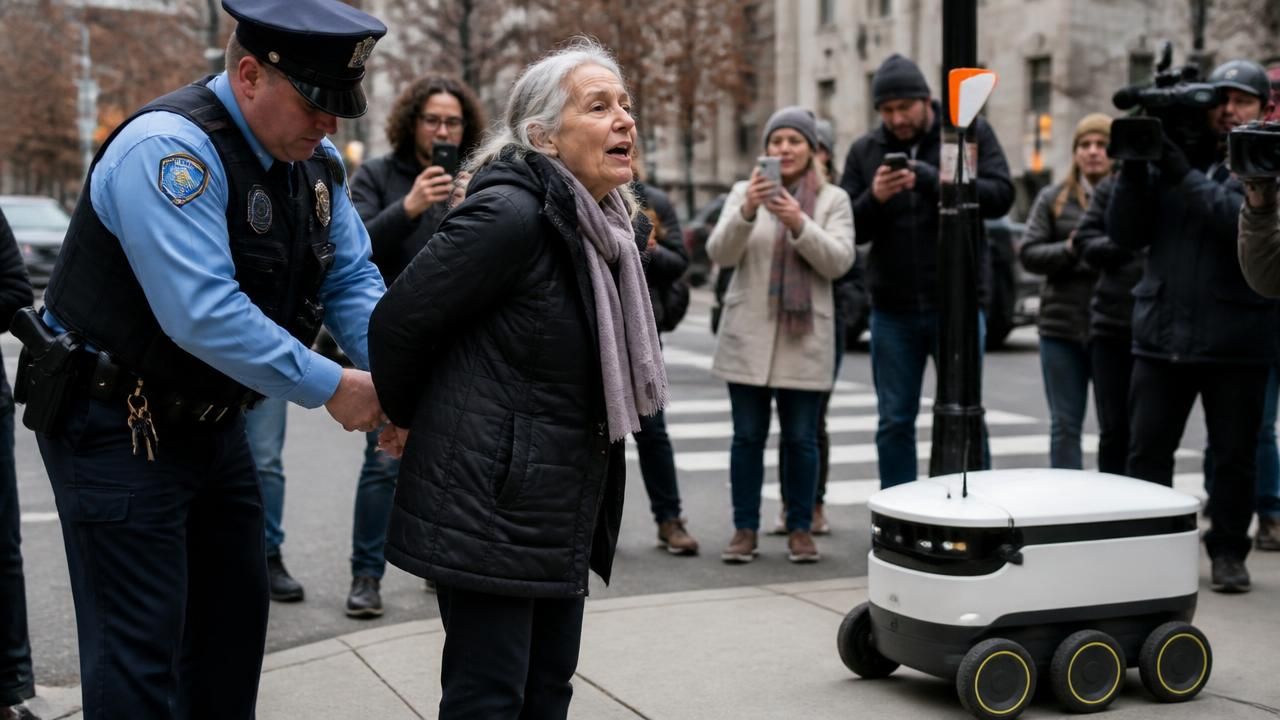
PHILADELPHIA — A confrontation between a 78-year-old woman and a knee-high delivery robot on a Center City sidewalk has become an unlikely flashpoint in the national debate over automation, gig work and who owns the public right of way.
Carolyn Marvin, a former University of Pennsylvania professor, was arrested and charged with disorderly conduct this week after she deliberately blocked the path of an Uber Eats delivery robot and refused repeated police requests to move, according to The Verge, which first reported the incident in detail. Video of the arrest has since spread across social media, drawing coverage from outlets as varied as the New York Post, The Sun, MSN and local site Hoodline.
What Happened
According to accounts from The Verge and other outlets, Marvin stood in front of the wheeled robot as it attempted to navigate a Philadelphia sidewalk, halting its progress. Police arrived and asked her to step aside. When she declined, officers handcuffed her and took her into custody.
Speaking to Philadelphia's ABC13, Marvin framed the act as a deliberate protest — one she said she has repeated whenever she encounters the machines.
“I know they're taking the jobs of human delivery workers and so, I have been protesting them whenever I saw them by standing in front of them and preventing them from going forward.”
The Sun reported that the encounter occurred shortly after Marvin left an appointment to receive a flu shot, a detail that lent the story its widely shared “dystopian” framing. Some outlets, including Hoodline and Yahoo, described her as charged following the confrontation; the New York Post identified her as a former University of Pennsylvania professor.
Why It Resonates
On its surface, the story is a minor municipal incident: a brief standoff, a low-level charge, a few minutes of police time. But the images — an elderly woman in handcuffs beside a squat autonomous delivery vehicle — compressed a much larger argument into a single frame.
Inc.com, which covered the arrest under the headline “A Woman Was Arrested for Blocking a Delivery Robot. Her Reason for Doing It Taps Into a Deep Fear,” argued that the episode resonates because it gives a human face to anxieties that are usually abstract: the suspicion that automation will erode paid work faster than new jobs appear, and that the public has little say in the process.
That fear is not unfounded, even if it is contested. Sidewalk delivery robots — operated by Uber, Serve Robotics, Starship and others — remain a relatively small slice of last-mile logistics, but they have proliferated rapidly in Philadelphia, Los Angeles, Austin and college campuses nationwide. Companies pitch them as cheaper and lower-emission than car-based delivery. Critics counter that they add clutter to already crowded sidewalks, raise accessibility concerns for wheelchair users and strollers, and displace couriers whose work is already precarious.
Differing Frames
The coverage reveals sharp differences in emphasis:
- The Verge centered the incident and Marvin's own stated rationale, treating the protest as the story's core.
- The New York Post foregrounded her identity as a former Ivy League professor, framing the arrest as a credentialed professional's rebellion against automation.
- The Sun and MSN leaned into the “dystopian” imagery, emphasizing her age and the flu-shot detail to heighten the sense of absurdity.
- Hoodline took a straight-news approach, focused on the charge and the police response.
- Inc.com zoomed out to the labor economics, using the arrest as a hook for a broader argument about technological displacement.
Notably absent from much of the coverage was any comment from Uber, Serve Robotics or Philadelphia police beyond confirmation of the arrest. Whether Marvin's conduct crosses from protest into obstruction is a legal question; whether it constitutes effective advocacy is a political one.
The Bigger Fight
Philadelphia has become an unintentional laboratory for robot-human coexistence. Delivery machines now routinely share narrow brick sidewalks with pedestrians, and the city has been wrestling with how to regulate them — a debate playing out in city councils across the country. MSN's weekly report card quipped that “Philly goes to war with robots,” but the underlying question is serious: who gets to decide how public space is used, and at what speed change arrives.
For her part, Marvin appears to have achieved a version of what she intended. A protest that might have gone unnoticed on a single block has become a national story, and the robot she stopped is now a symbol in a debate far larger than a burrito delivery.
Her case now moves through Philadelphia's courts, where the disorderly conduct charge will be adjudicated on far narrower grounds than the question the video raised. But the image — of a 78-year-old woman in handcuffs, and a machine waiting patiently behind her — is likely to outlast the docket.