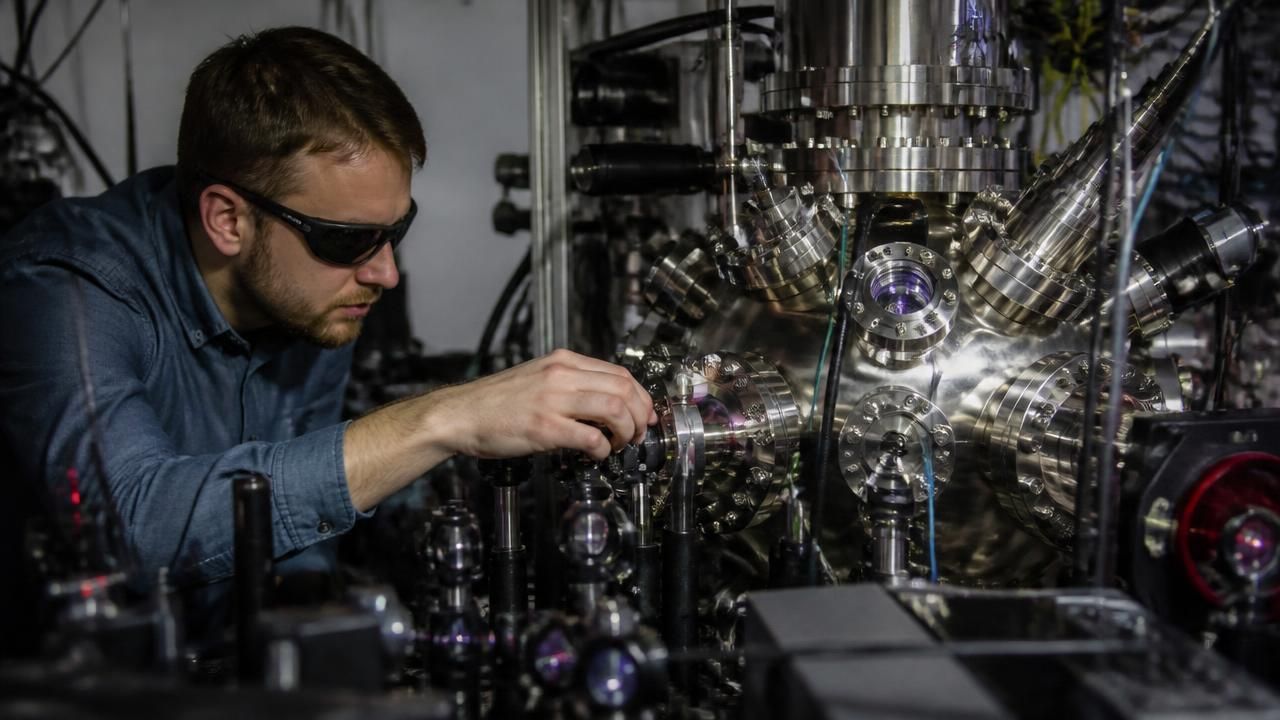
Physicists have created a previously unobserved state of quantum matter in which ultracold atoms abandon the familiar rules of organization and settle into a highly excited yet unexpectedly orderly configuration known as a "fractional Fermi sea." The result, reported across science outlets this week, challenges long-standing assumptions about how collections of fermions — the particles that include electrons, protons and many atoms — arrange themselves at extremely low temperatures.
The work centers on cesium atoms cooled to a fraction of a degree above absolute zero and held out of thermal equilibrium, a regime in which quantum effects dominate and ordinary intuition about order and disorder breaks down. According to ScienceDaily, the atoms form a configuration that is simultaneously highly excited and surprisingly structured — a combination that established theory says should be difficult, if not impossible, to sustain.
What Is a Fermi Sea?
To understand why the result matters, it helps to recall what a Fermi sea normally is. Fermions obey the Pauli exclusion principle: no two identical particles can occupy the same quantum state. When a gas of fermions is cooled, the particles fill up the lowest available energy levels one by one, like water pouring into a vessel. The surface of that filled region is called the Fermi surface, and the filled interior is the Fermi sea — the bedrock of our understanding of metals, semiconductors, neutron stars and much of condensed-matter physics.
In a conventional Fermi sea, the particles behave as though they were nearly free, and the system sits in its lowest-energy configuration. The newly observed "fractional" version departs from that picture. Rather than a sharp, well-defined boundary between occupied and empty states, the system appears to distribute its quantum occupancy in a fragmented way — hence "fractional" — while remaining globally ordered.
The Role of Nonequilibrium
Phys.org framed the discovery around the experimental technique: out-of-equilibrium cesium atoms revealing fractional Fermi seas and exposing a new critical quantum phase. That emphasis is significant. Much of quantum physics is studied in systems at or near equilibrium, where theorists have decades of well-tested tools. Driving a system far from equilibrium and watching it organize itself is a much harder problem, and the emergence of a stable, ordered phase under those conditions is what makes the result notable.
The phrase "critical quantum phase" points to quantum criticality — a regime where a system sits at the boundary between two competing phases and exhibits scale-invariant fluctuations. Such regimes are prized by physicists because they often host exotic collective behavior, including quasiparticles that behave nothing like the particles they emerge from.
'Super-Fermions' and Fractionalization
Perhaps the most provocative aspect of the discovery is the suggestion of exotic quasiparticles that researchers have dubbed potential "super-Fermions." Quasiparticles are collective excitations — emergent entities that behave like particles inside a material even though they are not fundamental. Fractionalization, in which a single electron or atom appears to split into multiple emergent pieces, is one of the most striking phenomena in modern condensed-matter physics and underpins phenomena such as the fractional quantum Hall effect.
The discovery challenges established quantum theories and hints at exotic quasiparticles that scientists have dubbed potential "super-Fermions."
If confirmed and characterized further, such quasiparticles could offer a new platform for studying strongly correlated quantum matter — systems in which particles interact so strongly that their individual identities blur into collective behavior. These are precisely the systems that theorists find hardest to simulate and that hold promise for future quantum technologies.
How the Coverage Differed
The story has been picked up with notably different emphases. ScienceDaily led with the conceptual shock — a strange new state that defies organizational rules — and highlighted the "super-Fermion" angle, appealing to readers interested in fundamental physics. MSN's headline leaned into the language of quantum weirdness, framing the result as an exotic new form of matter. Phys.org, by contrast, foregrounded the experimental specifics: cesium atoms, nonequilibrium dynamics, and the identification of a new critical quantum phase. Taken together, the accounts describe the same underlying advance from three vantage points — the surprising phenomenon, the popular-science intrigue, and the technical substance.
Why It Matters
The result sits at the intersection of several active research frontiers: ultracold atomic physics, nonequilibrium quantum dynamics, and the study of quantum criticality. Ultracold atoms are prized as quantum simulators because they can be manipulated with extraordinary precision, allowing physicists to realize theoretical models that are otherwise intractable — and, occasionally, to stumble onto behavior no one predicted.
- Fundamental theory: The findings challenge textbook descriptions of how fermions organize at low temperatures.
- New quasiparticles: The proposed "super-Fermions" would add a new entry to the growing catalog of emergent quantum entities.
- Quantum simulation: Out-of-equilibrium cesium gases offer a controllable testbed for strongly correlated physics.
- Long-term applications: Strongly correlated and critical quantum systems are of interest for sensing, metrology and quantum information science.
Open Questions
As with any frontier result, the immediate questions outnumber the answers. How robust is the fractional Fermi sea? Does it survive at higher temperatures or in other atomic species? What precisely are the "super-Fermions," and how would their fractional nature be measured directly? Independent replication and more detailed characterization will be essential before the phenomenon earns a settled place in the physics canon.
What is already clear is that the experiment adds to a growing body of evidence that quantum matter is far stranger than equilibrium theory alone suggests. By pushing cesium atoms far from equilibrium, physicists have opened a window onto a regime where order and excitement coexist — a result that reframes how scientists think about the Fermi sea and, potentially, about the emergent particles that inhabit it.