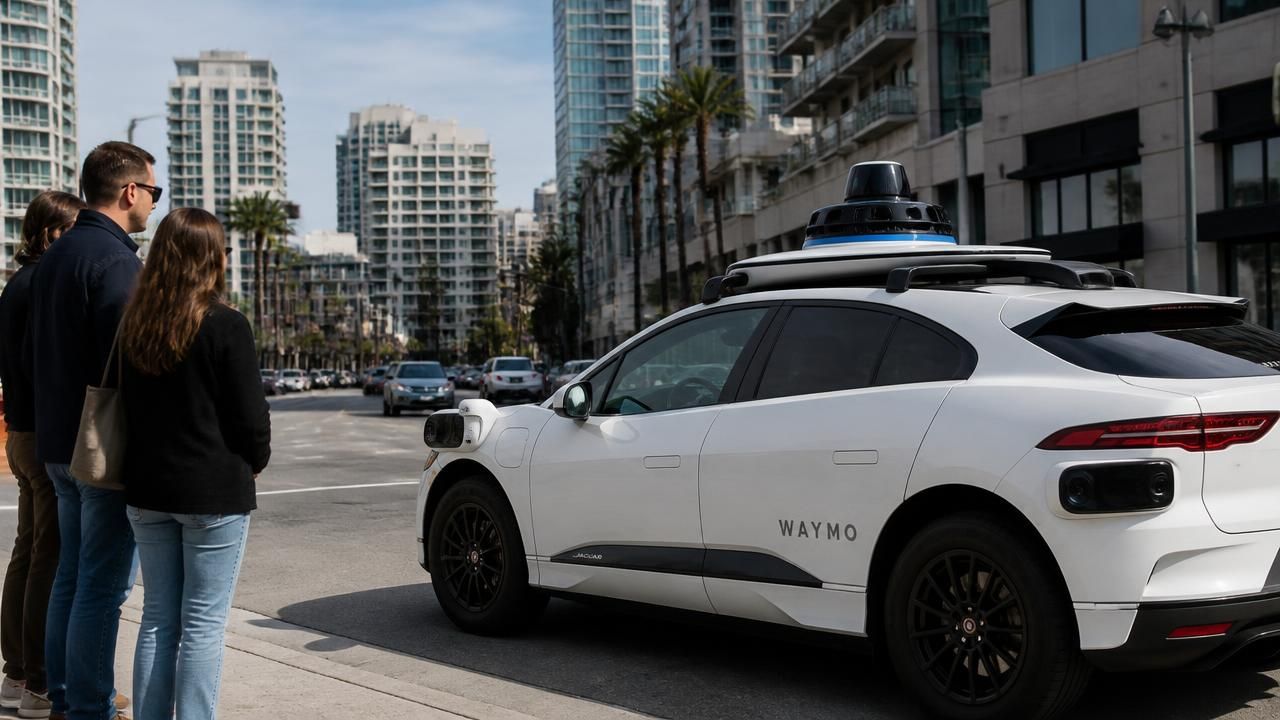
For more than a decade, the debate over self-driving cars played out in statehouses friendly to experimentation and in the language of inevitability. That era is ending. This month, the fight has moved decisively to city hall, where a patchwork of councils — from San Diego to St. Paul, Minnesota — is trying to slow, study or outright block autonomous vehicles before fleets scale up in their streets.
The pushback is unfolding against a backdrop of rapid commercial expansion. Tesla’s Cybercabs have been photographed lined up on a lot at the company’s Giga Texas plant in Austin, a visible marker of the company’s ambitions for a purpose-built robotaxi. Abroad, Lucid and Bolt have announced plans to put more than 25,000 robotaxis on European roads. The industry, in other words, is not slowing down — which is precisely why cities are scrambling to write rules.
How we got here
The regulatory vacuum cities are now trying to fill has deep roots. As The Verge’s Andrew J. Hawkins notes in The Stepback, Nevada became the first state to legalize self-driving cars on public roads in June 2011 — three years before Tesla introduced Autopilot, five years before Waymo spun out of Google’s self-driving car project, and seven years before the first commercial robotaxi service launched. In other words, the laws came first, the technology second.
That sequencing has shaped everything since. Because states — not cities — set most vehicle rules, municipalities have found themselves watching fleets arrive with limited authority to condition, cap or even inspect their operations. The current wave of local action is an attempt to claw back some of that ground through the tools cities do control: zoning, permitting, curb access, procurement and, above all, study and delay.
San Diego draws a line
In San Diego, the City Council has moved to put the brakes on robotaxis and autonomous vehicles, adding the city to a growing list of municipalities that want a say before driverless fleets scale. The council’s action reflects concerns that have become a standard litany in city halls: emergency-response interference, accessibility for disabled riders, the displacement of human drivers, and the use of public streets as a testbed without public consent.
The move drew an immediate and blunt rebuttal from the San Diego Union-Tribune’s editorial board, which argued that the council’s posture is backward-looking.
City Council’s opposition to robotaxis is nonsensical
The editorial’s core argument is familiar to anyone who has watched the AV debate: robotaxis do not drink, text, speed or tire, and the status quo of human driving kills tens of thousands of Americans a year. Restricting a technology that is, on average, more cautious than its human competition, the paper contends, is a reflex dressed up as prudence.
The grievances: deadheads, curbs and chargers
The counter-argument is that averages are not the whole story. Forbes examined a set of complaints now circulating in early deployment cities — that robotaxis cruise empty (so-called deadheading) to reposition or wait, that they double-park and monopolize curb space at pick-up points, and that they occupy EV chargers for long stretches while idle. The question Forbes poses is whether the anger is fair, or whether it reflects the friction of any new mode of transport encountering infrastructure that was never designed for it.
Both things can be true. Robotaxis do generate real, measurable nuisances at the curb — concentrated at exactly the places cities most want to keep clear, like transit stops and hospital entrances. But many of the loudest complaints are also generic congestion grievances, sharpened by novelty and by the suspicion that no local official can be held accountable for a fleet operating under state authority.
- Deadheading: empty repositioning miles that add traffic without carrying passengers.
- Curb hogging: vehicles idling at pick-up zones, loading areas and transit stops.
- Charger squatting: driverless cars occupying EV charging bays between trips.
- Emergency interference: difficult-to-resolve encounters with first responders.
- Labor displacement: pressure on driving and delivery jobs.
St. Paul takes the study-first route
St. Paul’s City Council has chosen a softer but potentially more durable strategy: approving a plan to study how robotaxis would affect the local workforce and public safety. It is a familiar municipal maneuver — commission a report, define metrics, and buy time — but it is also how cities build the evidentiary record they currently lack. If San Diego’s approach is a brake, St. Paul’s is a slow lane with a clipboard.
The workforce question may prove the most consequential. Ride-hail and delivery driving have functioned as a flexible, low-barrier employment sector in many metro areas, and cities have almost no data on how quickly driverless supply could erode it. Public safety agencies, meanwhile, want to know how robotaxis behave around fire scenes, crash sites and traffic stops — scenarios in which an empty vehicle with a remote operator presents genuinely novel problems.
A transatlantic divergence
The contrast with Europe is striking. Lucid and Bolt’s plan for more than 25,000 robotaxis across European roads signals that operators see the continent — with its denser cities, stricter safety rules and more centralized regulation — as the next frontier. Europe’s top-down framework may make it easier to deploy at scale once approved, whereas American operators face a state-by-state patchwork layered under a growing, unpredictable city-by-city resistance.
The road ahead
What is emerging is not a verdict on robotaxis but a collision over who decides. Operators argue that cities are acting on vibes rather than data, and that the technology’s safety record will vindicate them. Cities argue they are being asked to absorb the costs — congestion, curb pressure, labor disruption — while the upside accrues to shareholders and state regulators.
The likely outcome is neither a ban nor a free market. It is a mosaic: cities that welcome fleets with performance requirements, cities that stall with studies, and states that preempt both. For an industry that spent its first fifteen years lobbying legislatures, the next phase will be fought at council meetings — and the outcome will determine not whether robotaxis arrive, but what they are allowed to be.