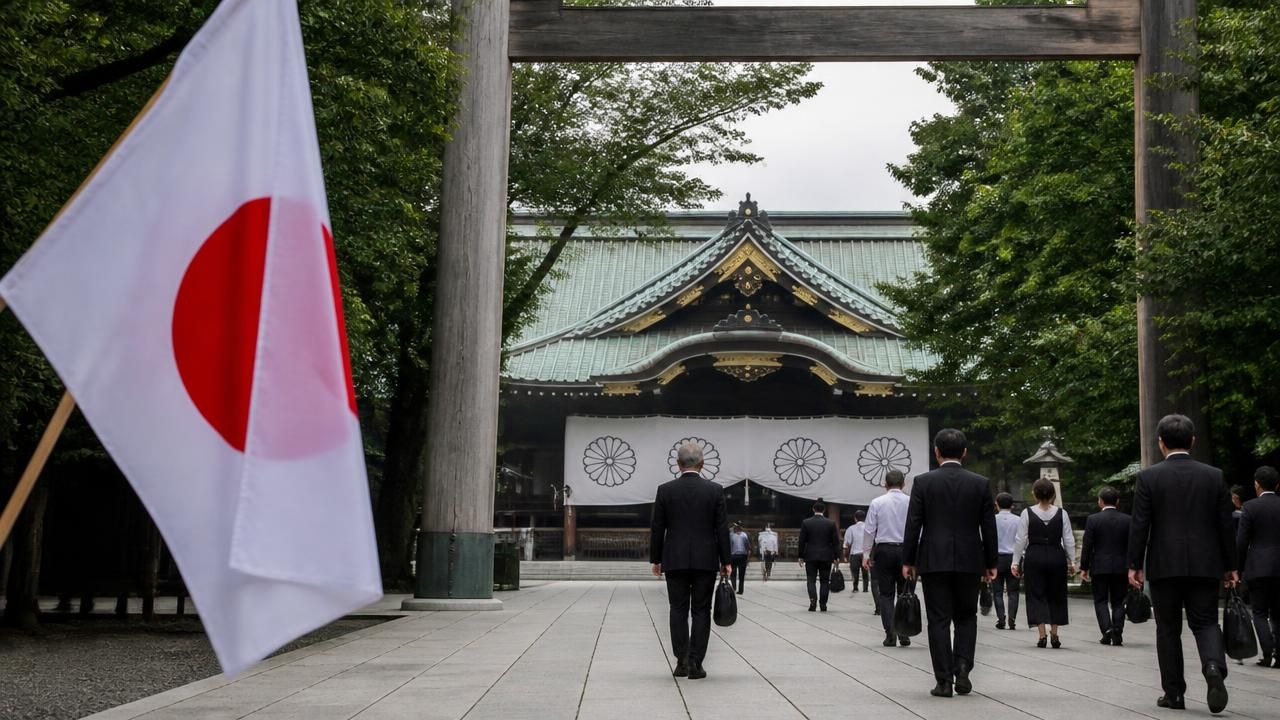
China’s embassy in Japan on Saturday condemned what it called Japan’s "negative moves" related to Tokyo’s Yasukuni Shrine, describing them as a provocation against the postwar international order and an affront to historical justice. The statement, reported by Bloomberg, Xinhua and Chinese state media, came as Japan marked the 81st anniversary of its World War II surrender and after reports that Japanese officials, including the defense minister, had prayed at or visited the shrine.
The Chinese Embassy in Japan said the actions amounted to an "affront to historical justice," according to Xinhua, and Chinese state media amplified the condemnation under headlines calling Yasukuni a "war criminal shrine." Global Times said Beijing strongly condemned Japan’s "negative moves" related to the "notorious" shrine.
A shrine at the center of memory and diplomacy
Yasukuni Shrine, in central Tokyo, commemorates about 2.5 million Japanese war dead, including 14 wartime leaders convicted as Class-A war criminals after World War II. For Beijing and Seoul, official visits and ritual offerings there are not private religious acts but symbols of Japan’s militarist past and a test of whether Tokyo is willing to confront wartime atrocities. Al Jazeera, in an explanatory piece, noted the shrine’s link to Japan’s wartime atrocities, while its news report said a Japanese minister’s visit had angered China and South Korea.
The controversy is recurring. Japanese lawmakers and ministers have made offerings and visits around the August 15 anniversary for years, prompting protests from China and South Korea and complicating regional diplomacy. This year, reports said Japan’s defense minister prayed at Yasukuni amid regional tension, and other reports referred to shrine offerings and visits by Japanese leaders. The Chinese Embassy statement followed those moves.
"An affront to historical justice," a Chinese embassy spokesperson said, according to Xinhua, condemning Japanese leaders’ moves at the shrine.
Conflicting signals from Tokyo
The picture from Tokyo was mixed. NBC News and Newser reported that Prime Minister Takaichi skipped a controversial visit to Yasukuni on the 81st anniversary of Japan’s surrender. Newser said she skipped the visit despite an earlier pledge, while NBC News said she avoided any mention of remorse over World War II. That omission drew attention because anniversary statements by Japanese leaders are closely watched in Beijing and Seoul for signals about historical responsibility.
At the same time, a Daily Gazette headline said China protested the Japanese prime minister’s and defense minister’s Yasukuni actions, suggesting that offerings or other shrine-related acts—not necessarily a physical visit by the prime minister—were at issue. MSN reported that China slammed Japanese officials’ visit to Yasukuni on the WWII anniversary. The varying headlines reflect the difficulty of pinning down exactly which officials did what, even as the diplomatic signal from Beijing was unmistakable.
How the story is being framed
Chinese outlets framed the episode in the language of historical justice and postwar order. Xinhua’s headlines referred to Japanese leaders’ "war criminal shrine moves," while Global Times cast Beijing’s response as a defense of historical truth. The Chinese Embassy’s statement said the moves were a provocation against the postwar international order, a phrase that ties the shrine issue to the broader security and political architecture established after 1945.
Western outlets focused more on the Japanese leader’s decision to stay away and on what she did—or did not—say about remorse. NBC News highlighted that Takaichi avoided mention of remorse on the surrender anniversary; Newser emphasized that she skipped the shrine despite an earlier pledge. Al Jazeera provided context on why the shrine is so sensitive, explaining its association with Japan’s wartime atrocities. The combined coverage presents a story that is at once about a specific anniversary, a domestic Japanese political balancing act and a long-running regional memory dispute.
Why it matters
The episode adds another layer of friction to China-Japan and South Korea-Japan relations, which are already sensitive over history, territory and security. Official acts at Yasukuni tend to trigger swift diplomatic protests, and they can complicate high-level exchanges and business confidence even when no immediate market reaction is reported. For Beijing, the shrine is a useful test of Tokyo’s posture on history; for Seoul, it is a recurring grievance; for Japanese leaders, it is a political symbol that can energize conservative supporters but alienate neighbors.
China’s embassy statement did not, according to the available reports, announce specific retaliatory measures. But the language was sharp, and Chinese state media gave it wide play. The immediate result is a familiar cycle: Japanese officials make shrine-related moves, Beijing condemns them as an affront to historical justice, Seoul adds its protest, and Tokyo’s own mixed signals—a prime minister skipping a visit while other officials go—leave the underlying dispute unresolved.
The 81st anniversary has thus produced a reminder that World War II memory remains a live force in Northeast Asian diplomacy. The shrine is not merely a religious site; it is a political litmus test. And this year, as in past years, the gap between Tokyo’s gestures and Beijing’s expectations kept the issue at the center of regional tension.