More than three decades after South Africa's first democratic elections ended legal apartheid, the families of victims of some of the regime's worst crimes are still waiting. Not for history to be written — that has been done, extensively — but for someone to be held responsible. As survivors and perpetrators alike grow older, a new wave of legal efforts is pressing for truth, accountability and reparations before the last witnesses are gone.
The renewed push, reported this week by NPR and carried by member stations including Boise State Public Radio, coincides with two anniversaries that frame the unfinished business of the transition: the 66th commemoration of the Sharpeville massacre on March 21, and the award of the 2026 Nobel Peace Prize to Navi Pillay, the South African jurist who spent a career turning a childhood under apartheid into a global human rights mandate.
A reckoning deferred
South Africa's transition was built on a bargain. The Truth and Reconciliation Commission, chaired by Archbishop Desmond Tutu and convened between 1996 and 1998, traded amnesty for full disclosure: perpetrators who told the truth about politically motivated crimes would not be prosecuted. The Commission heard testimony from more than 20,000 victims and referred thousands of cases for prosecution, alongside recommendations for reparations that included billions of rand in individual and community payments.
Nearly three decades later, the accounting looks lopsided to many families. Amnesty was granted generously; prosecutions were rare. Reparations arrived late, partially, and in amounts that survivor groups have long described as a fraction of what was promised. Successive governments have acknowledged the shortfall without closing it, and the National Prosecuting Authority's specialised unit for apartheid-era crimes has moved slowly, hampered by lost evidence, deceased suspects and the sheer passage of time.
The result, as NPR's reporting frames it, is a justice gap that is now as much a race against biology as against bureaucracy.
As survivors and perpetrators grow older, a new wave of legal efforts is seeking truth, accountability and reparations before it's too late. — NPR News
Sharpeville, 66 years on
No single date anchors that struggle more firmly than March 21, 1960. On that day in the township of Sharpeville, south of Johannesburg, police opened fire on a crowd protesting the pass laws that restricted Black South Africans' movement. Sixty-nine people were killed, many shot in the back as they fled; more than 180 were wounded. The massacre became a turning point in the international campaign against apartheid, and it is now commemorated in South Africa as Human Rights Day.
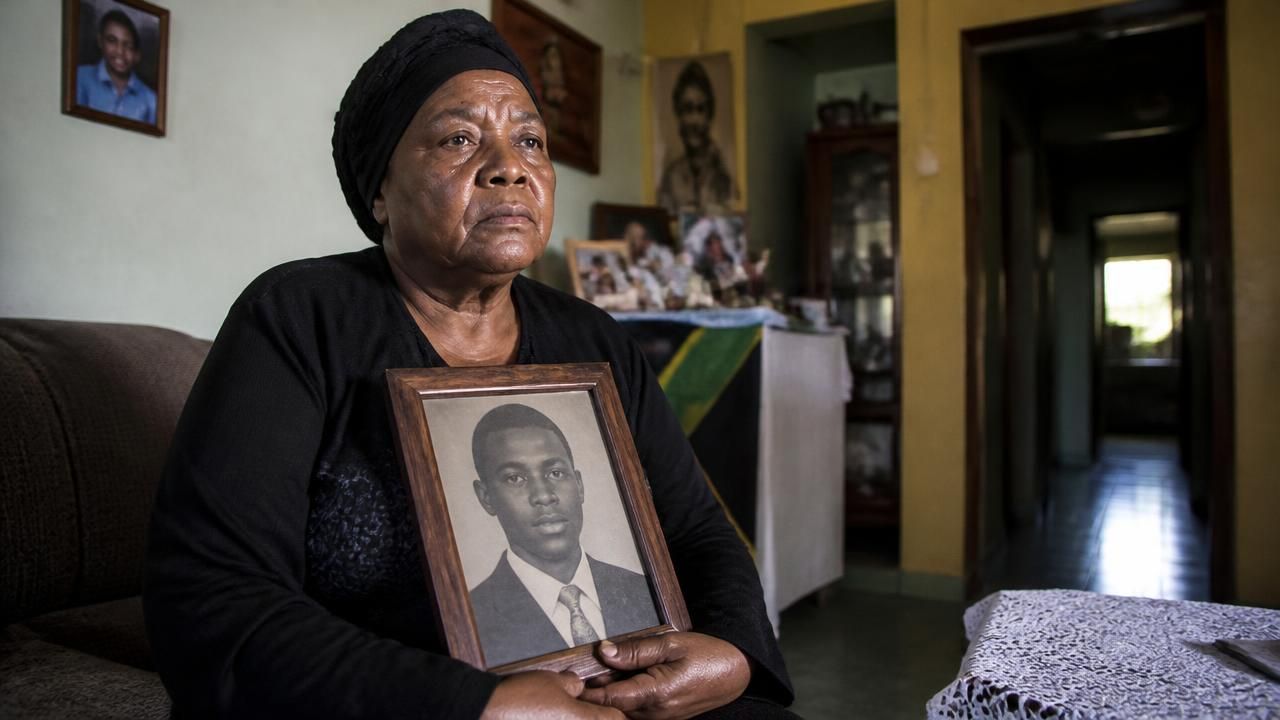
Al Jazeera's coverage of the 66th anniversary centres on the families who are still waiting — not for memorials, which exist, but for investigations, inquests and, in some cases, the identification of the officers responsible. Their grievance is specific and procedural: cases reopened and then stalled, dockets lost, requests for information unanswered. For these families, the language of national healing sits awkwardly beside the paperwork of an unresolved killing.
The two stories are, in effect, the same story told from different angles. One is institutional, examining courts, commissions and reparations policy. The other is personal, anchored in a single square in the Vaal and the households that have carried it for more than six decades.
Pillay and the export of a South African jurisprudence
The Nobel Committee's decision to honour Pillay, as reported by Smithsonian Magazine, adds a global dimension to the domestic argument. Born in Durban in 1941, Pillay came of age as a lawyer under a system that denied her clients basic rights. She became the first woman of colour to establish a legal practice in Natal, defended anti-apartheid activists, and later served as a judge at the International Criminal Court before becoming the United Nations High Commissioner for Human Rights from 2008 to 2014. In recent years she has chaired UN investigative bodies examining grave violations in the Middle East.
Her career is, in one sense, South Africa's most successful export: the idea that a legal order built to legitimise racial hierarchy can be dismantled through law, and that the resulting jurisprudence has value far beyond the country's borders. But the honour also casts an uncomfortable light at home. Pillay's international stature rests on principles — accountability, remedy, the rights of victims — that domestic processes have applied unevenly.
Why the timing matters
Advocates point to three converging pressures. First, demographics: the generation that witnessed 1960 and 1976 is thinning, and courts have repeatedly noted the difficulty of trying cases when witnesses die. Second, jurisprudence: South African courts have grown more receptive to civil claims by victims against the state, creating a pathway that did not exist a decade ago. Third, politics: a governing coalition under strain has less appetite for reopening the moral ledger, but also less ability to ignore it.
- Prosecutions: survivor groups want the NPA's apartheid-era unit resourced and its backlog published.
- Reparations: claimants seek the balance of TRC-recommended payments, plus community reparations for townships devastated by forced removals.
- Records: researchers and lawyers are pressing for the declassification of security-branch archives before they deteriorate.
The counterargument is familiar: amnesty was the price of a peaceful transition, and reopening old cases risks destabilising a settlement that has, for all its failures, held. Yet even sympathetic observers of the 1994 compromise now concede that truth without material remedy has left a durable wound — one that the Sharpeville families and others describe less as history than as an ongoing condition.
Sixty-six years after the shots in Sharpeville, and 32 after the ballot that ended apartheid, the question is no longer whether South Africa will reckon with its past. It is whether it will do so in time for anyone to answer.