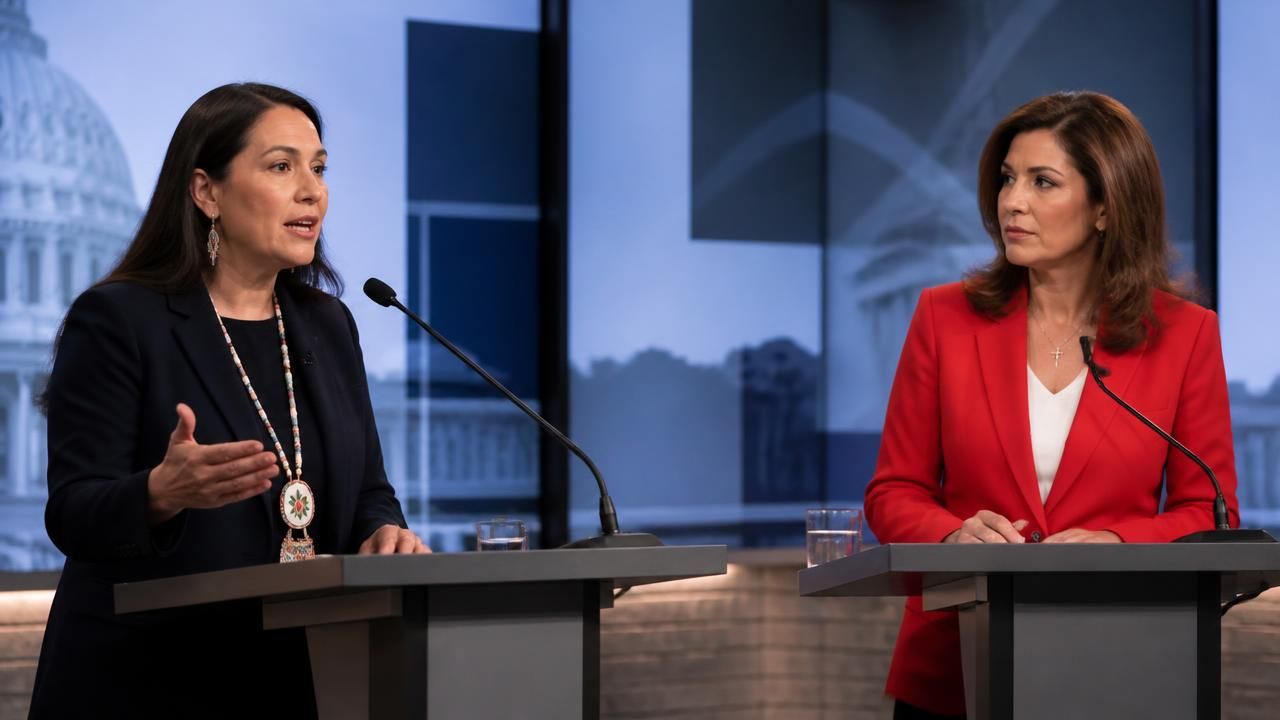
The two major-party candidates for Minnesota's open U.S. Senate seat met Friday for an hourlong debate hosted by MPR News, trading sharply different diagnoses of the state's problems across three dominant themes: welfare fraud, household affordability, and the local fallout from President Donald Trump's policies in Washington.
The forum paired Lt. Gov. Peggy Flanagan, the DFL-endorsed candidate and a former state legislator who has spent nearly a decade in the Tim Walz administration, against Michele Tafoya, the veteran sports broadcaster turned Republican candidate. The race is one of the most closely watched Senate contests of the cycle — a seat made open by an incumbent retirement, in a state that has not elected a Republican statewide since 2006 but where margins have tightened steadily.
The fraud question
Fraud dominated the first half of the debate. Minnesota has spent the past several years absorbing the consequences of the Feeding Our Future scandal, in which dozens of people were charged in a scheme to divert hundreds of millions of dollars in federal child-nutrition money, alongside separate prosecutions involving autism therapy billing and child care assistance payments. Legislative hearings, audits and an ongoing federal inquiry have kept the issue in local headlines and turned it into a central Republican line of attack.
Tafoya and her allies have argued that the pattern represents a failure of Democratic governance — that oversight agencies grew lax and that the state was slow to act once warning signs appeared. Flanagan, for her part, has pointed to stepped-up audit capacity, new fraud-detection authority and the fact that prosecutions are proceeding, framing the issue as a law-enforcement matter rather than an ideological one.
The sharpest exchange of the night came over whether fraud was fundamentally a story about accountability in St. Paul or about the cost of government — a framing battle that will define the race's final weeks.
From fraud to 'affordability'
That framing battle is the subject of intense interest among Republican strategists. As one line of coverage put it bluntly, the central question is whether the GOP can convert outrage over fraud into a credible affordability argument — treating public money lost to schemes as money that could have gone back to taxpayers squeezed by grocery bills, insurance premiums, heating costs and rent.
The bridge is not automatic. Polling in Minnesota and nationally has consistently shown that cost of living is the top issue for voters across party lines, and it is a subject on which Democrats have struggled to gain traction since the inflation surge of 2022. But voters also tend to distinguish between corruption in distant programs and their own household budgets, and Democrats have worked to localize the affordability debate around prescription drug costs, child care and housing supply — areas where Flanagan has a long record in state government.
Trump as the third candidate on stage
The Trump administration's policies loomed over much of the debate even where the president's name was not invoked. Federal workforce reductions have hit Minnesota's sizable public-sector and contractor economy; tariff actions have created uncertainty for manufacturers, farmers and the state's medical-device and food-processing employers; and immigration enforcement operations have intensified debate in the Twin Cities about federal agents' role in local communities.
Flanagan leaned on those consequences, warning that federal cuts and tariff volatility are filtering down to Minnesota households and small businesses, and casting the race as a choice about who will defend the state's interests in Washington. Tafoya countered that the administration's agenda — tighter borders, spending restraint, deregulation — addresses the underlying causes of stagnation, and she argued that Minnesota's Democratic leadership has made the state an outlier on taxes and regulation.
Beyond fraud and Trump
Beneath those dominant themes, other issues are quietly shaping races up and down the ballot. Health care costs and hospital consolidation remain potent in greater Minnesota, where rural closures have made access a kitchen-table concern. Education — from pandemic-era learning loss to school funding formulas — animates suburban parents. Agriculture and mining are live questions, with the long-contested copper-nickel proposals in the north and a soft farm economy pressuring rural counties. And housing, child care shortages and the state's aging workforce come up repeatedly in focus groups regardless of party.
Demographics and geography will matter as much as message. The DFL relies on overwhelming margins in Minneapolis and St. Paul and increasingly in the inner-ring suburbs, while Republicans need to run up totals in exurban and outstate Minnesota. Trump came within roughly four points of carrying the state in 2024, and Republican strategists see the fraud controversy as a rare opportunity to cut into Democratic margins in the suburbs by pairing a corruption message with a cost-of-living one.
What to watch
With the debate now behind them, both campaigns will test which frame travels. Expect Tafoya and allied groups to keep fraud at the center of paid advertising, tying it explicitly to taxes and prices. Expect Flanagan to keep the conversation on household costs and on the consequences of federal policy, while trying to deny Republicans the accountability narrative that has proven durable in other states.
- The fraud frame: Whether voters treat the scandal as a governance failure or as a prosecution already underway.
- The affordability frame: Which candidate can credibly claim to lower costs for middle-income families.
- The Trump frame: How much federal policy — layoffs, tariffs, enforcement — matters in a state that has voted Democratic in every presidential race since 1972.
Friday's debate did not settle those questions. But it clarified the battlefield: a race that began as a referendum on Washington is now being fought over what happened in St. Paul — and what that has cost Minnesota households.