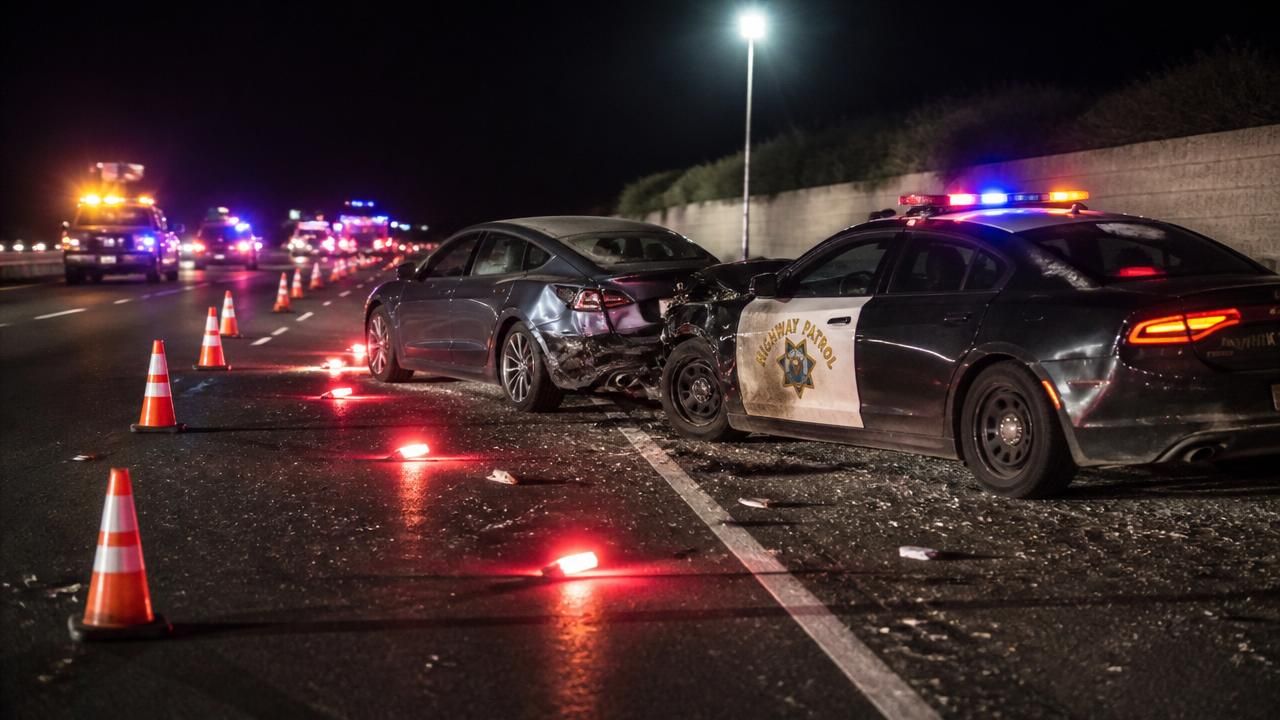
A Tesla driver told investigators he was asleep behind the wheel with the company's Full Self-Driving (FSD) system engaged when his car plowed into two California Highway Patrol vehicles parked at the scene of an earlier crash, seriously injuring two officers, authorities said.
The crash, captured on video released by the CHP's Solano area office, shows the Tesla traveling at highway speed past a gauntlet of warning flares, traffic cones and flashing emergency lights before slamming into the rear of a parked patrol vehicle. The two officers, who were working a separate incident at the time, were taken to a hospital with serious injuries.
A Driver Allegedly Asleep at Highway Speed
According to accounts of the incident, the driver reported being unconscious for the duration of the approach — an interval that, at highway speeds, would have spanned several seconds of unimpeded travel through a clearly marked emergency zone. Separate reporting described the driver as being asleep at roughly 60 mph while FSD was active.
The scenario is the nightmare version of a problem regulators and safety advocates have flagged for years: a system marketed with a name that implies autonomy, paired with a driver who treats that name literally. Tesla has for years told owners that FSD is a "supervised" system requiring an attentive driver with hands on the wheel and eyes on the road, and its onboard monitoring systems are designed to issue escalating warnings — and eventually disengage the feature — when it detects inattention.
The CHP's Blunt Warning on 'Full Self-Driving'
The California Highway Patrol did not mince words in its public statement on the collision, drawing a direct line between the branding of the technology and the conduct of the driver.
"Despite its name, full self-driving is not fully autonomous. Technology does not relieve drivers of their responsibility to safely operate their vehicles."
The statement reflects a recurring tension in the rollout of advanced driver-assistance systems. Automakers — Tesla most prominently — have pushed incrementally toward automation through over-the-air software updates, while state and federal authorities insist the legal and moral burden remains squarely on the human in the driver's seat.
The framing across outlets differed sharply. The Verge emphasized the technical and policy dimensions, foregrounding the CHP's language about autonomy and responsibility. The New York Post leaned into the spectacle, describing the "outrageous moment" a sleeping driver got a "rude awakening." Other coverage, syndicated across MSN and Yahoo, led with the human toll — two officers hospitalized — and the driver's own admission.
Mounting Scrutiny From Washington
The incident lands amid intensifying political pressure on Tesla's driver-assistance suite. An Illinois congressman has called for a formal probe into both Autopilot and FSD after a wave of widely circulated videos showing drivers asleep, distracted or otherwise disengaged while the systems were active.
Those calls add to a broader regulatory backdrop: the National Highway Traffic Safety Administration has spent years investigating crashes in which Autopilot was engaged, and has repeatedly pushed Tesla toward more robust driver-monitoring safeguards. The agency has the authority to require recalls when it determines a system poses an unreasonable safety risk — a lever it has used against the company before.
Critics argue the core problem is one of naming and expectation-setting. "Autopilot" and "Full Self-Driving" convey capabilities the systems do not reliably possess, they contend, encouraging exactly the kind of over-trust that allegedly occurred here. Tesla has countered that its manuals, in-car prompts and marketing disclaimers make the limits clear, and that misuse by a minority of drivers should not define the technology.
Tesla's Answer: More Automation, Not Less
Even as the crash renews questions about driver vigilance, Tesla is moving in the opposite direction technically — adding layers of automated intervention designed to act when humans fail. Among the company's newer capabilities is a crash-avoidance feature that can seize the steering wheel to steer around or mitigate an impending collision, functioning even in vehicles where FSD was never activated.
Such features are a double-edged response. On one hand, they can prevent or soften the kind of impact that injured the two CHP officers. On the other, they reinforce the perception that the car — not the driver — is ultimately in charge, which is precisely the assumption safety officials say is dangerous.
What Happens Next
The injured officers' recovery and the outcome of any investigation into the driver will unfold over the coming weeks. But the broader questions — whether marketing language should be constrained, whether driver-monitoring systems are adequate, and whether a system called "Full Self-Driving" can coexist with a legal regime that requires a human to be fully engaged — are unlikely to be resolved by a single crash.
- Two officers from the CHP's Solano area office were seriously injured and hospitalized.
- The driver told authorities he was asleep with FSD engaged at the time of impact.
- Video evidence shows the Tesla passing flares, cones and emergency lighting before striking a parked patrol unit.
- Political pressure is building, with an Illinois congressman seeking a federal probe of Autopilot and FSD.
- Tesla continues to ship automated safety interventions, including a steering-based crash-avoidance function.
For now, the CHP's message stands as the most concise summary of the dilemma: the technology may be improving rapidly, but on today's roads, the responsibility still belongs to the person in the driver's seat — asleep or otherwise.