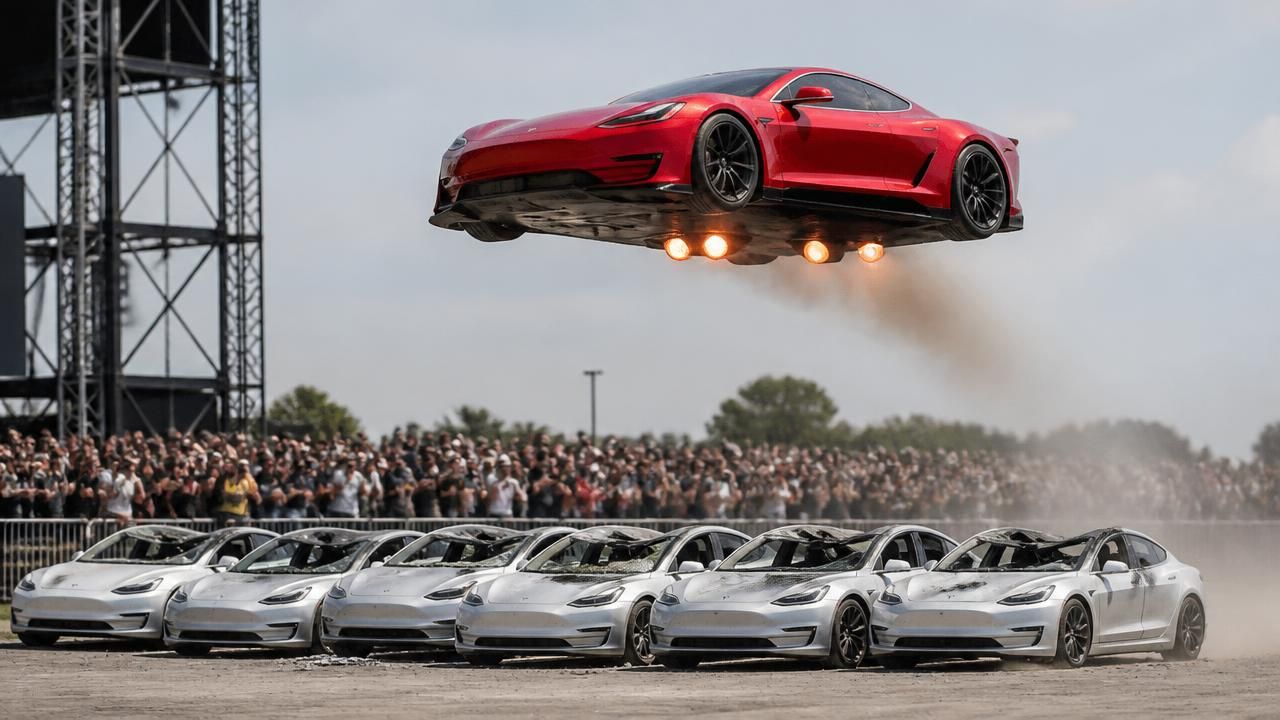
Tesla's long-promised, repeatedly delayed Roadster returned to the public eye this week — not on a motor show stand, but in the air. At an event in Waco, Texas, the company demonstrated a next-generation version of its electric supercar accelerating from 0 to 60mph in under a second, driving upside down, briefly flying, and — in one flourish reported by Swedish outlet Metro Mode — jumping over five cars.
The whole affair ran less than 30 minutes and, by the account of The Verge, "felt more like a stunt show than a product reveal." There was no mention of price, no release window beyond a vague promise of production in 2028, and no technical briefing. What the audience got instead was spectacle: a car pinned to a wall, a car briefly airborne, and a stopwatch reading that would embarrass a Formula 1 team.
"Elon Musk promised a flying car. And the Tesla Roadster did exactly that." — The Verge
What Actually Happened in Waco
According to reports from the demonstration, the Roadster — widely dubbed the Roadster 2 — used cold-gas thrusters derived from SpaceX technology to achieve maneuvers no conventional vehicle can manage. Car Dealer Magazine described the unveiling as Tesla "launching a 'flying' car," with the SpaceX thrusters positioned as the centrepiece of the machine.
The thrusters appear to serve two functions: altering the car's attitude mid-air, and generating downforce strong enough to hold the vehicle against a vertical surface — the "sucks to wall" trick that produced the upside-down driving footage. In the air, the same hardware lets the car rotate and stabilize without relying on aerodynamic surfaces.
The sub-one-second 0-60 time, meanwhile, is a figure that would make the car dramatically quicker than any current production vehicle, including the Rimac Nevera and the Lucid Air Sapphire, both of which sit in the sub-two-second range under ideal conditions. Tesla has not said whether that number was achieved with or without the thrusters engaged — a distinction that matters enormously for anything destined for public roads.
The Caveats Nobody Announced
The Verge was blunt that the car "likely will come with some heavy caveats and restrictions if it ever goes into production." Those caveats are substantial, and Tesla addressed none of them on stage:
- Legality. Cold-gas thrusters and flight capability fall far outside federal motor vehicle safety standards. A road-legal version would require either regulatory frameworks that do not currently exist or a heavily detuned production model.
- Price. Not mentioned. The original Roadster reservation programme asked customers for deposits, and a Founder's Series tier demanded a substantial up-front commitment.
- Timing. Musk said 2028. He has said similar things before.
- Homologation. No word on which markets, if any, could register such a vehicle.
From Vaporware to Showroom?
The scepticism is not idle. The Roadster was first unveiled in 2017, alongside the Tesla Semi, with a promised arrival of 2020. That slipped to 2021, then 2022, then "indefinitely." The Verge's follow-up coverage carried a notably dry headline: The Tesla Roadster could have stayed vaporware. That framing captures the central tension of the Waco event — a demonstration that proves capability without proving a product.
For Tesla, the stakes are different than they were in 2017. The company faces softening EV demand, intensifying competition from Chinese manufacturers, and a share price that has swung on Musk's political entanglements as much as on vehicle sales. A hypercar halo project does little for quarterly deliveries, but it does something arguably more valuable: it generates attention.
How the World Covered It
The coverage split neatly along geographic lines. US tech and business outlets — The Verge foremost among them — framed the event as a marketing stunt with unresolved engineering and regulatory questions. Aggregators on MSN ran the story straight, with headlines emphasizing the raw spectacle: "Flying cars: Tesla's new Roadster uses SpaceX thrusters to turn in the air, can drive upside down."
International outlets leaned harder into wonder. Metro Mode's Swedish coverage led with the car driving "up and down" and jumping five vehicles. Car Dealer Magazine, writing for a trade audience, treated it as a genuine launch. And Chinese-language coverage on Yahoo Taiwan framed the whole thing as an air-stunt curiosity — "跑車也玩空中特技?" — a rhetorical question about whether a sports car playing acrobat is impressive or absurd. The answer, evidently, depends on which side of the Pacific you're reading from.
What Comes Next
Tesla has given itself until 2028 to turn a Waco stunt into a production car. Between now and then lie questions about battery energy density, structural reinforcement for thruster loads, crashworthiness, insurance, and whether any regulator on earth will sign off on a vehicle that can leave the ground.
There is also the more prosaic question of whether customers still care. The original Roadster reservation holders have waited nearly a decade. Musk's promise this week was, functionally, an extension of that wait — dressed up with fire, flight, and a stopwatch.
It was, by any measure, a remarkable demonstration. Whether it was a product announcement remains, for now, an open question — and Tesla's own track record is the strongest argument for doubt.