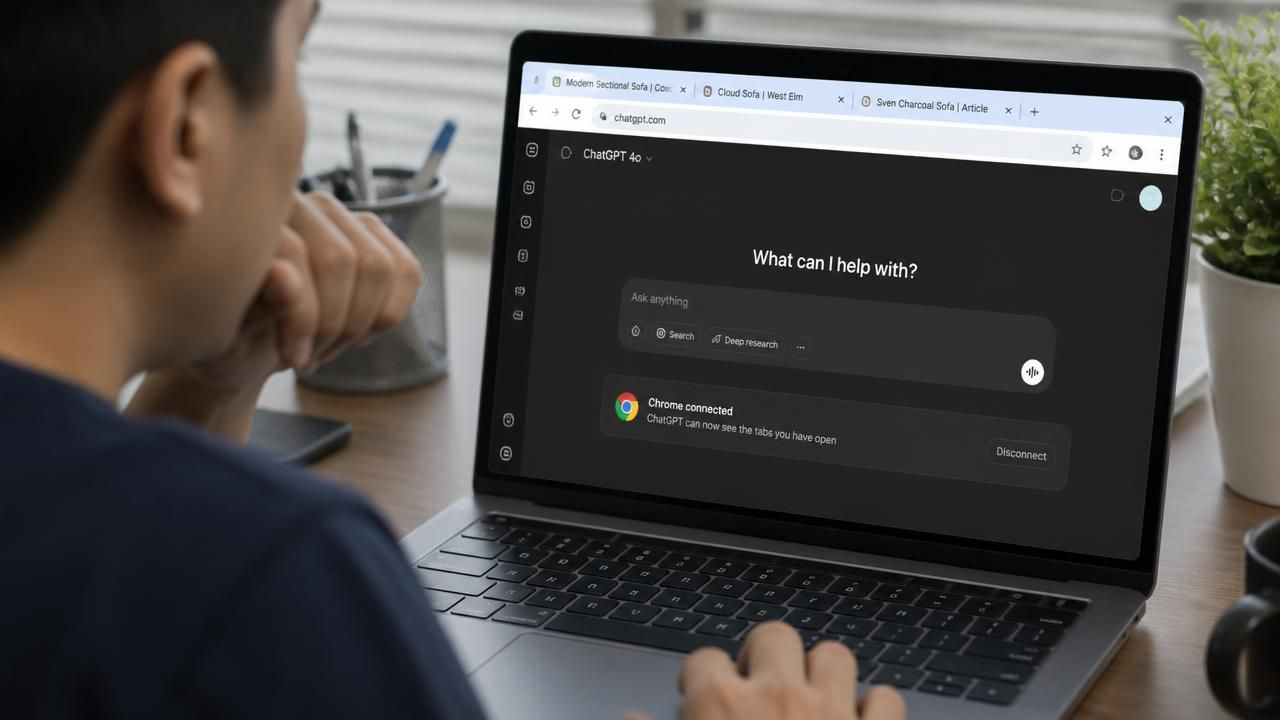
OpenAI is quietly turning Google Chrome into an extension of ChatGPT. The company announced a set of upgrades to its ChatGPT Chrome extension that allow the assistant to read and reason over the browser tabs a user already has open, effectively handing the chatbot a live view of a person's web session. The feature works when users tag Chrome inside ChatGPT's web or desktop app, per The Verge, which first reported the rollout.
The headline capability is what OpenAI is calling "computer use" for the browser — the ability for ChatGPT to perceive and act on what's on screen rather than waiting for a user to paste in text. In a demo video, a user asks ChatGPT to compare three open tabs containing sofas they are considering buying, and the assistant pulls details from each page to produce a side-by-side comparison.
What the update actually does
According to coverage of the announcement, the extension can now:
- Read open tabs — ChatGPT can pull context from the browser tabs currently active in a session when Chrome is tagged in the app.
- Ingest YouTube videos — the assistant can pull information from video pages, not just static article text.
- Use highlighted text — selections on a page can be handed directly to the model as context.
- Execute multi-step tasks — OpenAI frames this as the foundation of agentic browsing, where the model completes work on the user's behalf rather than merely answering questions.
"A few big upgrades for Chrome users today! We're bringing the power of computer use to anyone who uses Chrome. First up: ChatGPT can now use your tabs in Chrome to make answers more useful and get things done for you."
The framing is deliberate. OpenAI is not selling a new product so much as an upgrade to a surface people already use every day. By living inside Chrome — the world's most widely used browser — the assistant reaches users without requiring them to switch habits, install a new browser, or migrate their bookmarks and passwords.
The Google problem
That is precisely what makes the move strategically awkward for Google. Chrome is Google's distribution moat, and its own assistant, Gemini, has been steadily gaining browser-side capabilities, including tab comparison and AI-generated summaries. As one outlet put it, ChatGPT is now "coming for one of Google's smartest Chrome features" — the kind of contextual, tab-aware intelligence that Google has promoted as a reason to stay inside its ecosystem.
Google's advantage has always been integration: the browser, the search index, the assistant, and the operating system under one roof. OpenAI's counterargument is that it does not need to own the browser if it can own the layer of intelligence sitting on top of it. If a user's questions, comparisons, and tasks are routed through ChatGPT rather than Gemini, the value — and the data — accrues to OpenAI instead.
The Atlas question
The update lands amid confusing signals about OpenAI's broader browser ambitions. The Verge characterized the standalone ChatGPT Atlas browser as "gone," describing the Chrome extension as the successor to that effort. Other coverage tells a different story: one outlet reported a substantial Atlas update adding iCloud passkey support, vertical tabs, and more, while another covered OpenAI's original announcement of Atlas as "an AI-enabled web browser to challenge Google Chrome."
The discrepancy may reflect a distinction between the deprecated early iteration of Atlas and a newer release, or simply the speed at which OpenAI is shipping and reshuffling products. Either way, the direction of travel is consistent: OpenAI wants its assistant embedded wherever browsing happens, whether it controls the browser or not.
Hands-on impressions: useful, and a little unnerving
Early testers describe the experience as genuinely practical. One reviewer who handed ChatGPT access to "my mess of open Chrome tabs" reported that it organized the chaos into something useful — turning dozens of half-read articles and abandoned shopping pages into structured summaries. Another tester came away arguing that the new ChatGPT browsing experience makes Chrome "feel like a dinosaur," a pointed compliment given that Chrome remains the default for most of the web.
That enthusiasm comes with familiar caveats. Handing an AI assistant visibility into every open tab means handing it a portrait of your work, your research, your purchases, and your half-finished thoughts. OpenAI has positioned the feature as opt-in and user-triggered — the assistant only looks when tagged — but the practical effect is that a growing share of browsing activity becomes model input.
Why it matters beyond one extension
The tab-reading feature is best understood as a milestone on the road to agents. "Computer use" — a model operating software the way a person does, by looking at a screen and clicking — is the technical foundation for AI that books reservations, fills out forms, and completes multi-step workflows without human hand-holding. Chrome, with its billions of users and its vast surface area of forms, dashboards, and checkout flows, is the most valuable training ground and deployment target imaginable.
It also intensifies a distribution fight that now spans browsers, operating systems, and default assistants. Microsoft has pushed Copilot into Edge and Windows; Google has Gemini in Chrome; Anthropic and Perplexity have shipped their own browsing tools. OpenAI's Chrome extension is a low-friction flanking maneuver in that contest — one that lets it compete on Google's home turf without asking users to leave it.
For now, the update is rolling out to Chrome users of ChatGPT's web and desktop apps. The larger question — whether the browser becomes a neutral stage for competing AI assistants, or a battleground where each platform favors its own — is only beginning to be answered.