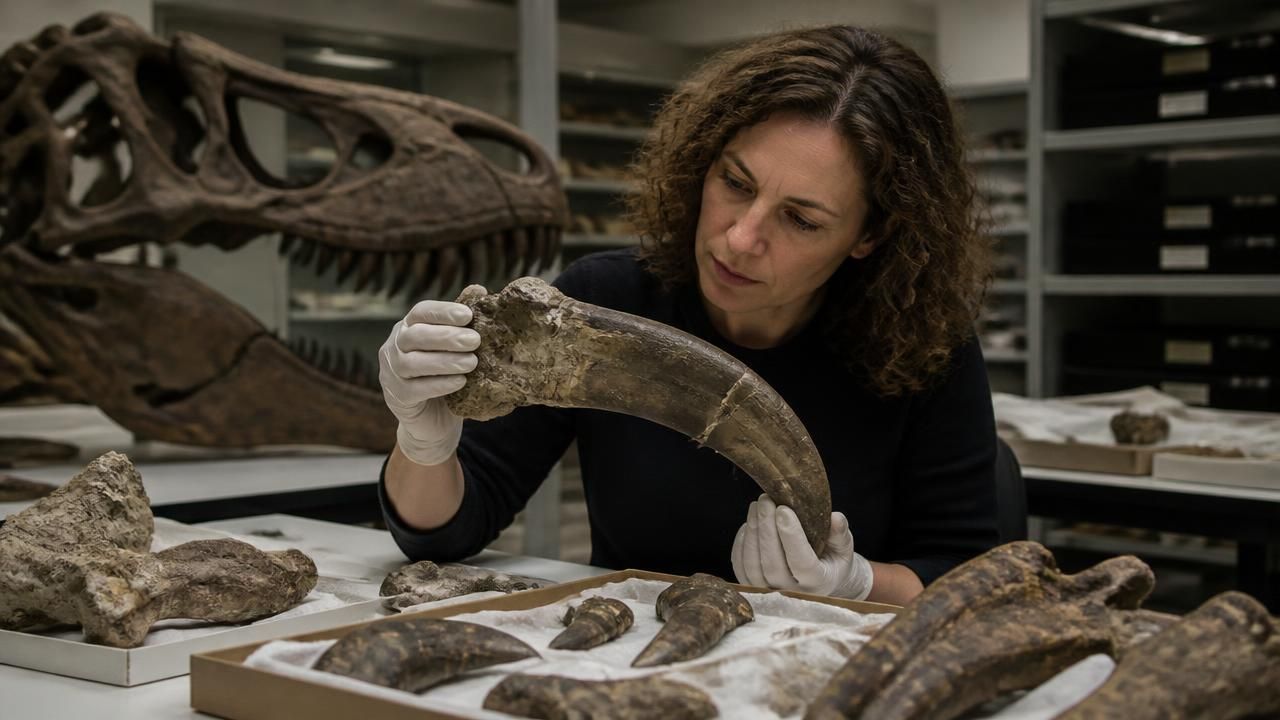
A fossil that sat unstudied in a museum collection for nearly a century has been identified as a previously unknown species of predatory dinosaur — a tiger-sized hunter armed with enormous claws that scientists describe as anatomically bizarre and, pound for pound, potentially more lethal than a Tyrannosaurus rex.
The 120-million-year-old remains, announced this week, push the known range of a mysterious group of dinosaurs called megaraptorans into Europe for the first time, offering a rare window into how these animals evolved into some of the largest hunters of the Cretaceous. News of the discovery circulated widely, though different outlets emphasized strikingly different angles — from the sheer scale of the creature's weaponry to its resemblance to a feathered bear.
A Specimen Hiding in Plain Sight
The story begins not in the field but in storage. According to Science Daily, the fossil was collected roughly a century ago and then effectively forgotten, its bones catalogued but never properly analysed. Only when researchers revisited the specimen did they recognise a suite of features that matched no known dinosaur.
That rediscovery places the find in a growing tradition of museum-based paleontology, in which overlooked drawers and mislabelled cabinets yield major discoveries. The identification required the kind of detailed comparative anatomy that depends on patience as much as luck: measuring claw curvature, counting teeth, and mapping the architecture of limb bones against global collections.
What the Bones Reveal
Several outlets seized on the most dramatic details. One headline described "3-foot claws, tons of teeth," while the source material labelled the animal "anatomically bizarre" — a description that, in paleontological terms, is high praise rather than an insult. Like other megaraptorans, the animal appears to have combined a relatively slender, lightweight build with disproportionately large, sickle-like claws on its forelimbs and a long, tooth-studded jaw.
"The tiger-sized predator also provides the first evidence of megaraptorans in Europe, helping explain how these mysterious dinosaurs eventually became gigantic hunters," Science Daily reported.
That combination — modest body size, outsized weaponry, and a skull full of teeth — has fuelled debate for years over how megaraptorans actually hunted. Some researchers argue the claws were used to grapple and pin struggling prey; others suggest they were better suited to slashing or to hooking into carcasses. Because no stomach contents or associated kill sites have been found, the question remains open.
Why Europe Matters
The geographic implication may ultimately prove more scientifically significant than the claws themselves. Megaraptorans are best known from South America, with additional fossils from Australia and Asia. A European representative would substantially widen the group's known distribution and complicate existing models of how the lineage spread across the globe during the Early Cretaceous — a period when rising seas fragmented continents into island archipelagos.
If megaraptorans were present in Europe, the group may have been far more widespread and ecologically adaptable than the fossil record has so far suggested, occupying mid-tier predator niches before some lineages grew into apex giants tens of millions of years later.
The 'Feathered Bear' Framing
A separate strand of coverage focused on a fossil from China, described as a giant-clawed dinosaur that "may have looked like a feathered bear." That comparison, while vivid, reflects a genuine shift in how dinosaurs are reconstructed: growing evidence that many theropod lineages carried filamentous or fully developed feathers, and that some had bulky, shaggy silhouettes quite unlike the sleek, scaly reptiles of older museum murals.
The two finds may be related — or may simply illustrate that giant-clawed predators were evolving similar body plans in different parts of the world. The reporting does not fully resolve the geographic overlap, and readers should treat the European and Asian threads as distinct claims that specialists are still working to reconcile.
How the Story Was Framed
- Science-focused coverage led with the century of neglect and the scientific significance: first European megaraptoran, clues to gigantism.
- Popular outlets led with spectacle: three-foot claws, "tons of teeth," and a comparison to T. rex as the benchmark of danger.
- Wire and aggregator coverage emphasised the institutional backstory — a fossil overlooked for 100 years before earning a species name.
- Reconstruction-minded coverage stressed appearance, asking what the animal actually looked like and pointing to feathered, bear-like possibilities.
The T. rex comparison deserves scrutiny. A tiger-sized animal would be vastly smaller than the 8-tonne tyrant lizard, and any claim about danger to humans is speculative pop-science framing rather than a measurable finding. What the comparison captures is the density of weaponry relative to body size: claws proportionally larger than those of many far bigger predators.
What Comes Next
Peer-reviewed description is only the first step. Researchers will now need to place the new species in a phylogenetic analysis, test whether it is genuinely a megaraptoran or represents a convergent lineage that independently evolved similar claws, and re-examine other overlooked specimens from the same formation and era.
For museums, the lesson is pointed: collections assembled a century ago, under very different scientific assumptions, remain a frontier. For the public, the payoff is a reminder that the dinosaur story is still being rewritten — sometimes from bones that have been sitting quietly in a drawer the whole time.