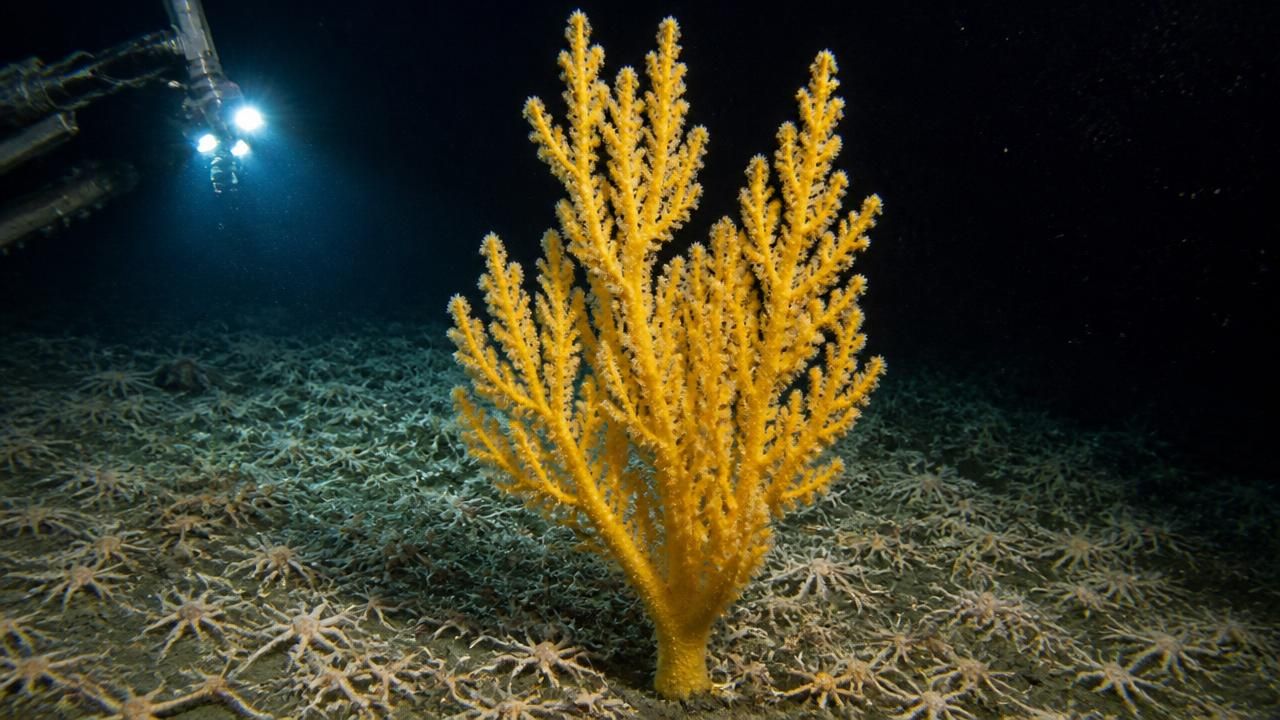
Marine biologists working the deep seamounts off the coast of Costa Rica have pulled from the darkness something that did not fit anywhere in the existing catalogue of life: a brilliant yellow coral, standing roughly a meter tall, whose genetic code belongs to no known coral family. The discovery, reported this week, forced researchers to do something rare in modern taxonomy — erect an entirely new family to hold a single, spectacular organism.
The species has been given the name Laurinque elenya, a Tolkien-inspired construction the researchers translate as "golden tree of the stars." The name is a nod to both the coral's luminous, branching form — golden trunks lifting off the seafloor like trees in an autumn wood — and to the constellation of brittle stars that carpets the sediment around it, their arms radiating outward in every direction.
A coral that refused to be classified
What made the find extraordinary was not merely its appearance but its isolation. When the team subjected samples to advanced genetic analysis, comparing mitochondrial and nuclear markers against the broader coral tree of life, the results refused to resolve into any accepted family. The lineage had branched off so long ago — and in such a direction — that its nearest living relatives are, evolutionarily speaking, distant cousins.
The colonies rise more than a meter above a seafloor carpeted with brittle stars, a sight that led the team to a name drawn from Tolkien's Elvish: the golden tree of the stars.
In coral taxonomy, family-level distinctions are not handed out lightly. The order Scleractinia — the stony corals — contains dozens of families, most of them defined by a mix of skeletal architecture, polyp anatomy and, increasingly, molecular data. Adding an entire family for one genus is the biological equivalent of discovering a new chapter rather than a new sentence. It signals that the deep sea still holds lineages whose divergence predates much of what scientists have catalogued in shallower, better-studied waters.
Reading a new branch on the tree of life
That framing is exactly how several outlets covered the story. One aggregator headline emphasized the strangeness — a coral "so strange scientists created a new family for it" — while another leaned on the metaphor of descent, describing the find as a new branch grafted onto the tree of life. Both readings capture the same scientific fact from different angles: novelty, and kinship.
The distinction matters for how the public absorbs deep-sea science. The "too strange to classify" angle foregrounds wonder and the limits of human taxonomy. The "new branch" angle foregrounds evolutionary history — the idea that this coral is not an anomaly but a surviving witness to an ancient radiation that has otherwise gone unrecorded. In practice, the two are inseparable. A lineage becomes "strange" precisely because it is old, and it is discoverable precisely because it still exists.
The seamounts that keep producing surprises
The coral was collected from deep-sea seamounts — submerged mountains that rise from the ocean floor and act as biological magnets. Seamounts accelerate currents, sweeping nutrient-rich water across their flanks and supporting dense communities of filter feeders: corals, sponges, crinoids, brittle stars. Because they are isolated from one another like islands, seamounts are also evolutionary laboratories, where populations diverge in isolation and endemism runs high.
Costa Rica's Pacific seamounts have become a focal point for exactly this reason. Over the past decade, a series of expeditions using remotely operated vehicles and deep-diving submersibles has returned with a steady stream of new species — from octopus nurseries to previously unknown sponges and now, apparently, an entirely new coral family. The pattern suggests that the region's biodiversity is not merely rich but structurally under-described.
Why the discovery resonates beyond taxonomy
The find lands at an awkward moment for the deep sea. Interest in seabed mining, particularly for polymetallic nodules rich in cobalt, nickel and manganese, is intensifying across the Pacific. Seamounts and abyssal plains are squarely in the crosshairs. A coral that took millions of years to diverge — and that occupies a niche scientists are only beginning to understand — is a reminder of how poorly the baseline is known before industrial activity begins.
Conservation scientists argue that family-level discoveries are a particularly useful lever in that debate. A single new species can be dismissed as a local curiosity. A new family, by contrast, represents a substantial chunk of evolutionary history with no substitute elsewhere. Losing it would not be a local extinction but the erasure of an entire branch.
- What was found: A meter-tall, bright yellow branching coral on deep seamounts off Costa Rica.
- Why it is significant: Genetic analysis placed it outside all known coral families, requiring a new family to be described.
- What it is called: Laurinque elenya, or "golden tree of the stars," a Tolkien-derived name.
- Where it lives: Seamount habitats carpeted with brittle stars, in a region under growing pressure from deep-sea mining interest.
What comes next
The immediate scientific task is replication: additional sampling to determine how far the species ranges, whether it forms forests or isolated colonies, and how it reproduces in cold, dark water. Researchers also want to sequence more of the genome to pin down when the lineage split from its nearest relatives — a date that could reshape timelines for coral evolution more broadly.For now, the coral stands as a rare thing in modern biology: a genuinely new limb on the tree of life, found not in a remote jungle or an unexplored cave, but on a seamount that scientists had already visited. That is perhaps the most pointed lesson of the discovery. The deep ocean is not finished surprising us — it has barely begun.