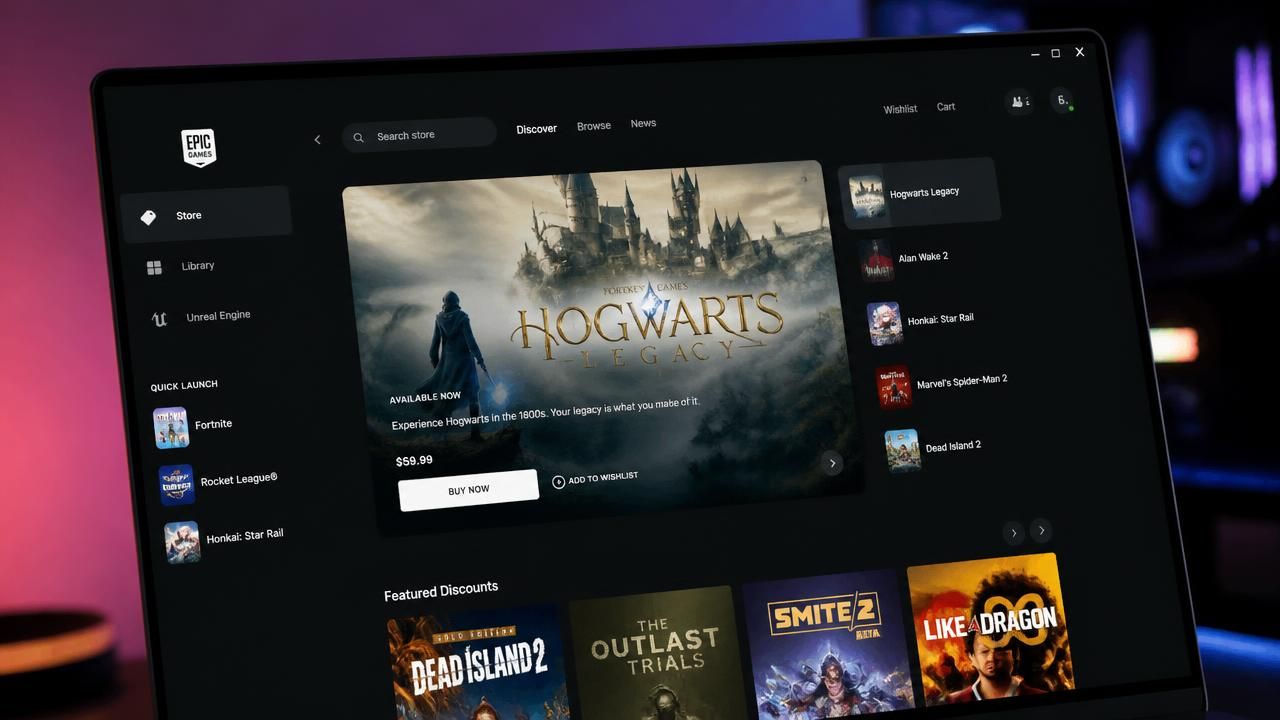
Epic Games has released a public "Preview" build of a completely rewritten Epic Games Launcher, and the company is making no apologies for how it was built. In a blog post announcing the release, Epic leaned into the internet's favorite new software-development shorthand: "Programming is hard. So, instead of doing that, we vibe coded a new Epic Games Launcher that's way faster and more responsive than the current one, and has a new look."
The framing is deliberately playful, but the claims underneath it are aggressive. Epic says the new launcher starts up 46 percent faster than Steam, that the overall experience is roughly 1.8x faster than Valve's rival client, and — according to one Epic talking point amplified by IGN — that "the library loads 30x faster" than before. The Preview build is available now on Windows and Mac, with a Linux version promised.
What Epic actually built
According to Epic Games Store General Manager and VP Martin Keely, the new launcher is not a refactor of the existing codebase. The team, he told PC Gamer, "started from scratch" and used AI as "a tool to write and review new features and new capabilities from the ground up in a different tech stack than what we had previously." The goal, he said, was to "look at functionality that existed [in the current Epic Games Launcher] and [say] we want to replicate that, but not the code itself."
Speaking to IGN, Keely framed the AI usage in practical, headcount terms rather than technological triumphalism: it "made us more efficient and allowed a small team to rewrite the code base and be able to launch it faster across platforms, support Windows and Mac, and we're going to have a Linux version as well."
"Programming is hard. So, instead of doing that, we vibe coded a new Epic Games Launcher that's way faster and more responsive than the current one." — Epic Games
"Vibe coding" — a term popularized in early 2025 to describe generating software by describing intent to an AI model and accepting the output with minimal manual review — has become a loaded phrase in developer circles. Used sincerely, it implies speed and lower cost. Used derisively, it implies code nobody fully understands.
Linux, Fortnite, and anti-cheat
Perhaps the most concrete engineering news buried in the marketing is Epic's renewed commitment to Linux. GamingOnLinux reports the Preview launcher ships with native Linux support, and that Epic is upgrading Easy Anti-Cheat as part of a push to finally bring Fortnite to Linux — a long-standing request from the platform's community, and a notable reversal for a company whose anti-cheat technology has historically been a hard blocker for Linux and Steam Deck players.
That detail matters more than the startup benchmarks for a segment of PC gamers who have spent years dual-booting Windows purely for a handful of Epic-published titles. If Epic delivers, it also quietly strengthens the case for Linux as a viable gaming platform — a cause Valve has championed with Proton and SteamOS.
Eight years of chasing Steam
Epic launched its Game Store and launcher in December 2018, positioning itself as the first serious challenger to Steam's near-monopoly on PC game distribution. Its pitch was economic: an 88/12 revenue split for developers versus Steam's 70/30, a steady stream of free weekly games for users, and aggressive timed-exclusivity deals.
Eight years on, Epic has won legal battles against Apple and Google over mobile app store rules and built Fortnite into a cultural institution, but the launcher itself has remained a persistent punching bag — frequently criticized for slow startup, sluggish library navigation, and a feature set that trails Steam's. The new Preview build is, in effect, Epic's attempt to remove its most-cited liability.
How the coverage split
Reaction across the tech and gaming press divided sharply along the framing of Epic's own blog copy. Outlets such as Ars Technica, Wccftech, VideoCardz, and Inven Global led with the benchmarks — "1.8x Faster Than Steam," "Crushes Steam In Speed Tests" — treating the story as a straightforward performance and platform-expansion announcement.
Others foregrounded the joke. MSN syndications ran headlines like "Epic's bulletproof plan to outdo Steam: 'We vibe coded the Epic Games Launcher'" and "announce company we're somehow supposed to see as a serious Steam competitor," capturing the skepticism of a PC audience that has heard Epic's promises before. The Outerhaven was blunter still, running the piece under the headline "Epic Games Is Getting Playful About Its 'Vibe Coded' Launcher, but I'm Not Laughing," and questioning what accepting AI-generated code at this scale means for stability and security.
That tension — between a genuinely notable engineering and platform story and a marketing line that invites eye-rolling — is the real story here. Epic's decision to lead with a self-deprecating meme rather than a technical whitepaper is itself a strategic choice: it signals that AI-assisted development is now mainstream enough at a major publisher to be a punchline, not a scandal.
What to watch
- Verified benchmarks: Epic's 46 percent and 1.8x figures are self-reported. Independent timing against Steam on identical hardware will determine whether the gains are real or relative to a poorly optimized baseline.
- The Linux rollout: Native launcher support is here; Fortnite on Linux via upgraded Easy Anti-Cheat is the milestone that will actually matter to that community.
- Code quality at scale: Epic says humans reviewed AI-written features. Whether the vibe-coded launcher holds up under years of patching — and scrutiny from security researchers — is an open question.
- Competitive pressure: Valve has not meaningfully redesigned Steam's startup path in years. If Epic's numbers hold, expect that to change.
For now, the Preview build is opt-in and Epic is inviting feedback. But the company has already made its bet clear: in 2026, the fastest way to compete with a 20-year-old incumbent may not be better programming — it may be not programming at all.