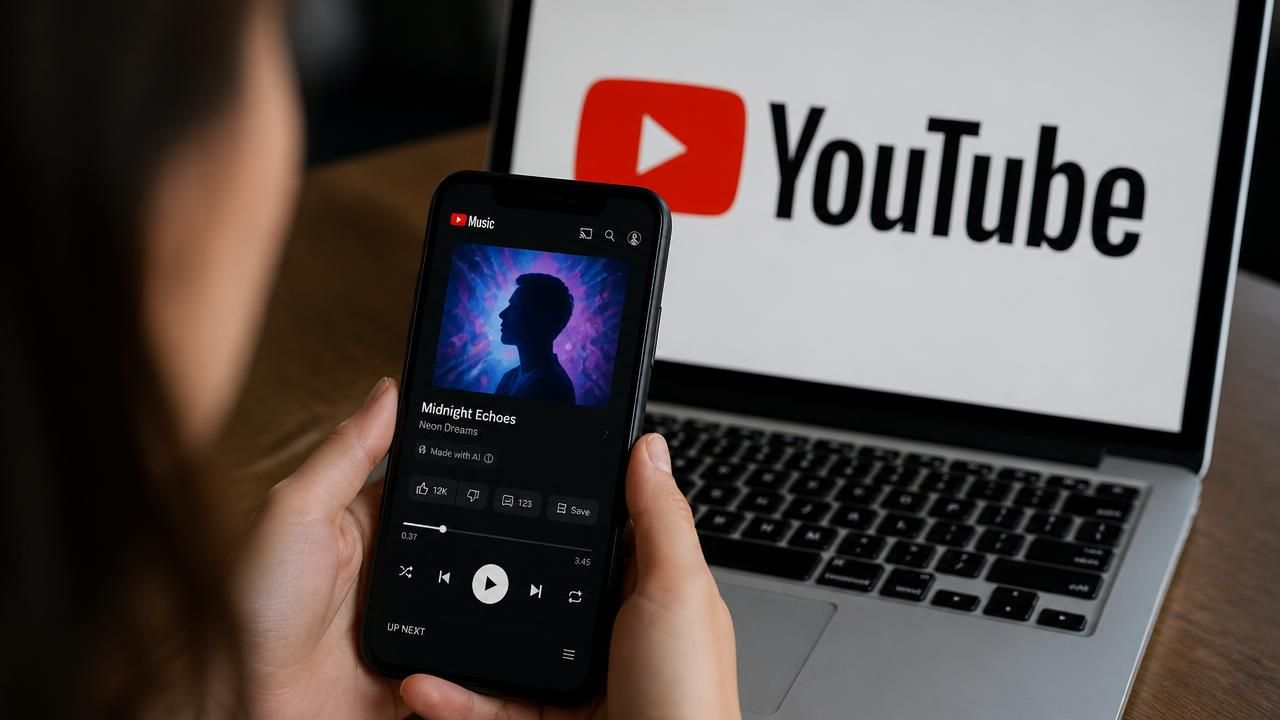
YouTube began applying a "Made with AI" label to music tracks on Tuesday, extending to songs a transparency regime the company first built for video. The label will appear on tracks that were "altered or fully generated" using artificial intelligence, and it is rolling out across YouTube's platforms, including YouTube Music, starting today.
The change is the clearest signal yet that the world's largest music-streaming-adjacent platform intends to police — or at least disclose — the growing wave of AI-generated songs flooding its catalog. It also lands at a delicate moment for the music industry, which is simultaneously suing AI model builders, signing licensing deals with them, and quietly experimenting with the technology itself.
What the label actually covers
According to YouTube's guidelines for music partners, the disclosure requirement is narrower than a blanket ban on AI-assisted production. The company says the label applies to cases such as "using a generative model to create the composition and vocals" — meaning a track whose melody, lyrics or vocal performance was synthesized by tools like Suno, Udio or similar systems. Ordinary uses of AI in the studio, such as noise reduction, stem separation or mixing assistance, appear to fall outside the labeling threshold.
That distinction matters. Producers have used machine-learning tools in audio post-production for years, and an overly broad labeling rule would have swept in a huge share of mainstream releases. YouTube appears to be targeting the category that has alarmed rights holders most: songs that sound like human artists but were never performed by one.
Disclosure — and detection
YouTube is asking music partners who upload songs to disclose generative AI use through a formal process. But the company is not relying on the honor system alone. If a partner does not disclose, YouTube says it may use "other signals" to determine whether a song was AI-generated and apply the label anyway.
That combination — self-reporting plus internal detection — mirrors the approach YouTube took with video, where it introduced altered-or-synthetic content disclosures and has since layered on automated detection. Industry trade coverage of the rollout emphasized precisely this dual mechanism, framing it as an attempt to close the gap between what creators admit and what the platform can independently verify.
Four ways the story is being told
The framing of the announcement has varied sharply by outlet, and the differences are instructive.
- Product-focused tech press treated it as an incremental platform update, noting the parallel to YouTube's existing AI labels on video and parsing exactly which creative uses trigger a tag.
- Entertainment trade coverage led with the audience angle, headlining that listeners "want transparency" — positioning the label as a consumer-trust play as much as a compliance measure.
- Music-business trade reporting zeroed in on the machinery: partner disclosures, internal detection tools, and what the policy means for the labels and distributors who supply YouTube with its catalog.
- Consumer-tech coverage framed the feature instrumentally — as a tool for listeners who dislike AI music to identify and skip it.
Each lens captures part of the reality. YouTube is simultaneously building a product feature, a rights-management system and a public-relations answer to an industry that has spent two years demanding one.
Listeners want transparency — and the label is designed to give them a way to know what they're hearing.
The context behind the rollout
The announcement did not arrive in a vacuum. Since 2023, when an AI-generated track mimicking Drake and The Weeknd circulated widely before being pulled from streaming services, the recorded-music business has been locked in an increasingly public argument about consent, compensation and attribution. Lawsuits against generative music startups have proceeded in parallel with licensing negotiations, and major labels have signed deals intended to bring AI tools under legitimate commercial frameworks.
YouTube has been positioning itself in the middle of that fight. The platform launched an AI music incubator with a major label in 2023 and has since published principles around responsible AI development in music. Labeling is a lower-stakes intervention than litigation or licensing: it does not remove content, block uploads or dictate how songs are made. It simply tells the listener what they are hearing.
Open questions
Whether labeling changes behavior is unclear. Historical evidence from similar transparency features — fact-check tags, synthetic-media warnings — suggests labels can inform audiences without substantially altering consumption, and that their effect depends heavily on visibility and placement in the interface.
Enforcement is the harder question. Detection of AI-generated audio remains imperfect, particularly for tracks that blend human and synthetic elements or that are generated privately and uploaded with minimal metadata. False positives risk penalizing legitimate artists; false negatives undermine the label's credibility.
There is also the question of retaliation and evasion. If an AI label meaningfully suppresses streams, some uploaders will have an incentive to obscure how a track was made — precisely the scenario YouTube's "other signals" clause is meant to cover. The company is effectively betting that its detection systems are good enough to make non-disclosure a losing strategy.
For now, the label is live, the rules are published, and the music industry has one more data point about how the largest platforms intend to handle the AI era. The next test will be whether the tags are visible enough to matter — and accurate enough to be trusted.