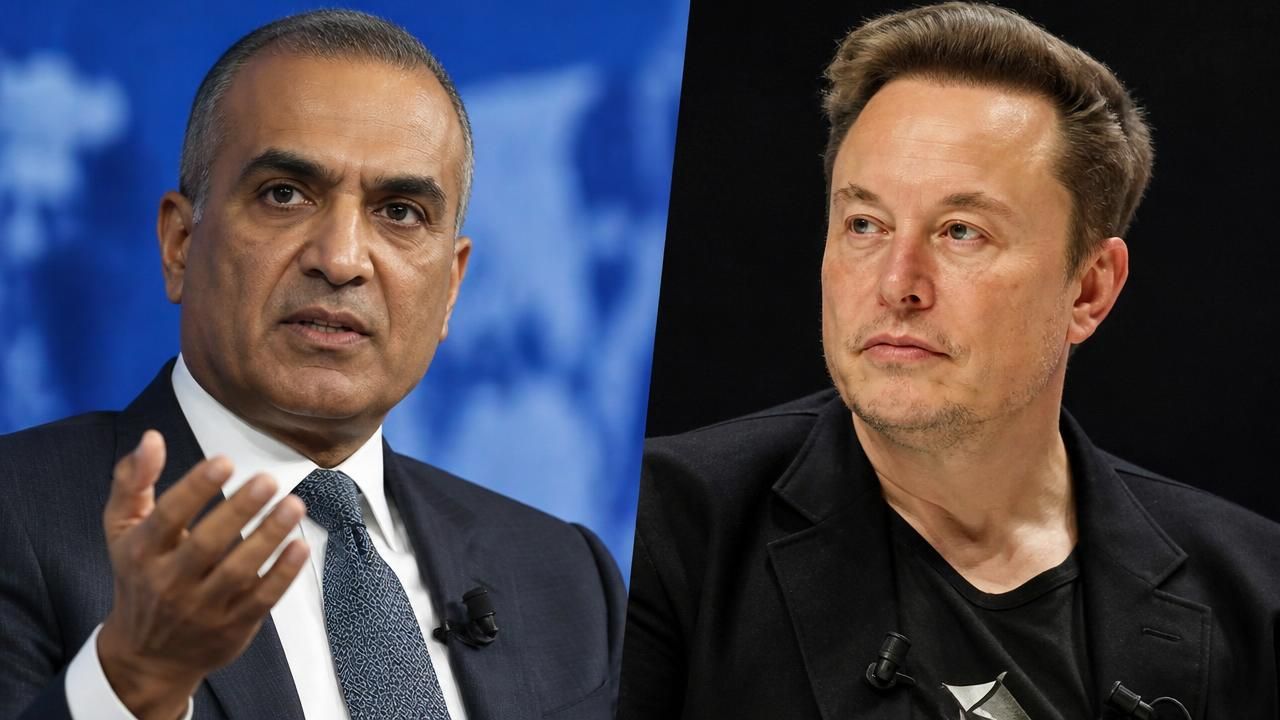
Sunil Bharti Mittal has a simple message for Elon Musk: you are not the only one waiting. Responding to the SpaceX chief's complaints that Indian regulators are dragging their feet on Starlink's satellite internet licence, the Bharti Airtel chairman said his own satellite venture, OneWeb, is stuck in the same queue — and he believes he is standing in front of Musk.
"Many companies are awaiting regulatory approvals," Mittal said when asked about Musk's remarks concerning Indian telecom billionaires, adding that he believed he was ahead of the SpaceX founder in the queue. Asked about the prospect of Starlink finally winning clearance, Mittal was dryly competitive: "We'll be very happy to get it at least a few days before him."
Setting the record straight
The exchange marks a rare public spat between two of the world's most prominent satellite-broadband aspirants, and it cuts to the heart of a broader frustration in India's fast-consolidating telecom market: the gap between ambition and regulatory reality.
Musk, who has used his platform on X to argue that Starlink faces bias in India and that the approval process has been unreasonably slow, has repeatedly pointed to the country's enormous unmet demand for connectivity in rural and remote areas. India's satellite communications market is viewed as one of the largest prizes in Asia, with hundreds of millions of users potentially beyond the reach of terrestrial fibre and mobile networks.
Mittal's rebuttal reframes the narrative. Rather than a story about Starlink being singled out, he casts it as a story about an entire industry waiting on the same paperwork — a queue that includes Bharti-backed OneWeb, now part of the Eutelsat Group, in which Bharti is the largest shareholder.
"Many companies are awaiting regulatory approvals... We'll be very happy to get it at least a few days before him." — Sunil Bharti Mittal
How the story is being framed
Coverage of the exchange has diverged sharply. Bloomberg Markets led with the queue positioning — essentially a business story about competitive order of precedence. Other outlets, syndicated through MSN, foregrounded the personal back-and-forth, with headlines such as "Elon Musk cries bias over Starlink delay" and "We are waiting too." A third framing emphasised the shared regulatory limbo: "Awaiting approval of Satcom services," one headline read.
Taken together, the coverage converges on one substantive fact: no private satellite-broadband operator has yet been granted the full set of clearances needed to commercially launch in India, and every major player says it is still waiting.
What the licences actually require
Satellite broadband in India requires a Global Mobile Personal Communication by Satellite (GMPCS) licence from the Department of Telecommunications, along with security clearances from the Ministry of Home Affairs and authorisation from IN-SPACe, the space regulator. Operators must also commit to setting up gateways on Indian soil, localise data and meet interception and lawful-access requirements — conditions that have slowed applicants across the board.
- Starlink (SpaceX): has applied for GMPCS authorisation; has flagged delays publicly and is seeking clarity on timelines.
- OneWeb (Eutelsat Group, Bharti-backed): also awaiting satcom service approvals following the completion of its global constellation.
- Domestic incumbents: Reliance Jio and Bharti Airtel have struck distribution alliances with satellite players even as they argue about how spectrum should be awarded.
The spectrum fight underneath
The licensing delay sits atop a longer-running policy battle over how India assigns satellite spectrum. Musk has argued for administrative allocation, the method favoured by most governments for satellite services. Reliance Jio's Mukesh Ambani has pushed for auctions, arguing that anything less would disadvantage terrestrial operators who paid billions for airwaves.
For Mittal, the issue is less philosophical than pragmatic. Bharti has sunk substantial capital into OneWeb and needs a domestic revenue stream to justify it. Every additional month of delay is a month of foregone subscribers — and, crucially, a month in which a rival might get there first.
Why it matters
India's satellite broadband market could reshape connectivity for millions of people in areas where laying fibre is uneconomic. But the standoff also illustrates a wider tension: global satellite operators want rapid market access, while Indian regulators and domestic carriers want assurances on security, data sovereignty and competitive fairness.
Mittal's remarks suggest the industry's frustration is not aimed at any single company but at the pace of the process itself. Whether Starlink or OneWeb crosses the finish line first may matter less than the fact that, for now, neither has.