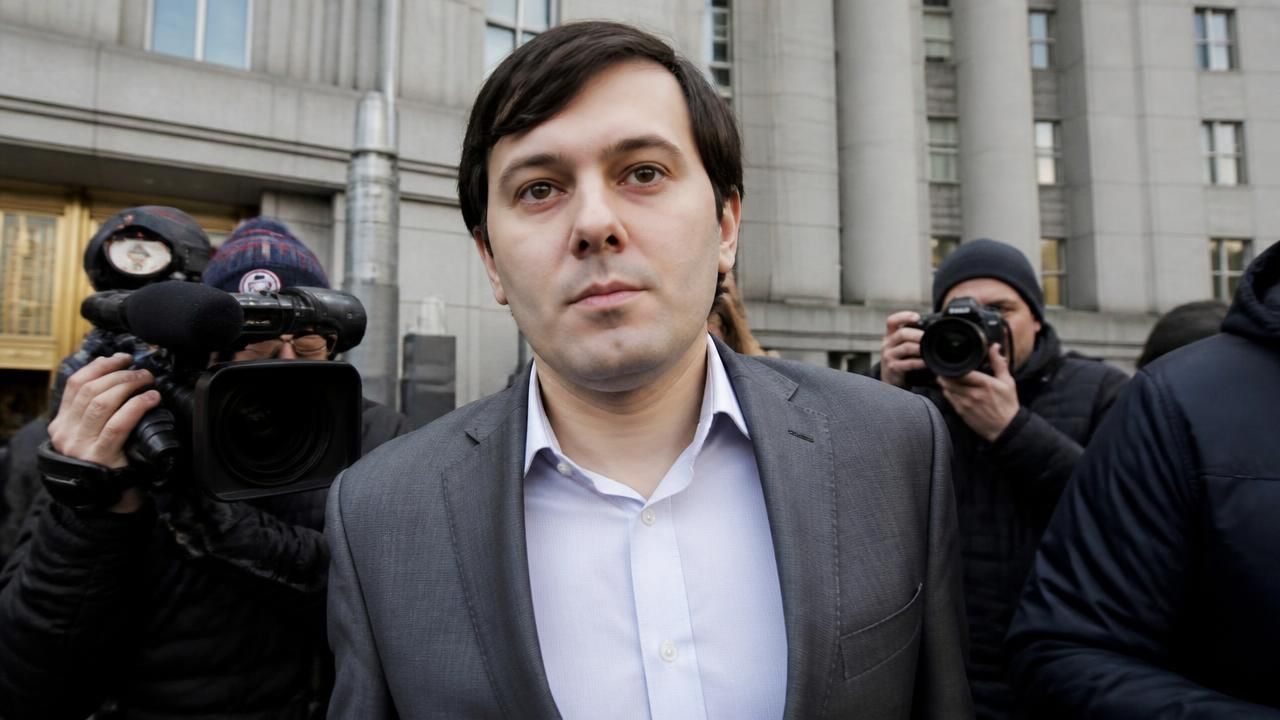
Federal regulators and a coalition of state attorneys general are asking a federal judge to punish Martin Shkreli for what they describe as a years-long, open defiance of the lifetime ban that was supposed to keep him out of the pharmaceutical business for good.
On Tuesday, the Federal Trade Commission and the attorneys general of seven states — New York, California, Illinois, North Carolina, Ohio, Pennsylvania and Virginia — filed a motion asking the court to hold the former pharmaceutical executive in contempt. According to the filing, Shkreli has "flagrantly and repeatedly" violated the lifetime industry ban he has been under since 2022, allegedly by trading stock in dozens of drug companies and by discussing the pharmaceutical industry at length during livestreams on social media.
The seven states are the same ones that joined the FTC in suing Shkreli in 2020 over what regulators called an "elaborate anticompetitive scheme" built around Daraprim, a decades-old anti-parasitic drug used to treat toxoplasmosis in immunocompromised patients.
The Daraprim affair, revisited
Shkreli became a household name — and a durable internet villain — in 2015, when his company, Turing Pharmaceuticals, raised the price of Daraprim from $17.50 per pill to $750 per pill virtually overnight, an increase of more than 4,000 percent. The drug had been on the market since 1953 and cost pennies to manufacture, making the hike one of the most visceral illustrations of pharmaceutical price-setting power in modern memory.
Regulators alleged the price increase was paired with tactics designed to block generic competitors from reaching the market, preserving Turing's de facto monopoly. That conduct formed the basis of the 2020 antitrust suit, which ultimately produced the lifetime ban on Shkreli serving as an officer or director of a publicly traded pharmaceutical company and on engaging in the industry more broadly.
The same period brought criminal exposure. Shkreli was convicted of securities fraud stemming from his management of the hedge funds MSMB Capital and MSMB Healthcare, and he was sentenced to seven years in federal prison. He was released in 2022 — around the time the lifetime pharmaceutical ban took effect.
What the government says he did
According to Ars Technica's account of the new filing, the alleged violations began almost immediately. Rather than comply, Shkreli is said to have continued operating in the drug sector in ways the ban was explicitly designed to prevent — most notably by buying and selling stock in dozens of pharmaceutical companies, and by publicly holding forth on the industry in livestreamed broadcasts that reach a substantial online audience.
Shkreli has "flagrantly and repeatedly" violated the lifetime ban, the FTC and the seven states allege in their filing.
Trading in drug-company equities is not incidental to the ban; it is precisely the kind of activity the lifetime prohibition was intended to foreclose, on the theory that someone with Shkreli's history should not be positioned to profit from or influence the sector again.
The New York Attorney General's office framed the motion in stark terms, urging the court to punish Shkreli for what it characterized as a brazen disregard of the order. The FTC's request for a contempt finding, meanwhile, was reported by financial outlets including Yahoo Finance, which emphasized the procedural stakes: contempt is the mechanism courts use when a party ignores an existing order, and it carries the possibility of sanctions, fines or other remedies determined by the judge.
How the story is being framed
Coverage of Tuesday's filing illustrates how differently outlets approach the same facts. Ars Technica, writing for a technically literate audience, leads with the mechanism of the alleged violation — the stock trades and the livestreams — and treats the case as a technology-and-platform story as much as a pharma one, noting that Shkreli's social media presence is itself part of the government's evidence.
The New York Post, by contrast, leans on the nickname. Its headline reduces the story to "'Pharma Bro' Martin Shkreli broke lifetime ban on drug industry trades," an approach that treats Shkreli as a tabloid character whose notoriety is the point. The New York Attorney General's office positions the filing as a matter of institutional accountability, with the attorney general personally urging the court to act — a framing that centers the state's role in policing a repeat offender rather than the spectacle around him.
Some aggregators picked the item up with minimal elaboration; a couple of syndicated versions returned access errors rather than full text, a reminder of how a story this recognizable propagates through wire and content networks largely on the strength of its headline.
Why it matters
The case sits at the intersection of two broader trends in U.S. regulation. The first is aggressive antitrust and consumer-protection enforcement aimed at pharmaceutical pricing, an area where the FTC has become markedly more active in recent years. The second is the difficulty of enforcing conduct-based bans in an era when a prohibited individual can reach millions of people — and trade securities — from a laptop.
- For the FTC: A contempt finding would demonstrate that negotiated bans have teeth and that continued monitoring of defendants is worthwhile.
- For the states: New York, California and their co-plaintiffs have an interest in showing that a multistate remedy is not merely symbolic.
- For Shkreli: He has consistently treated his legal troubles as content. The government's filing suggests that strategy may now be legal exposure.
What happens next rests with the federal judge who imposed the ban. If the court finds the alleged conduct violates the order, Shkreli could face sanctions, and the scope of the original injunction could be tightened. If he successfully contests the motion, the practical reach of a lifetime industry ban will have been meaningfully narrowed.
Either way, the filing marks a notable escalation: the government is no longer arguing about what Shkreli did before prison, but about whether the punishment imposed afterward meant anything at all.