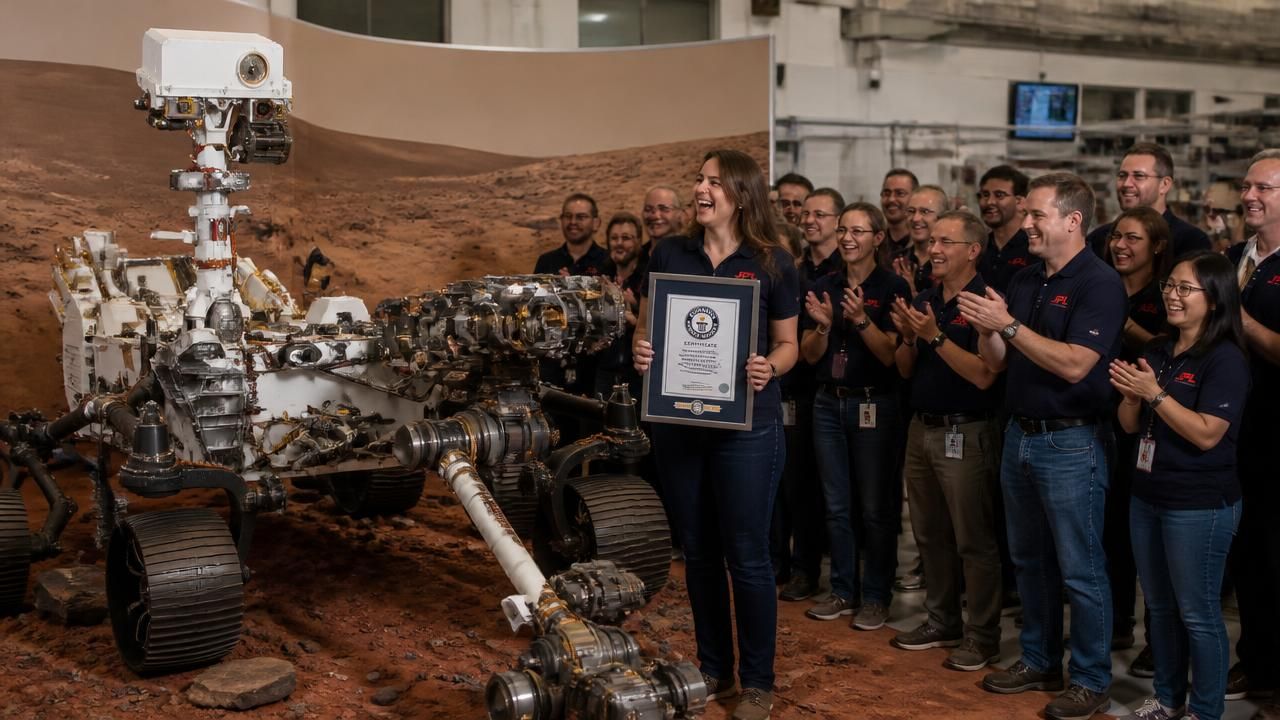
NASA's Perseverance rover has become the most-traveled wheeled vehicle ever operated beyond Earth, breaking a distance record that had stood for nearly a decade and certifying a new benchmark for off-world driving. The Guinness World Records milestone was marked at the agency's Jet Propulsion Laboratory in Southern California, where members of the mission team gathered in the Mars Yard with the certificate recognizing the rover's cumulative odometer on the Red Planet.
The achievement caps a journey that began with Perseverance's dramatic landing inside Jezero Crater on Feb. 18, 2021. In the more than five years since, the car-sized rover has logged roughly 45.2 kilometers — about 28 miles — of driving across ancient river delta terrain, crater floor, and rugged highlands, eclipsing the mark set by its predecessor Opportunity.
The Record, by the Numbers
Opportunity, which operated on Mars from 2004 to 2018, drove a total of 45.16 kilometers (28.06 miles) across Meridiani Planum — a figure that was widely regarded as the off-world driving record and the closest any robotic explorer had come to completing a marathon (42.195 km) on another planet. Perseverance crossed that threshold and pushed past it, becoming the first vehicle to complete a marathon-distance traverse on a world other than Earth.
The comparison extends beyond Mars. The Soviet Union's Lunokhod 2 covered roughly 42 kilometers on the Moon in 1973, and Lunokhod 1 managed about 10.5 kilometers in 1970. NASA's Apollo Lunar Roving Vehicles accumulated about 35.7 kilometers combined across three missions. On Mars, Curiosity has driven on the order of 32 kilometers since 2012, while Spirit covered 7.7 kilometers and Sojourner — the first Mars rover, in 1997 — traveled barely 100 meters.
What makes Perseverance's total stand out is the pace. Opportunity needed nearly 15 years to reach 45 kilometers. Perseverance has covered a comparable distance in roughly a third of the time, aided by faster driving software, a more powerful onboard computer, and a landing site chosen for traversability.
How Perseverance Drives Itself
Much of the credit goes to the rover's autonomous navigation system, known as AutoNav. Earlier rovers required engineers to plan each drive in detail, using stereo images downlinked to Earth to map safe routes — a slow process limited by the roughly 5-to-20-minute one-way light-time delay between the two planets.
Perseverance instead carries a dedicated vision-compute module that processes images onboard, builds 3D terrain maps in real time, and steers around hazards without waiting for human input. The result is a rover that can cover more ground per sol, or Martian day, and can navigate terrain that would have been considered too risky for blind drives. Engineers have described the rover as effectively the first self-driving vehicle on another planet, and the autonomy experiment has been widely judged a success — one that will inform the design of future rovers and, eventually, crewed surface vehicles.
That capability has not come without cost. The same terrain that makes Jezero scientifically valuable — boulder fields, steep slopes, and loose sand — has repeatedly forced the team to weigh science targets against the risk of immobilization. The rover's wheels, like Curiosity's, show expected wear from sharp rocks, though the improved wheel design has held up well.
The Team Behind the Record
In the image released to mark the milestone, the flight team stands in the Mars Yard at JPL alongside OPTIMISM — the Operational Perseverance Twin for Integration of Mechanisms and Instruments Sent to Mars. The full-scale engineering model, nicknamed for the rover's twin, is used to rehearse driving routes and science activities before commands are sent to Mars, making it an indispensable part of daily operations.
JPL, managed by Caltech for NASA, built and operates Perseverance on behalf of the agency's Science Mission Directorate in Washington as part of the Mars Exploration Program. The mission's science payload includes instruments such as Mastcam-Z, SuperCam, PIXL, SHERLOC, and the MEDA weather station, along with the MOXIE experiment that demonstrated oxygen production from the Martian atmosphere.
The record is not an end in itself — it is a measure of how much science a rover can deliver when it can keep moving.
Why Distance Matters
For planetary scientists, kilometers are a proxy for discovery. Every additional traverse exposes the rover to new rock units and stratigraphic layers, and Perseverance's core mission — caching rock and soil samples in sealed titanium tubes for a future Mars Sample Return campaign — depends directly on reaching geologically diverse sites.
The mobility record also carries weight for human exploration planning. Engineers studying crewed Mars missions need realistic data on vehicle durability, wheel wear, power budgets, and autonomous driving in unfamiliar terrain. A rover that has driven 45 kilometers over five years provides exactly that kind of long-duration field data.
Perseverance's aerial companion, the Ingenuity helicopter, added a second dimension to the mission, flying 72 times before being grounded in early 2024 after suffering rotor damage. Together, the rover and helicopter demonstrated a combined surface-and-air exploration architecture that NASA expects to reuse.
How the Story Is Being Told
Coverage of the milestone has varied by outlet. NASA's own channels and JPL have emphasized the institutional achievement — the Guinness certificate, the Mars Yard photo, and the engineering model that supports operations. Local Southern California outlets, including Pasadena-area and Los Angeles broadcasters, have framed it as a hometown triumph for JPL, highlighting the Pasadena-built rover and the lab's role in the region's aerospace economy.
Technology and science publications have focused instead on the autonomy story, arguing that the real headline is not the odometer but the fact that a self-driving vehicle has operated reliably for years on a planet with no GPS, no road network, and no human oversight. International outlets have leaned into the superlative framing — a record for the farthest distance driven on any world — often comparing the rover to a car and translating the figure into marathon terms.
Science-focused sites have stressed the marathon analogy, noting that Perseverance has now covered more ground than any vehicle in the history of space exploration while still collecting samples along the way.
What Comes Next
Perseverance is far from finished. The rover continues to climb and explore the western rim of Jezero Crater, terrain that mission scientists believe may preserve some of the oldest rocks exposed in the region — material that could date back more than 4 billion years and potentially hold evidence of ancient microbial life.
With the record already broken and the odometer still climbing, the question facing the team is no longer whether Perseverance will set a mark, but how far it can go before its power, wheels, or instruments finally limit it. On a planet where every kilometer is earned one cautious, computer-guided meter at a time, that is a record worth watching.