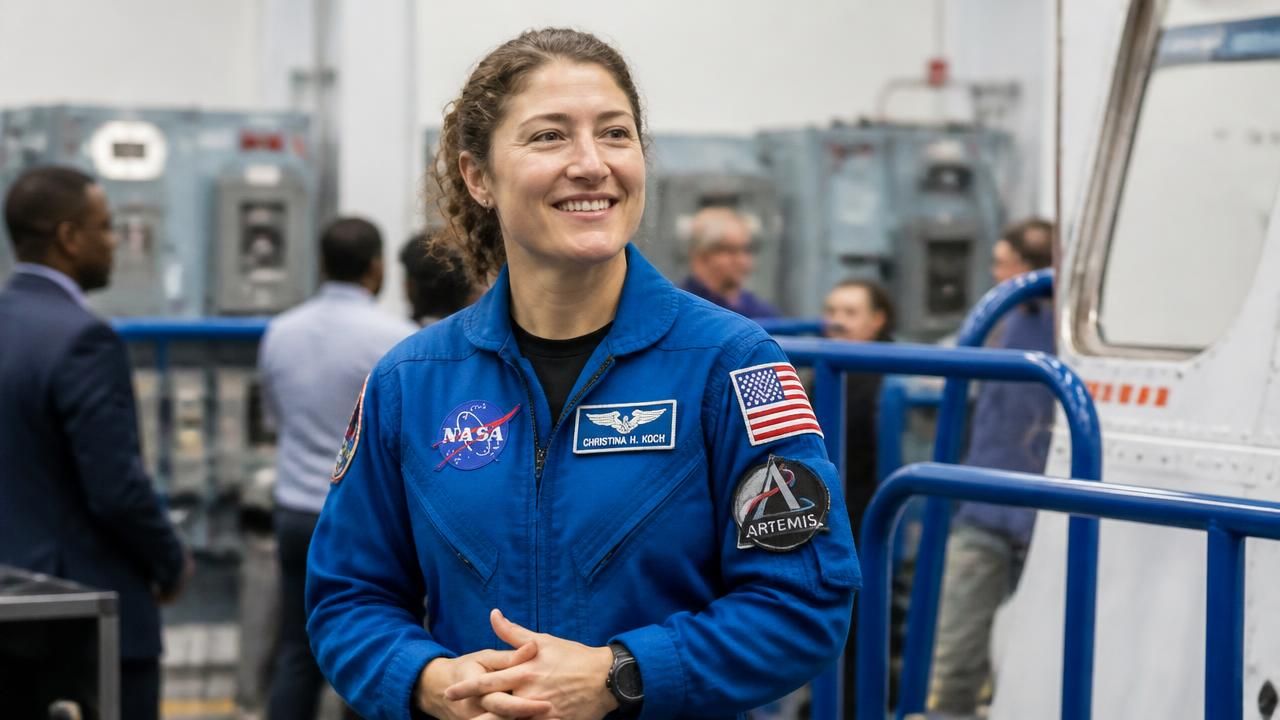
NASA announced on Oct. 13, 2026 that veteran astronaut Christina Koch will serve as the agency's acting deputy chief engineer, beginning Sunday, Nov. 1. The appointment caps an extraordinary run for Koch, who spent nearly a year aboard the International Space Station and this year flew aboard Artemis II, helping return American astronauts to the vicinity of the Moon for the first time in more than five decades.
Koch succeeds Katherine Van Hooser, who will retire Wednesday, Oct. 21 after more than 35 years of service to the agency. In her new role, Koch will help lead NASA's engineering community, supporting technical oversight, mission readiness and engineering excellence across the agency's programs and projects.
From Orbit to the Front Office
The transition is more consequential than a routine personnel move. With the appointment, Koch moves to management astronaut status and will no longer be eligible for future spaceflight assignments — a formal end to a flight career that made her one of the most recognizable figures in human spaceflight.
NASA Administrator Jared Isaacman framed the decision as a deliberate investment in institutional knowledge:
"Christina has seen NASA engineering from both sides of the equation: developing complex systems on the ground and trusting them with her life in space."
Isaacman added that after spending nearly a year aboard the ISS and helping lead America back around the Moon on Artemis II this year, Koch brings "an extraordinary combination of technical expertise, operational experience, and judgment" to the engineering directorate.
That combination is well documented. Koch was a crew member on Artemis II, the mission that carried astronauts around the Moon in 2026. Earlier, she logged 328 days in orbit aboard the ISS — the longest single spaceflight by a woman — and took part in the first all-female spacewalk alongside Jessica Meir in October 2019. Before joining the astronaut corps, she worked as an electrical engineer on scientific instruments at NASA's Goddard Space Flight Center, giving her the rare dual credential of hardware developer and end user.
North Carolina Claims Its Own
While NASA's announcement was framed around engineering leadership and mission readiness, North Carolina outlets covered a different, parallel story: Koch's homecoming. The astronaut is a North Carolina State University alumna, and the university has moved to enshrine that legacy permanently.
NC State celebrated Koch with a building dedication in her honor and the launch of a commemorative ice cream flavor — a distinctly Wolfpack tribute to a graduate who has become one of the university's most celebrated alumni. WUNC, the state's public radio network, highlighted the honors under the banner of a university recognizing its alumna and NASA astronaut.
Her itinerary reached well beyond campus. Koch visited North Carolina A&T State University in Greensboro, where she met with students and faculty. And the North Carolina Department of Labor hosted the Artemis II astronaut, an appearance covered by the occupational health and safety trade press — an indication of how widely her appeal stretches across institutions that have little to do with spaceflight.
The pattern reflects a broader phenomenon in the post-Artemis II period: astronauts as civic figures. Where NASA's own release reads as an internal engineering-org memo dressed in mission language, local coverage reads as a hometown celebration. The same individual anchors both narratives — one about technical stewardship of a multi-billion-dollar exploration architecture, the other about a state claiming credit for producing her.
Why the Timing Matters
The appointment lands at a busy moment for NASA's engineering workforce. With Artemis missions progressing and the agency under sustained pressure to demonstrate schedule discipline and cost control, the deputy chief engineer's office sits at the center of technical risk decisions — the reviews and readiness assessments that determine whether hardware flies.
- Date: Koch begins Nov. 1, 2026. Van Hooser retires Oct. 21 after 35-plus years.
- Scope: Technical oversight, mission readiness and engineering excellence across NASA programs.
- Trade-off: Management astronaut status removes her from the flight assignment pool.
- Background: 328 days in orbit, the first all-female spacewalk, and a crew seat on Artemis II.
For Koch, the move follows a well-worn NASA path — from orbit to management, where flight experience shapes how requirements are written and how risk is judged. For the agency, it means placing a recently flown astronaut inside the engineering chain of command at a time when that perspective is arguably most valuable.
For North Carolina, the story is simpler. NC State has a building, an ice cream flavor and a graduate who has now been entrusted with helping keep NASA's engineering enterprise flying. Those two narratives will continue to run in parallel, each complete on its own terms.