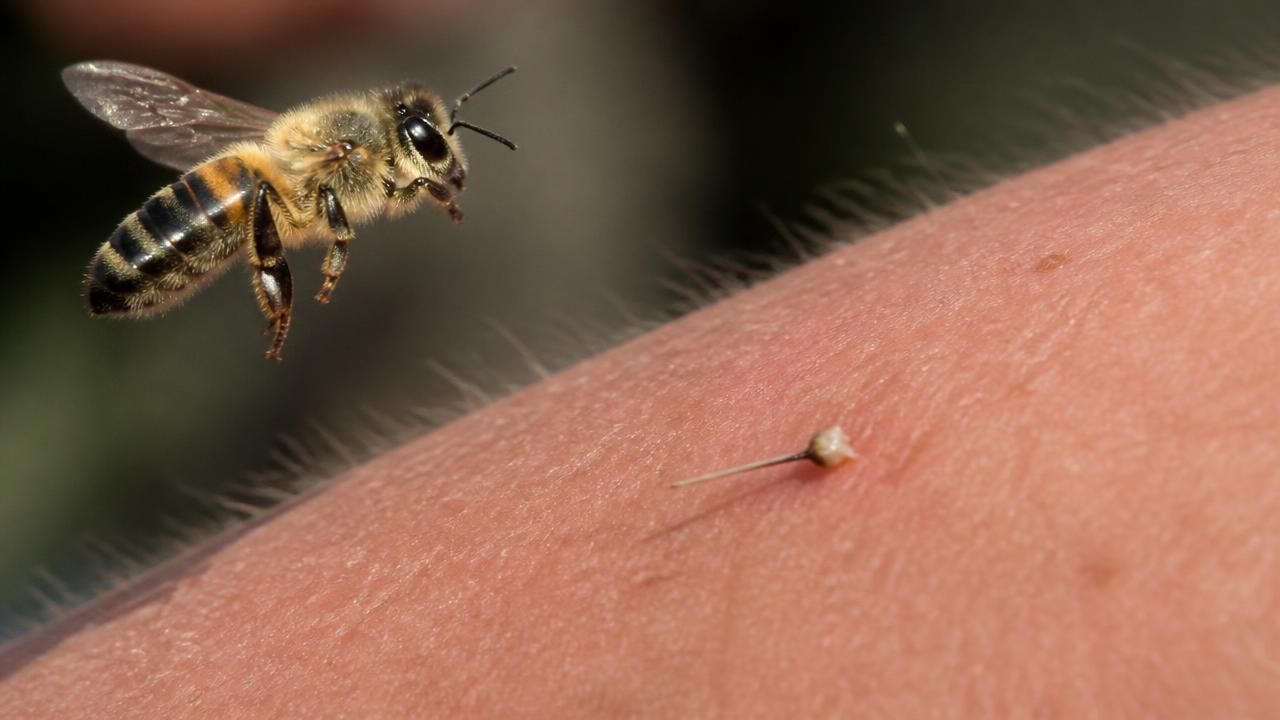
It is one of the most familiar small traumas of summer: a sharp pinprick, a flash of panic, a bee buzzing away. But the pain does not peak at the moment of the sting — it keeps building, sometimes for a minute or more, even though the insect that caused it is already gone. Now, researchers using high-speed videography say they have worked out exactly why, and the answer is stranger and more elegant than most people would guess: the stinger left behind is not a passive splinter. It is a self-contained, still-operating machine.
A pump that keeps pumping
According to a new paper published in the Proceedings of the National Academy of Sciences and credited to Ramirez-Esquivel and colleagues, the honey bee (Apis mellifera) stinger functions as a double-piston pump. Three interlocking elements form the venom canal: a central stylet that widens to create the main pumping chamber, flanked by two sharp-tipped lancets that slide alternately back and forth, piercing tissue and driving venom into the wound.
Venom delivery across the animal kingdom is remarkably varied. Spiders wrap muscles around their venom glands, squeezing the contents out through hollow fangs. Bees, wasps and ants generally rely on one of two strategies: contracting muscles around a venom reservoir, or using stiff, hardened lancets working in concert. Honey bees, the new research shows, do something more elaborate still — combining reciprocating lancets with valve-like anatomy to create a piston action that continues under its own power.
The behaviour is a rare example of autotomy: the deliberate shedding of a body part. Worker honey bees are among the only animals known to leave a working venom-delivery device embedded in a target and fly away. A honey bee's stinger is barbed, anchoring it in elastic skin; when the insect pulls free, the sting apparatus — including the venom sac, muscles and ganglia — is torn from the abdomen. The bee dies within hours. The stinger, however, does not.
“The stinger continues to penetrate the tissue and pump venom on its own, a rare phenomenon known as autotomy.” — Ars Technica, describing the study's findings
Like a saw, like a piston
Different outlets framed the same mechanism in strikingly different registers. Ars Technica leaned into the biomechanics, emphasising the interlocking stylet-and-lancet architecture and the mechanics of a pump that requires no living owner. Yahoo's coverage, by contrast, reached for a carpenter's metaphor, describing stingers that “work like saws” — a fair image for the ratcheting, reciprocating motion of the barbed lancets, which alternately hook into tissue and drag the shaft deeper even as they shuttle venom downward.
The video itself, captured at frame rates far beyond the human eye, is what made the discovery possible. At normal speed the process looks instantaneous. Slowed down, the stinger becomes a visibly active instrument: the lancets slide out of phase with one another, the shaft advances, and pulses of venom travel down the canal in a rhythm that continues for as long as the detached apparatus retains energy.
The tabloid framing was predictable. The Daily Mail billed the footage as “horrifying,” promising readers a look at what “really happens” when a bee stings — a reminder that the same piece of science can be sold as either wonder or gross-out depending on the audience. MSN's aggregation stuck closer to the wire-service register, foregrounding the high-speed video and the word “detachment.” Each version is accurate; only the emotional temperature changes.
Why evolution built a self-driving stinger
Autotomy looks suicidal for the individual, and it is — a worker bee that stings a mammal is a dead bee. But honey bee colonies are superorganisms, and the calculus is collective. When a stinger is left behind, it typically tears open venom and alarm glands, releasing a pheromone blend dominated by isopentyl acetate. That scent marks the target and summons nestmates, turning a single defensive sting into a coordinated swarm response.
A stinger that keeps working after detachment extends that defence in two ways: it delivers more venom than the bee could inject in a single strike, and it keeps delivering it while reinforcements arrive. A single honey bee sting deposits on the order of 0.1 milligrams of venom, a cocktail whose principal component, melittin, ruptures cell membranes and accounts for much of the burning sensation. Because the pump keeps operating, the dose from a detached stinger can be considerably larger than the initial injection suggests — one reason sting reactions often worsen in the minutes after the bee departs.
From clickbait to the clinic and the laboratory
The mechanics have implications well beyond insect biology. Venom immunotherapy for people with severe bee-sting allergies depends on accurate dosing, and a better understanding of how much venom a stinger actually delivers could refine treatment protocols. Bioengineers, meanwhile, have spent years trying to build microneedles and implantable pumps that can deliver drugs into tissue without an external power source. A structure that anchors itself, advances through tissue and meters out fluid using nothing but stored elastic energy is an unusually good design brief — and evolution has already filed the patent.
The study also sharpens practical advice. Because the detached apparatus continues to inject, speed matters more than technique when removing a stinger. Public health guidance has long debated whether to scrape or pinch; the emerging consensus is that the difference is minor compared with how quickly the stinger comes out.
What remains unanswered
- How long a detached stinger can keep pumping before it exhausts its muscular energy.
- Whether the pump's rate varies with temperature, skin tension or the depth of penetration.
- How much the mechanism differs across the other stinging Hymenoptera — wasps, hornets and ants — most of which do not practise autotomy at all.
For now, the study offers a tidy reframing of a commonplace irritation. The bee, in the end, is only the delivery van. What stings you is the machine it leaves behind — and for a minute or so after the buzzing stops, that machine is still on the clock.