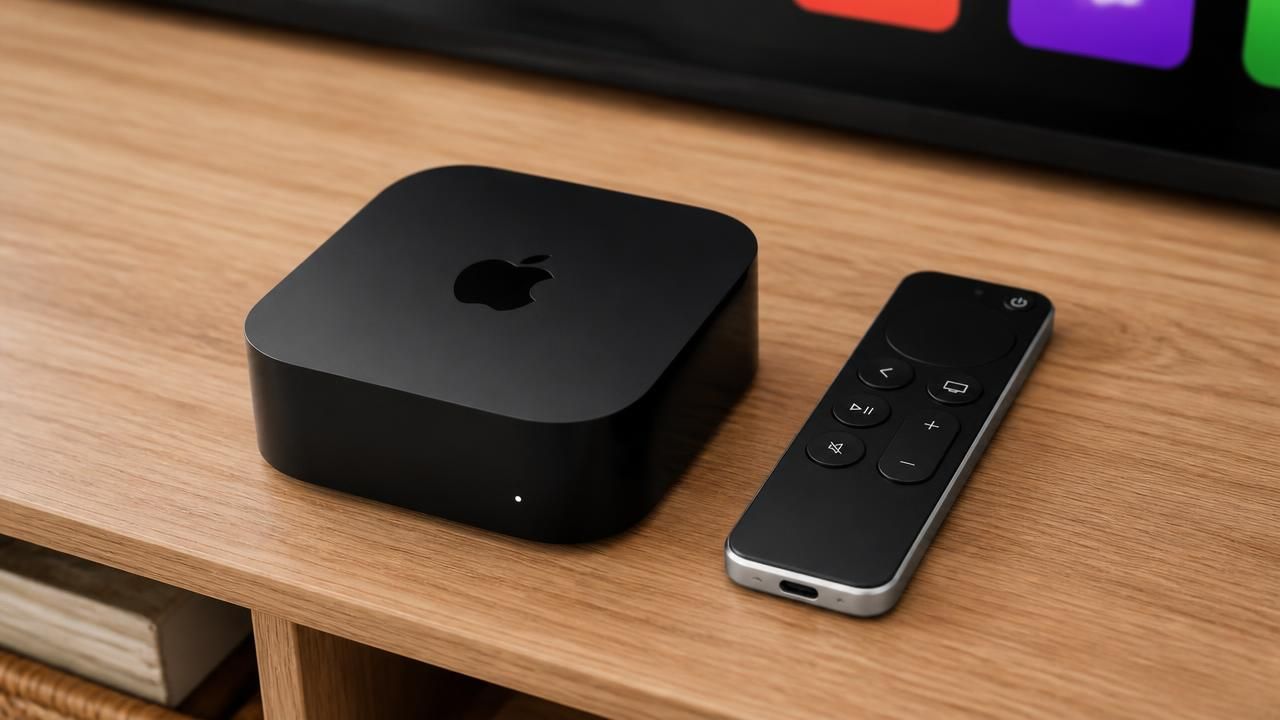
Apple is reportedly testing a new generation of its Apple TV streaming box that would trade its long-standing reliance on the Siri Remote for something closer to an always-listening smart speaker. According to reports circulating across technology outlets — including The Verge, iClarified, notebookcheck, Digital Trends, NewsBytes and MSN — the company is prototyping an Apple TV with a built-in microphone array, paired with a redesigned remote that adds a speaker of its own.
The rumor is unconfirmed by Apple, which as usual has declined to comment on unreleased hardware. But the consistency of the reports across multiple outlets suggests the details are coming from a common supply-chain or developer-adjacent source.
What the reports actually claim
At the center of the story are two hardware changes that, taken together, would fundamentally alter how users interact with the device.
- A built-in microphone on the Apple TV itself. Rather than requiring users to press a button on the remote or speak toward a paired HomePod, the box would listen for Siri commands directly.
- A speaker inside the next Siri Remote. The addition would let the remote play an audible alert so owners can locate it — a feature already common on rival remotes from Roku and Amazon.
The Verge framed the mic as a way to remove the remote from the equation entirely. The publication noted that a hands-free Apple TV could also "serve as a simple smart home hub — controlling thermostats and locking doors — without the need to hunt for the remote." That is a meaningful shift in positioning: Apple TV would stop being just a media player and start behaving like a stationary voice assistant.
Siri without the middleman
Digital Trends summarized the change bluntly, describing a set-top box that could finally "hear without the Siri Remote playing the middleman." That framing captures the frustration Apple has been trying to solve for years. Siri on Apple TV has historically been one of the weakest implementations of the assistant, gated behind a button press and dependent on a remote that is easily lost, sat on, or drained of battery.
An always-listening Apple TV would put the company's voice stack in direct competition with the Amazon Echo and Google Nest lines — devices that already sit in living rooms and listen continuously. Apple has never shipped a TV-adjacent product with that capability, despite the HomePod line demonstrating it can build the acoustic hardware to do so.
The lost-remote problem
The speaker-equipped remote is a quieter but arguably more practical upgrade. Apple's current Siri Remote is thin, small and expensive to replace, and it has drawn complaints for years from users who misplace it under cushions or inside furniture. A remote that can chirp on command would match functionality Roku has offered since 2017 and Amazon introduced with its Alexa Voice Remote Pro.
It is a small feature, but it addresses one of the most common real-world grievances about the Apple TV experience — and it hints that Apple is paying attention to usability criticism rather than simply adding faster silicon.
Why this matters beyond the living room
The strategic stakes extend well past streaming. Apple has spent the better part of a decade building a smart home platform — HomeKit, then Matter, then the HomePod mini as a hub — but has consistently trailed Amazon and Google in installed base. A microphone-equipped Apple TV would give the company another always-on hub in the home, one that already sits beneath a television in millions of households.
That could matter more as Apple pushes further into AI-assisted features. A stationary device with a microphone, a screen nearby, and a persistent network connection is a natural anchor for the kind of ambient, conversational computing Apple has hinted at with Apple Intelligence.
Skepticism, and the questions left open
Not everything in the rumor is settled. Reports have not specified a launch window, pricing, or whether the microphone would be always-on or activated by a wake word. Privacy is the obvious flashpoint: an always-listening device in a living room raises questions Apple has historically answered with on-device processing and hardware mute switches — an approach the company would almost certainly lean on again.
There is also the matter of overlap. Apple already sells HomePod and HomePod mini, both of which listen for Siri. Adding the same capability to Apple TV risks cannibalizing those products unless Apple positions the box as a media-and-home hybrid rather than a pure speaker.
What to watch
Coverage from iClarified, which reported the testing under the headline "Apple Tests Microphones and a Remote Speaker for New Apple TV," and from notebookcheck and NewsBytes, all describe the hardware as being in testing rather than production — a distinction that leaves room for the feature set to change or disappear before any announcement.
Still, the direction of travel is clear. Apple's competitors have spent years treating the television as a voice-first platform. The next Apple TV, if these reports hold, would be the company's acknowledgment that it needs to do the same — and that the remote, however clever, should not be the only thing listening.