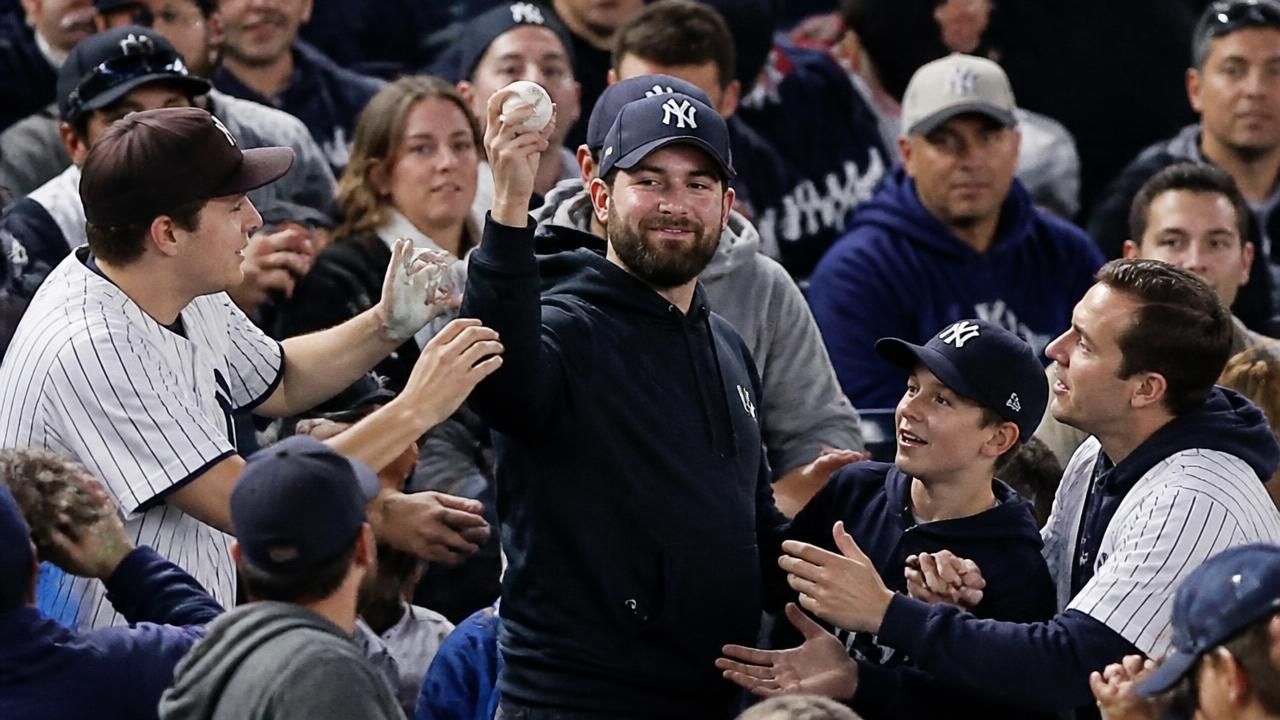
It is, by any measure, a small thing: a baseball, roughly five ounces of cork, rubber, and yarn wrapped in leather, leaving the field of play for a few seconds before landing in a stranger's hands. And yet few objects in American life carry as much unwritten moral weight as a ball caught in the stands during a playoff game.
This week, that weight landed on one fan who snagged a ball during the Major League Baseball postseason and chose to keep it — a decision that quickly turned a private moment in the seats into a public referendum. The image, credited to photographer Colin Hubbard, captured the fan holding the prize while the crowd around him reacted, and the question that followed was the one ballparks have been asking for generations: give it to a kid, or keep it?
An Opinion Question, Not a Box Score
It's worth noting how the story reached audiences. Rather than breaking news, the incident arrived largely as commentary. NPR published an opinion piece built around the dilemma, and Boise State Public Radio carried the same essay — a reminder that in an era of fractured media, a single caught ball can travel through the opinion pages of national and local outlets alike. Neither framed the fan's choice as a scandal. Both framed it as a test of character, and invited readers to imagine themselves in the aisle, ball in hand, a child two rows down.
The framing matters. Hard news would ask who the fan was and which team was batting. Opinion asks what kind of person you are. That shift — from event to ethics — is precisely why the moment spread.
The Unwritten Rules
Baseball has no official code governing what a fan does with a ball that clears the wall or sails into the seats. Once a ball is out of play and in the stands, it belongs to whoever gets to it first, and MLB's rulebook stays silent on generosity. What governs instead is custom — a soft, provincial etiquette that varies by ballpark, by city, and by how close the nearest eight-year-old in a team cap happens to be standing.
"Give it to a kid. You'll remember that longer than you'll remember the ball."
That refrain is the dominant one on social media after every such incident, and it carries real force. Foul balls and home run balls are among the few things a professional sports league simply hands to its fans for free, and the cultural expectation that an adult will pass that windfall to a child is one of the sport's most durable rituals.
The counterargument is quieter but equally American: the fan bought the ticket, sat in the seat, and made the catch — often barehanded, sometimes at real physical risk. Fewer than a few dozen balls per game ever reach the stands. Treating that as a windfall someone is obliged to surrender, the argument goes, ignores the effort and luck that produced it.
When the Stands Become the Story
This is not the first time a fan's hands have shaped a postseason narrative. In 1996, a young Yankees fan named Jeffrey Maier reached over the wall at Yankee Stadium to deflect a Derek Jeter fly ball into the stands; it was ruled a home run, and the Orioles have not entirely forgiven the city of New York since. In 2003, Steve Bartman's attempt to catch a foul ball at Wrigley Field became one of the most infamous moments in Cubs history — an incident so corrosive that it took nearly two decades and a World Series title before Chicago could speak of it calmly.
Those cases involved interference, not ownership, but they explain the intensity of the reaction here. Fans understand, instinctively, that their hands can alter outcomes. A caught ball is therefore never entirely neutral: it is a small piece of the game's outcome, removed from the field and held by a civilian.
The Memorabilia Question
There is also money. Postseason baseballs — particularly those with documented significance, tied to a specific home run, a specific inning, a specific series — can command thousands of dollars on the collectibles market, and occasionally far more. Authenticated playoff balls from milestone moments have sold for five and six figures. That economic reality complicates the moral math considerably: a fan weighing whether to hand a ball to a child is also weighing whether to hand away an asset.
Most caught balls, of course, are worth little beyond sentiment. But the ambiguity is enough to make the decision harder than it looks from the couch.
Why We Keep Talking About It
Sociologists and sports ethicists have long noted that fandom is a system of reciprocal obligation. Fans invest attention, money, and identity; in return, they receive moments — and occasionally objects — that feel earned. Handing a ball to a child is a way of inducting the next generation into that system, transferring both the souvenir and the loyalty attached to it.
Keeping it is a way of asserting that the investment was real, and that the reward is private.
Both readings are defensible, which is why the debate never resolves. Every postseason, a new fan finds a ball in his or her hands, a camera finds the fan, and the country re-litigates a question with no rulebook answer. The fan this week chose to keep it. The internet, predictably, chose to weigh in.
For the moment, the ball stays where it landed — in the hands of the person who caught it.
Editor's note: Two additional source documents provided with this story — interviews with Australian wheelchair basketball player Caitlin de Wit and independent U.S. presidential candidate Joe Schriner — were unavailable at the time of publication because their host site blocked automated retrieval.