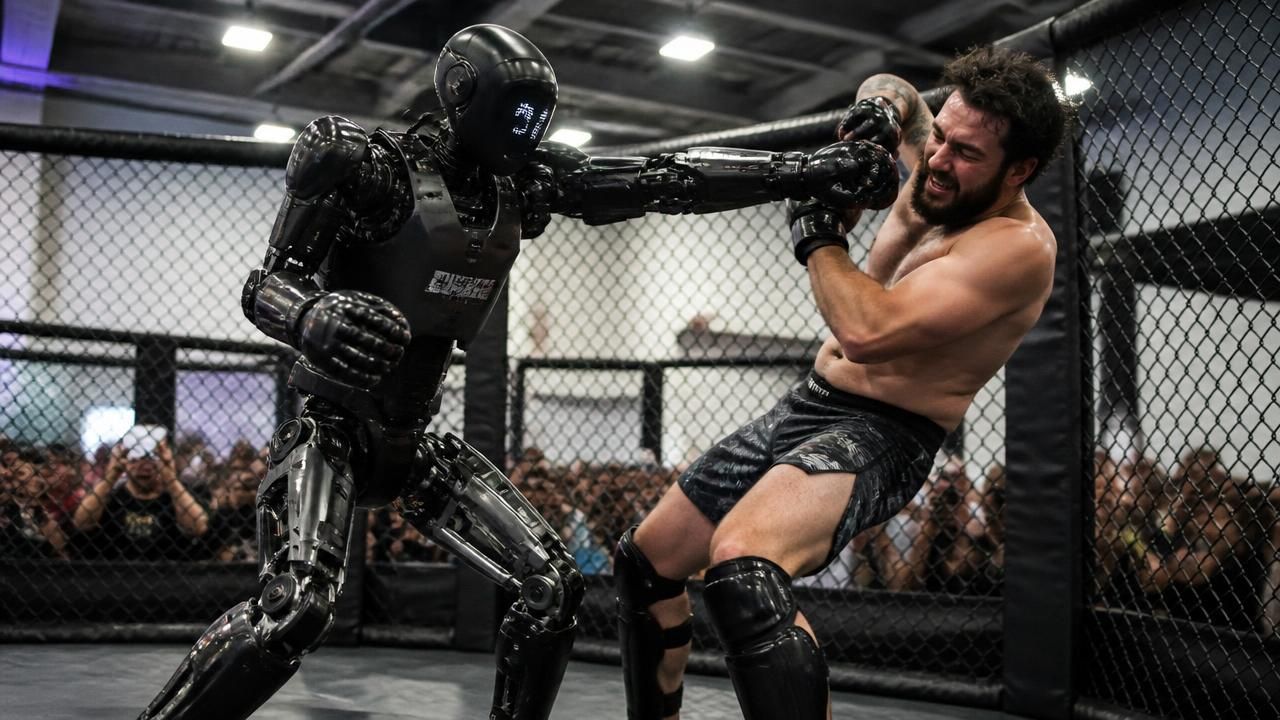
California regulators have ordered a tech startup to stop staging cage matches between humans and humanoid robots, escalating a bizarre collision of combat sports, robotics and entertainment law into a formal enforcement action. The California State Athletic Commission sent a cease-and-desist letter to Rek, the startup behind a September 18 fight that pitted a human, Frankie LaPenna, against a humanoid robot owned by the company, according to The Verge, which cited a New York Times report.
The match drew attention because it looked less like a traditional robotics competition and more like a science-fiction spectacle. Video circulating online shows the robot throwing punches and kicking the human influencer across the cage, according to MSN. The robot appears to be an EngineAI model modified with a Terminator-like head. But the fight was not an autonomous machine decision: The Verge and The New York Times reported that the robot was being piloted by a human using a remote virtual-reality system.
What California objects to
The commission’s cease-and-desist is not about whether a robot can throw a punch. It is about whether the event qualifies as an unlicensed combat sports exhibition under state law. The California State Athletic Commission regulates boxing, mixed martial arts, kickboxing and other combat sports, requiring promoters to obtain licenses, secure insurance, provide medical oversight and follow safety rules. A human-versus-robot cage match falls outside any sanctioned category.
The New York Times framed the story bluntly: Man vs. Terminator-Like Robot in a Cage. California Called It Illegal. That headline captures the regulatory logic. However novel the technology, the commission appears to view the event as an illegal, unregulated fight that exposed a human participant to potential harm without the safeguards that govern professional combat sports.
A startup with big ambitions
Rek has branded itself as the humanoid robot fighting league. The company is trying to turn robot combat into a spectator sport, blending the appeal of BattleBots with the drama of human fighting. The September event was staged with a humanoid robot that had been modified for combat, and the human operator wore a VR rig to control its movements in real time.
Rek describes itself on its website as the humanoid robot fighting league.
That framing is central to the dispute. If Rek is promoting a sport, it must answer to athletic commissions. If it is promoting a technology demonstration, it may argue for different oversight. California’s action suggests regulators are not willing to let the distinction be decided by marketing alone.
Differing media frames
The coverage has split along familiar lines. The Verge, a technology outlet, emphasized the oddity and the startup angle, noting the cease-and-desist and the remote-VR piloting. The New York Times treated the story as a regulatory and legal matter, focusing on the commission’s finding that the fight was illegal. MSN’s coverage leaned into the viral spectacle, with headlines about the robot throwing punches and kicking the influencer across the cage, and another describing an international robot/human fight promoter being ordered to cease in California.
Together, the accounts show how the same event can be framed as entertainment, as a tech stunt, or as a public safety and licensing problem. The commission’s letter effectively rejects the entertainment frame. It treats the fight as a regulated activity that skipped the required process.
The teleoperation question
One of the most important details is that the robot was not acting on its own. It was being piloted by a human through a remote virtual-reality system. That means the bout was not truly human versus artificial intelligence. It was human versus human, with one person using a machine as an avatar.
That distinction matters for both safety and fairness. A remotely operated humanoid can be stronger and more durable than a human body, but it can also malfunction, lose connection, or respond unpredictably. The human fighter, meanwhile, is exposed to physical force with no equivalent protection. For regulators, the presence of a human operator does not make the event less dangerous. It may make the liability more complicated.
What happens next
The cease-and-desist could force Rek to stop promoting fights in California or seek a sanctioning pathway. The company has been described as an international promoter, which raises the possibility that it could stage future events in jurisdictions with looser rules. But California’s move may encourage other states and countries to examine whether human-versus-robot combat fits existing laws.
For the nascent humanoid robotics industry, the episode is a reminder that public demonstrations can run into legal boundaries quickly. Robot combat has existed for decades in the form of BattleBots and similar competitions, but those events typically involve machines fighting machines, not humans. As humanoid robots become more capable and more teleoperated, the line between sport, stunt and workplace tool will keep blurring.
California’s message is clear: if you want to stage a fight, even one involving a robot, you need to follow the rules. Whether that slows the robot fighting league or simply pushes it to friendlier venues remains to be seen. What is certain is that the September 18 match was not just a viral moment. It is now a test case for how the law treats the next generation of robotic entertainment.