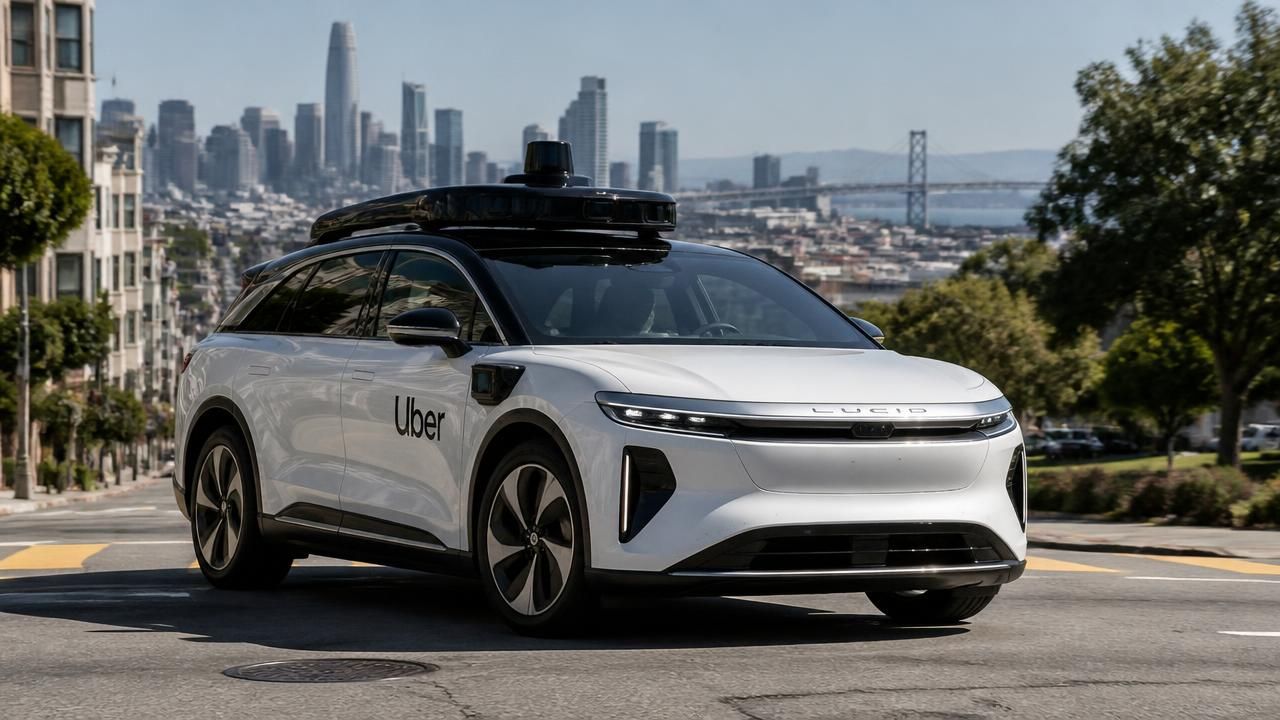
Uber's high-stakes bet on autonomous ride-hailing is officially losing its human safety net. Nuro, Lucid and Uber have begun fully driverless testing on public roads in the San Francisco Bay Area, with employee-only rides expected to follow shortly — a milestone the companies describe as the last major technical hurdle before a commercial debut.
The program, first announced in July 2025, pairs Uber's ride-hailing marketplace with Nuro's autonomous driving software and Lucid's electric Gravity SUVs. Until now, every test mile logged by the alliance included a trained safety operator behind the wheel. Removing that operator shifts the vehicles from supervised trials into genuine driverless operation on open public streets, alongside ordinary traffic, cyclists and pedestrians.
A three-way split of the autonomous stack
Each partner occupies a distinct role in the arrangement. Lucid supplies the vehicle platform — the Gravity, a three-row electric SUV whose architecture was designed from the outset to accommodate redundant steering, braking and power systems. Nuro provides the self-driving system: perception, planning and control software built on the company's years of low-speed delivery robot deployments. Uber contributes what it has always contributed: demand, dispatch and the customer relationship.
The division of labor is deliberate. Uber has made clear it does not intend to rebuild an in-house autonomous driving program. Instead, it is assembling a portfolio of partners — Alphabet's Waymo in Phoenix and Austin, and now Nuro and Lucid in the Bay Area — and positioning itself as the neutral demand layer that any robotaxi operator can plug into.
By pulling human safety operators from behind the wheel of Lucid Gravity SUVs, the companies say they are clearing a critical hurdle toward a public launch.
The current testing phase remains narrow in scope. Rides are restricted to employees, and coverage is confined to the Bay Area. The full public launch is now slated for early 2027 — a slight slip from the timeline the companies sketched when the partnership was unveiled, underscoring how routinely autonomous deployment schedules drift.
The comeback that took five years
The significance of this moment for Uber is difficult to overstate. In December 2020, the company sold its self-driving division, Uber Advanced Technologies Group, to Aurora Innovation, ending a costly and troubled in-house effort that had been marred by a fatal 2018 crash involving a test vehicle in Tempe, Arizona. For several years afterward, Uber's autonomy strategy amounted to partnerships rather than engineering.
That posture now looks less like retreat and more like a calculated repositioning. Uber's network — millions of riders and drivers, and the routing and pricing infrastructure that connects them — is arguably the most valuable distribution asset in the sector. Robotaxi operators need demand density to make unit economics work, and Uber has spent the past two years persuading them that it is cheaper to rent that density than to build a consumer brand from scratch.
Why the Bay Area, and why now
The Bay Area is among the most demanding proving grounds in the world for autonomous driving: dense, hilly, fog-prone, and populated by some of the least forgiving road users on the planet. It is also the home turf of nearly every competitor in the space, including Waymo, Cruise's remnants and Zoox. Testing driverless there is as much a signal of confidence as an engineering exercise.
Nuro's path to this point has been circuitous. Founded in 2016 by two former Google engineers, the company built a reputation on small, slow, purpose-built delivery vehicles before pivoting toward licensing its autonomy stack to vehicle manufacturers. The Lucid partnership is the clearest test yet of whether that licensing model can scale.
The competitive and regulatory backdrop
The announcement lands in an increasingly crowded field. Waymo already operates fully driverless commercial service in San Francisco, Phoenix, Los Angeles and Austin, and has logged tens of millions of rider-only miles. Tesla has begun limited robotaxi service in Austin. Zoox is testing purpose-built vehicles in several cities. Uber's alliance is, by contrast, a late entrant on the technology curve but a formidable one on the distribution curve.
Regulatory scrutiny remains the wild card. California's DMV and CPUC govern testing and commercial deployment respectively, and both have tightened reporting requirements after high-profile incidents elsewhere in the industry. Any safety event during this driverless phase would invite immediate scrutiny of the entire program — and of the partner model itself, in which responsibility for a failure is split across three companies.
- What's happening: Fully driverless public road testing in the San Francisco Bay Area, with employee-only rides to follow.
- Who's involved: Uber (demand and dispatch), Nuro (autonomous driving system), Lucid (Gravity electric SUVs).
- When: Announced July 2025; driverless testing now underway; public launch targeted for early 2027.
- Why it matters: Removing safety operators is the final technical gate before commercial service, and marks Uber's return to the front line of autonomy after selling its in-house unit in 2020.
What to watch
Three things will determine whether this alliance delivers. First, the pace of the employee-ride phase: how quickly the companies expand from a handful of vehicles and staff riders to paying customers will reveal how much of the underlying stack is truly production-ready. Second, the economics. Lucid's Gravity is a premium vehicle, and Nuro's licensing fees add cost on top of it; whether the resulting per-mile price competes with a human-driven Uber remains an open question. Third, the competitive response. Waymo has a multi-year head start on miles and a fully owned stack; Uber's counterargument is that it does not need to win the technology race, only to be the platform on which it is delivered.
For now, the message from all three companies is the same: the safety driver is gone, and the clock toward 2027 has started.