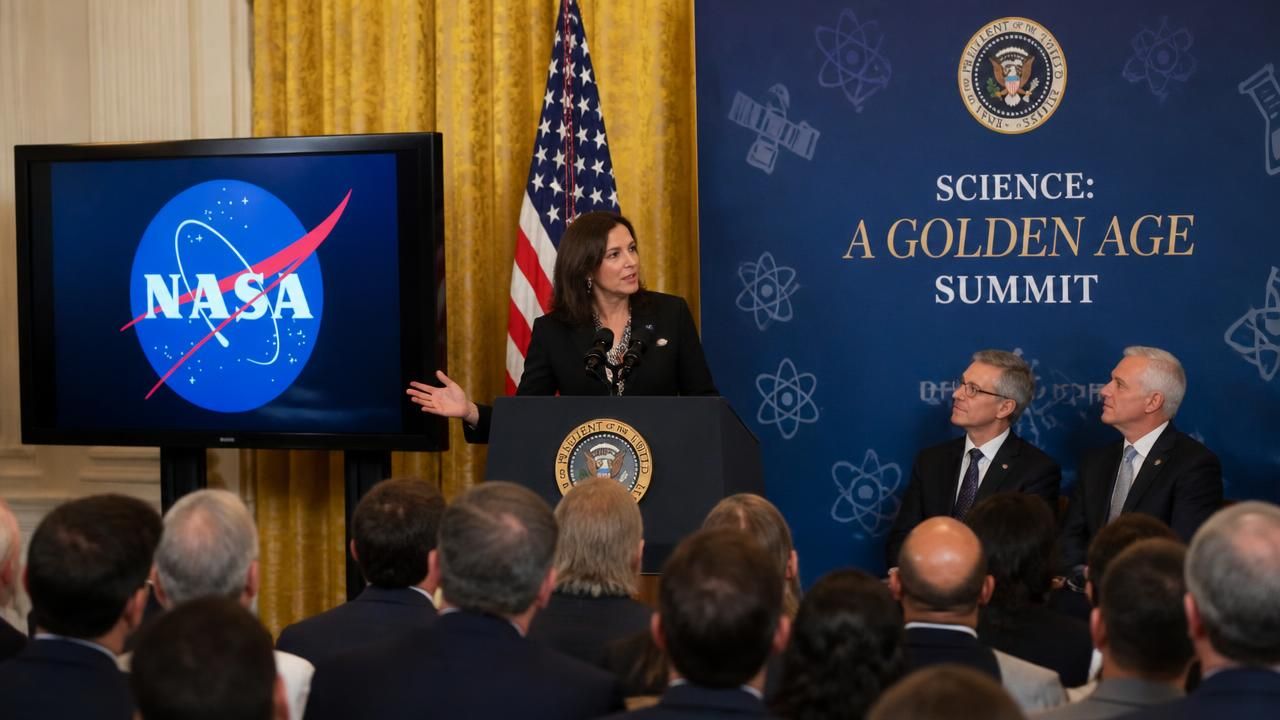
NASA unveiled two new science and technology initiatives on Thursday, pairing a sweeping experiment in how the agency evaluates research with a major investment in early-career scientists. The announcements came during the White House Office of Science and Technology Policy's "Science: A Golden Age Summit" in Washington, an event that gathered top U.S. agency leaders and framed federal research spending as a cornerstone of the Trump administration's innovation agenda.
One initiative focuses on peer review — the often opaque process by which scientific proposals are judged — while the other establishes the Genesis Mission Fellowships, aimed at supporting the next generation of researchers. NASA said the programs reflect its "commitment to pioneering research and transformative technologies" and advance the vision laid out in the July report to the president, Science: A New Golden Age.
What NASA Announced
According to the agency, the two efforts are designed to work in tandem: one to speed and sharpen how the best ideas are identified and funded, the other to ensure there are enough trained people to carry those ideas forward.
- A coordinated metascience effort: NASA said it is moving to establish a coordinated approach to "metascience" — the study of science itself — as part of an experiment in how the agency evaluates and accelerates promising research proposals.
- Genesis Mission Fellowships: A new fellowship program intended to draw researchers into NASA's scientific enterprise and build a pipeline of talent for long-horizon missions.
NASA Administrator Jared Isaacman cast the announcements as a continuation of the agency's institutional character rather than a break from it.
"NASA has a proud history of pursuing bold ideas and achieving the near impossible," Isaacman said. "Under President Trump's leadership, we are building on that legacy by creating new opportunities for great science, experimenting with how we evaluate and accelerate the best ideas, and investing in the next generation of researchers through the Genesis Mission Fellowships. We are entering a new Golden Age of American innovation and discovery, and NASA will be at the forefront."
The Summit Stage
The initiatives were announced in conjunction with the OSTP summit, which brought together leaders from across the federal science apparatus. A centerpiece of the program was a fireside chat between Isaacman and Michael Kratsios, assistant to the president for science and technology and director of OSTP. According to NASA, the two were set to discuss the coordinated metascience effort and the broader question of how the government should identify and scale the most promising research.
The summit's formal name was confirmed in an editor's note appended to NASA's release, a small detail that underscored how carefully the administration has choreographed the rollout of its science messaging.
Two Frames, One Story
Coverage of the announcement split along familiar lines. NASA's own release emphasized the scientific and institutional dimensions — peer review, fellowship pipelines, and the language of discovery. Aggregated and syndicated coverage, by contrast, led with the political framing: "NASA Unveils Science Initiatives at Golden Age Summit" and "Trump Administration Unveils Major Science Initiatives."
One outlet pushed the framing further still, presenting the news under the headline "The New Golden Age of Science: The Trump Administration's Over $6 Billion Investment in Science." That emphasis shifts the story's center of gravity from methodology to money, casting the summit as the visible tip of a much larger federal spending commitment rather than a set of discrete agency programs.
The divergence is instructive. For NASA, the headline is a procedural reform — how to evaluate ideas better and faster. For the administration's political communicators, the headline is scale: billions of dollars and a governing philosophy. Both readings can be true simultaneously, but they point readers toward very different questions.
Why Peer Review Is the Hard Part
Peer review is the machinery that decides which scientific proposals get funded, and it has long been a target of reformers who argue it is slow, risk-averse, and biased toward incremental work. "Metascience" — the empirical study of how science is conducted and funded — has emerged as the tool of choice for critics who want evidence rather than anecdote about what works.
NASA's decision to build a coordinated metascience capability is therefore more consequential than it may first appear. If the agency begins systematically testing alternative review models, it could generate data that other federal funders — from the National Institutes of Health to the Department of Energy — might eventually adopt. But it also invites scrutiny: experiments with peer review raise questions about transparency, conflicts of interest, and whether speed can be bought without sacrificing rigor.
The Fellowship Question
The Genesis Mission Fellowships address a parallel concern. Federal science agencies have warned for years about pipeline problems — graduate students deterred by long timelines, early-career researchers squeezed out of grant competitions, and a shrinking pool of candidates with the specialized skills required for space science. Fellowship programs are a standard remedy, but their impact depends entirely on scale, duration, and whether fellows receive a credible path to permanent research positions.
NASA did not immediately detail fellowship numbers, award sizes, or eligibility criteria in its announcement, leaving many of the practical questions unanswered.
What to Watch
The July report to the president, Science: A New Golden Age, provides the policy architecture into which both initiatives fit. Congressional appropriators, university research offices, and scientific societies will now be watching to see whether the summit's rhetoric translates into sustained funding — and whether the metascience experiment produces publishable results or quietly disappears into an agency memo.
For Isaacman, the stakes are institutional as well as political. NASA has staked its reputation on ambitious missions in which the quality of the underlying science is not an abstraction but a precondition. If the agency can demonstrate that its new approach to evaluating ideas genuinely accelerates discovery, the "Golden Age" framing may prove durable. If it cannot, the summit will be remembered as a moment of branding rather than reform.