Margaret Hamilton, the MIT mathematician and software architect whose on-board flight code guided Apollo 11 to the lunar surface — and who coined the term "software engineering" at a time when the phrase was treated as an oxymoron — has died. She was 90.
News of her death was reported by Ars Technica and carried by outlets around the world, from Yahoo and MSN to smaller international sites, nearly all of them reaching for the same shorthand: the woman whose code saved the Moon landing. That framing is accurate, if incomplete. Hamilton spent her career arguing that software was not a support act to hardware but an engineering discipline in its own right, and she spent the Apollo years proving it under conditions that allowed no second draft.
"To say Margaret Hamilton was a pioneer — to say she was ahead of her time — would be a dramatic understatement," said Olivier de Weck, interim head of the MIT Department of Aeronautics and Astronautics. "She was a software engineer at a time when that field was in its infancy, and she not only developed advanced code herself but also led a team in using that nascent technology to develop one of the most complex systems humanity had ever achieved."
From Paoli, Indiana, to the Apollo Guidance Computer
Born in Paoli, Indiana, in 1936, Hamilton graduated from Earlham College in 1958 with a degree in mathematics and a minor in philosophy — a nod, Ars Technica noted, to a family that prized language as much as logic, including her father, a poet, and her grandfather, a headmaster. She married James Cox Hamilton that same year. The plan was modest and temporary: she would work while he finished law school, then he would support her through a doctorate in mathematics.
The plan changed. Hired at MIT, she moved from work on the SAGE air-defense system to the Instrumentation Laboratory, where NASA had contracted the institute to build the Apollo Guidance Computer. Hamilton led the team that wrote the on-board flight software — the code responsible for navigation, guidance, and control of the spacecraft — a group that eventually grew to roughly a hundred engineers and programmers. It was in that role that she began insisting on a phrase her peers found eccentric. Software, she argued, deserved the same rigor, process, and accountability as hardware.
The daughter, the simulator, and the alarm that saved Apollo 11
Hamilton's most consequential contribution may have arrived by accident. As the story is widely told, her young daughter Lauren was playing astronaut on a Command Module simulator in the lab one day and pressed a key that launched a pre-launch program mid-flight, crashing the simulation. Hamilton wanted safeguards added — code that could detect an unexpected condition, shed lower-priority tasks, and recover. NASA engineers, according to her later accounts, doubted an astronaut would ever make such a mistake.
She insisted anyway. On July 20, 1969, three minutes before Eagle touched down in the Sea of Tranquility, the guidance computer began flashing alarms — 1201 and 1202 — as a mis-set rendezvous radar switch flooded the machine with extra data. The priority display and restart routines Hamilton's team had built kept the computer running, shedding non-critical tasks so the landing could continue. In Mission Control, a young engineer named Jack Garman recognized the codes and yelled that they were safe to ignore. The descent went on.
"There was no second chance. We knew that." — Margaret Hamilton
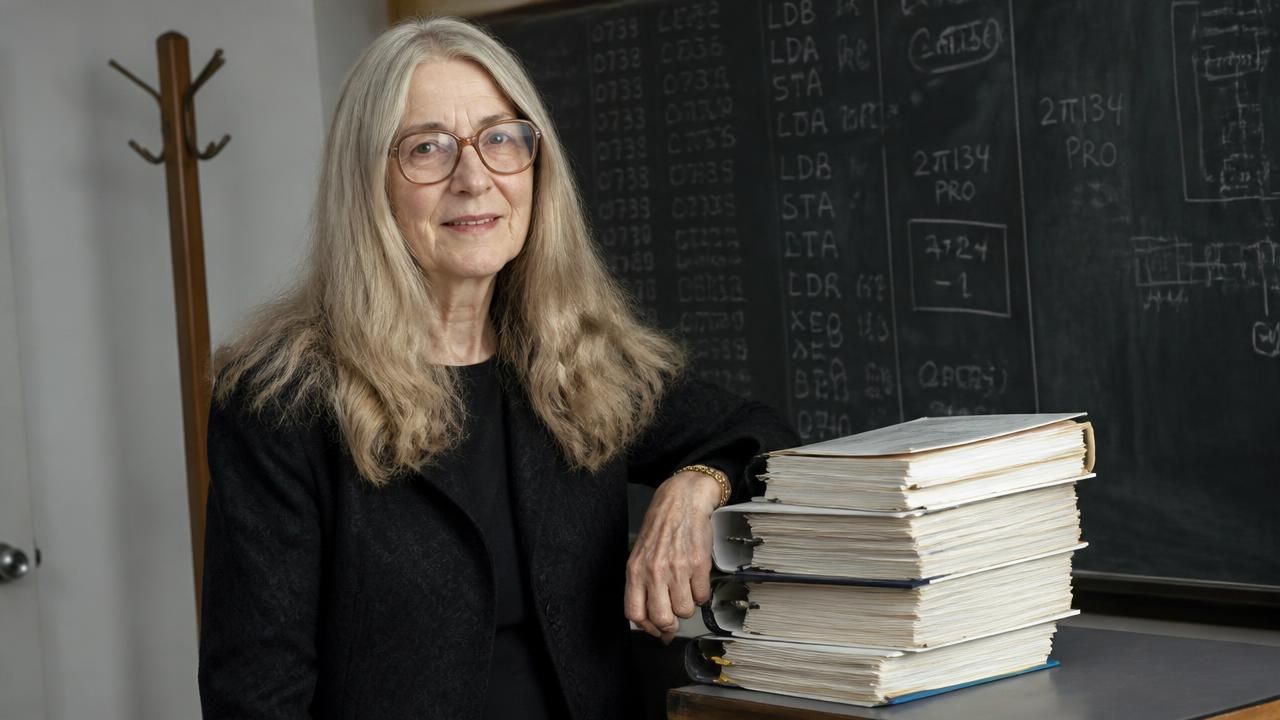
A photograph of Hamilton standing beside towering stacks of printed Apollo flight code became one of the most reproduced images in the history of computing — an image that, however staged it may have been, captured something true about the scale of what her team wrote by hand.
How the story was told
The coverage that followed her death reveals as much about the tellers as the subject. Ars Technica framed its obituary as a memorial to a discipline as much as a person, leading with the coinage of "software engineering" and cataloguing her honors. The MSN-syndicated headlines leaned hard on outcome — "Woman whose code saved the moon landing" and "pioneer whose software powered Apollo 11" — compressing her career into a single dramatic rescue. Yahoo emphasized the phrase "pioneering computer scientist," while Newsbytes went with "woman coder," a phrasing that would have puzzled Hamilton, who spent decades fighting to be called an engineer.
The pattern is familiar: in death, women in technical fields are often described by what they contributed to a famous mission rather than the field they founded. Yet nearly every account returned to the same two facts — the Apollo 11 alarms and the term "software engineering" — because both are, in the end, the same story about anticipating failure before it happens.
A legacy measured in standards, not just missions
Hamilton received NASA's Exceptional Space Act Award in 2003, at the time the largest financial award the agency had ever granted. In 2016, President Barack Obama awarded her the Presidential Medal of Freedom. The following year she was immortalized as a LEGO minifigure in the "Women of NASA" set, alongside astronauts Mae Jemison and Sally Ride.
- 1960s: Leads on-board flight software development for the Apollo Guidance Computer at MIT's Instrumentation Laboratory; popularizes the term "software engineering."
- 1986: Founds Hamilton Technologies in Cambridge, Massachusetts, developing the Universal Systems Language and the "Development Before the Fact" design methodology.
- 2003: NASA Exceptional Space Act Award.
- 2016: Presidential Medal of Freedom.
- 2017: LEGO "Women of NASA" minifigure.
For a generation of programmers, Hamilton's larger argument has aged better than any single line of her code. Software now runs cars, hospitals, power grids, and financial markets — systems where, as she put it, there is no second chance. The discipline she named, and spent a career insisting deserved the respect of engineering, is the one her successors work in every day.